沪深300指增

Search documents
这一次微盘股指数下跌,量化指增经受住了考验
私募排排网· 2026-03-26 12:00
Core Viewpoint - The recent decline in small-cap stocks has been significant, with the Wind Micro Cap Index dropping 7.12% in one week, and a total pullback of 14.6% over nine trading days from March 11 to March 23, indicating a rapid contraction in market risk appetite [2] Group 1: Market Performance Comparison - The current round of small-cap stock declines is less severe compared to the February 2024 downturn, with the Wind Micro Cap Index and the CSI 2000 Index experiencing weekly declines of approximately one-third of those seen in February 2024 [2][3] - In February 2024, the Wind Micro Cap Index fell by 21.69%, while in March 2026, it only fell by 7.12%, showcasing a significant improvement in market stability [3] Group 2: Quantitative Product Performance - Quantitative investment products have shown relative stability during the recent downturn, with drawdowns significantly lower than those experienced in February 2024, where mainstream index products like CSI 1000 and CSI 500 saw declines around -5% [6] - The performance of various quantitative strategies has improved, with the small-cap index strategy experiencing a drawdown of -5.90% in March 2026 compared to -11.48% in February 2024 [7] Group 3: Excess Return Distribution - The distribution of excess returns has improved significantly, with the overall excess returns for various index products converging around zero in March 2026, indicating a more balanced and stable performance compared to the extreme negative excess returns seen in February 2024 [10] - In March 2026, the small-cap index strategy achieved a positive excess return of 1.23%, contrasting with a negative excess return of 10.21% in February 2024, reflecting a notable improvement in strategy effectiveness [11] Group 4: Risk Management Enhancements - The recent downturn has prompted stricter risk management measures among quantitative private equity managers, including limiting small-cap stock positions, enhancing liquidity controls, and optimizing quantitative models to better predict and respond to extreme market conditions [13] - These upgrades in risk management practices have contributed to the resilience of quantitative strategies during market fluctuations, reducing the likelihood of extreme drawdowns [13]


量化私募基金收益TOP10揭晓!龙旗、蒙玺、明汯、翰荣、鹿秀、传山等居前!
Sou Hu Cai Jing· 2026-01-27 10:56
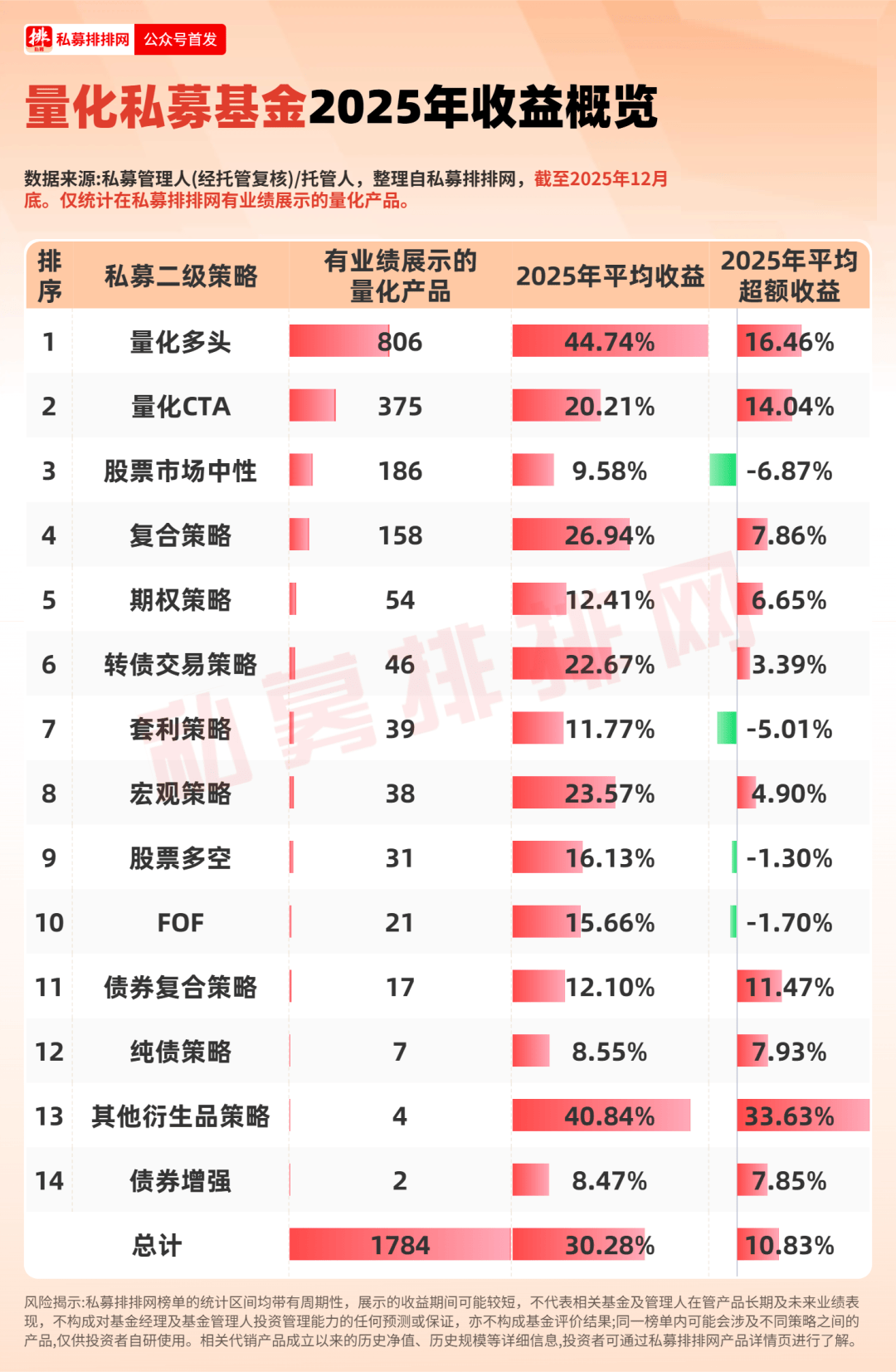
Core Insights - 2025 is a landmark year for quantitative investment, driven by the emergence of DeepSeek and a bullish A-share market, particularly favoring small and mid-cap stocks, with the CSI 2000 and micro-cap indices rising over 36% and 80% respectively, creating a favorable environment for quantitative long strategies [1] - The average return for quantitative products in 2025 reached 30.28%, with an average excess (geometric) return of 10.83%, while quantitative long strategy products achieved returns of 44.74% and excess returns of 16.46% [1] Summary by Category Quantitative Products Performance - A total of 1784 quantitative products were tracked, with 806 being long strategy products, which outperformed other strategies [1] - The average return for quantitative long strategy products was 44.74%, significantly higher than other strategies such as quantitative CTA (20.21%) and stock market neutral (9.58%) [2] Top Performing Quantitative Long Strategy Products - The top three quantitative stock selection products in 2025 were from Hainan Gaia Qingke, Shuizhuquan Asset, and Hanrong Investment, with average returns of 42.28% and excess returns of 17.70% [3] - The leading product, "Gaia Qingke Cattail Progress A Class," achieved outstanding performance, with returns exceeding ***% [5][6] Sector-Specific Performance - The "CSI 500 Index Enhancement" products had an average return of 46.32% and excess returns of 12.22%, with the top three products from Guobiao Asset, Zhaoxin Private Fund, and Zhaoyue Private Fund [7] - The "CSI 1000 Index Enhancement" products achieved an average return of 49.68% and excess returns of 17.41%, with top products from Jintong Investment, Luxiu Investment, and Mengxi Investment [10] Other Notable Products - The "CSI 300 Index Enhancement" products had an average return of 31.22% and excess returns of 11.52%, with top products from Guangzhou Chuanshan Private Fund and Minghuo Investment [13] - The "Other Index Enhancement" products had an average return of 46.76% and excess returns of 19.95%, with leading products from Qing Shang Jia Wan, Zhongmin Huijin, and Yang Shi Asset [16][17]
中金基金王阳峰:以投资者为本 打造特色化指数产品体系
Zhong Zheng Wang· 2025-08-19 14:04
Group 1 - The core viewpoint is that with the increasing variety of index investment tools, fund companies need to seek differentiated index product development paths [1] - The company is committed to creating a product system with long-term allocation value and research-added value in the development of specialized indices [1] - The company emphasizes a customer-centric approach, embedding investor needs throughout the product lifecycle and focusing on the investor's holding experience [1] Group 2 - The company has established a business layout that includes three core product lines: broad-based ETFs, index enhancement, and specialized indices [1] - The index enhancement products cover indices such as the CSI 300 Index, CSI 500 Index, and CSI 1000 Index [1] - The specialized index products include the CSI Selected 300 Index, while the broad-based ETF products consist of the CSI 300 ETF and CSI A500 ETF [1]
灵均投资蔡枚杰、马志宇:以“晴天修屋顶”心态做好投研与治理
Zhong Guo Zheng Quan Bao· 2025-08-11 00:15
Core Viewpoint - Lingjun Investment has faced significant challenges following regulatory measures in early 2024, prompting a deep reflection and reform in its operational and governance structures to ensure survival and competitiveness in the quantitative investment industry [2][3][4]. Group 1: Company Challenges and Reforms - The company experienced its most severe crisis since its establishment due to the "2·19 incident," which led to a three-day trading restriction on its products [2][3]. - In response to the crisis, Lingjun Investment initiated comprehensive reforms focusing on cultural and governance improvements, establishing a "co-management + specialization" collaborative mechanism [3][4]. - The leadership structure was redefined, with Cai Meijie overseeing cultural and governance aspects while Ma Zhiyu focused on research and investment strategies [4]. Group 2: Compliance and Risk Management Enhancements - The company has implemented a systematic overhaul of its compliance and risk management frameworks, embedding risk control parameters into all trading strategies to ensure adherence to regulatory requirements [5][6]. - A dual-layered risk control mechanism has been established, integrating strategy-level controls with comprehensive system-level rules to mitigate risks effectively [6][7]. - All trading activities are now monitored under a unified risk management framework, allowing for cross-product risk analysis and compliance oversight [6]. Group 3: Focus on Fundamental Factor Research - Lingjun Investment has been deepening its research into fundamental factors since 2015, recognizing their growing importance in evaluating corporate value and enhancing strategy resilience [8][9]. - The company aims to expand its fundamental factor research by exploring new industry-specific factors and refining existing ones to improve their quality and effectiveness [9]. Group 4: Performance and Strategy Adjustments - The quantitative strategies of Lingjun Investment have shown strong performance, with average returns of 11.50% and 14.85% for private equity quantitative stock selection strategies and the CSI 1000 index enhancement strategy, respectively, in the first half of the year [10]. - The company has adjusted its product line to focus on its leading quantitative stock selection strategies while also expanding its index enhancement products to meet diverse investor needs [10][11]. - Recent strategy upgrades have balanced long-term signals with short-term predictive capabilities, enhancing the company's adaptability to market fluctuations and contributing to its strong performance [11].