治疗设备

Search documents
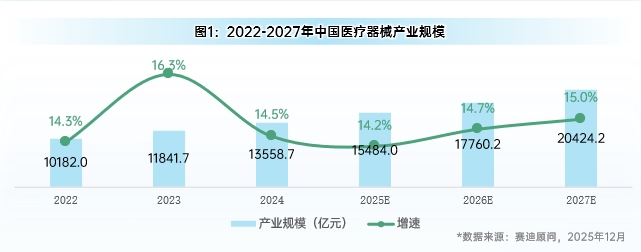
赛迪顾问预测2027年中国医疗器械产业规模有望突破2万亿元
Cai Fu Zai Xian· 2026-02-15 08:02
Core Insights - The Chinese medical device industry is experiencing steady growth, with a projected scale of approximately 1,355.87 billion yuan in 2024, reflecting a growth rate of 14.5%, which is 7.5 percentage points higher than the global growth rate [1] Industry Overview - The Chinese government has been actively supporting the upgrade of key equipment in the medical sector, leading to an accelerated development of the medical device industry [1] - The medical equipment sector is the largest segment within the industry, expected to reach a scale of 784.34 billion yuan in 2024, accounting for 57.8% of the total industry [1] Competitive Landscape - The quality and performance of medical diagnostic and treatment devices are improving, with a shift towards high value-added areas, indicating strong international competitiveness [1] Future Projections - The Chinese medical device industry is anticipated to surpass 2 trillion yuan by 2027 [1]

新政发布!支持医疗器械!卫健、药监、医保、经信、科委等联合推动
思宇MedTech· 2025-11-26 08:29
Core Viewpoint - The article emphasizes the significance of Beijing's newly released measures for the high-quality development of the medical device industry, particularly focusing on the integration of clinical application and promotion within the policy framework, leveraging Beijing's unique medical resource advantages [3][4]. Group 1: Policy Overview - The document outlines 15 measures aimed at enhancing the medical device industry, covering aspects from research and development to clinical application and international registration [2]. - A notable feature is the establishment of a support mechanism for direct hospital admission of medical devices, which is seen as a critical development for the industry [2]. Group 2: Clinical Application Focus - The policy shifts its focus from merely encouraging research and development to promoting the clinical application of innovative medical devices, marking a significant transition in policy emphasis [3][6]. - The introduction of a "hospital admission - demonstration - promotion" three-stage system is a unique aspect of the policy, facilitating a streamlined process for medical devices to be used in clinical settings [5][16]. Group 3: Support for Early-Stage Innovation - The measures include early-stage innovation support of up to 1 million yuan and a focus on cross-disciplinary collaboration between medical and engineering sectors [9]. - The reduction of inspection cycles to 60 days for non-active devices and 90 days for active devices is a critical change aimed at expediting the market entry of medical devices [10][13]. Group 4: Financial Incentives - The policy provides financial rewards for companies based on their clinical promotion effectiveness, with a cap of 10 million yuan for significant contributions [11][22]. - A listing reward of up to 200,000 yuan per product, with an annual cap of 1 million yuan per company, is introduced to incentivize innovative products [14]. Group 5: Industry Ecosystem and Supply Chain - The policy allocates up to 50% subsidies (maximum 50 million yuan) for establishing industrial spaces, targeting heavy asset enterprises [28]. - Support for key component development, with a cap of 30 million yuan, aims to strengthen the supply chain for high-end medical devices [30]. Group 6: AI and Digital Transformation - The introduction of support for industry models up to 30 million yuan signifies a push towards integrating AI capabilities within medical device enterprises [33]. - The policy also includes provisions for AI-assisted diagnosis trials, with support up to 5 million yuan, to facilitate the clinical application of AI technologies [37]. Group 7: Internationalization Efforts - The measures provide support for international registration costs, with a cap of 1 million yuan per product, aimed at easing the burden on companies seeking to enter global markets [39]. - Incentives for international product introduction and export facilitation are designed to attract foreign innovative medical device companies to establish operations in Beijing [40][41]. Group 8: Industry Signals - The policy signals Beijing's ambition to position itself as a hub for high-end medical devices and AI, differentiating itself from other cities like Shenzhen and Suzhou [42]. - The emphasis on clinical application and support for heavy asset enterprises indicates a strategic focus on enhancing the local medical device ecosystem [47].

鹿得医疗股价下跌2.69% 股东会通过回购股份注销议案
Sou Hu Cai Jing· 2025-07-29 20:00
Group 1 - The stock price of Lude Medical closed at 11.59 yuan on July 29, 2025, down by 0.32 yuan, representing a decline of 2.69% from the previous trading day [1] - The trading volume for the day was 76,470 hands, with a total transaction amount of 90 million yuan [1] - Lude Medical operates in the medical device sector, focusing on the research, production, and sales of medical devices, including diagnostic and therapeutic equipment [1] Group 2 - On the evening of July 29, Lude Medical announced that its first extraordinary general meeting of shareholders in 2025 approved several proposals, including the adjustment of the purpose of share repurchase and the cancellation of shares, which will reduce registered capital [1]
年内超5亿元投融资数超去年全年,医疗器械赛道“吸金”热
Nan Fang Du Shi Bao· 2025-05-08 11:05
Group 1 - Guangzhou Xinhang Road Medical Technology Company completed a 600 million RMB Series B financing led by Meituan Longzhu Fund and Eli Lilly Asia Fund, marking another significant investment in the medical device sector this year [2] - The number of large financing events (over 500 million RMB) in the medical device sector in 2025 has already surpassed the total for the entire year of 2024, indicating a notable recovery in investment activity [3][4] - The highest single financing amount in the medical device sector this year was over 1 billion RMB for Ruichao Dink Medical Technology Co., which focuses on innovative medical devices for chronic diseases [3] Group 2 - In the first quarter of 2025, there were 87 financing cases in the medical device sector, a 27.40% increase quarter-on-quarter and a 4.49% increase year-on-year, with a total disclosed financing amount of 8.202 billion RMB, reflecting a 129.62% increase quarter-on-quarter and a 96.93% increase year-on-year [4][5] - The proportion of mid-to-late stage financing (B round to E round) has increased significantly, rising from 24.66% in Q4 2024 to 42.53% in Q1 2025, indicating a shift in investor preference towards more mature projects [5] - A total of 124 institutions invested in medical device projects in Q1 2025, with Qiming Venture Partners being the most active, participating in six investments [5][6] Group 3 - The medical device sector saw 58 financing cases in Q1 2025, with a total financing amount of 6.054 billion RMB, making it the most attractive area for investors [7] - The rehabilitation equipment sector also experienced significant activity, with 11 financing cases totaling 1.49 billion RMB, driven by interest in brain-machine interfaces and embodied intelligence [7] - AI technology is rapidly advancing in the pharmaceutical industry, with significant potential for transforming drug development processes, as highlighted by Qiming Venture Partners' early investments in "AI + medical" projects [8] Group 4 - The People's Bank of China announced a 500 billion RMB loan to support consumption and elderly care, which is expected to boost the "silver economy" and related industries, including rehabilitation equipment [9]

医疗器械2025年一季度投融市场报告
Wind万得· 2025-05-07 22:36
Core Viewpoint - The medical device sector is experiencing a significant recovery in investment and procurement activities, driven by supportive government policies and a release of pent-up demand for equipment updates starting from Q4 2024 [2][6][19]. Group 1: Industry Overview - The medical device market is set for a surge in equipment updates in the second half of 2024, with various provinces beginning to collect and update equipment [2][6]. - The demand for medical equipment updates is gradually being released, with hospitals and local governments announcing procurement projects since Q4 2024, leading to a noticeable increase in procurement scales [6][7]. - In Q1 2025, the total procurement scale for medical devices reached 545 billion yuan, a 53.09% increase quarter-on-quarter and a 16.45% increase year-on-year [7]. Group 2: Investment Dynamics - In Q1 2025, there were 87 financing cases in the medical device sector, a 27.40% increase quarter-on-quarter and a 4.49% increase year-on-year, with disclosed financing amounts totaling 8.202 billion yuan, marking a 129.62% increase quarter-on-quarter and a 96.93% increase year-on-year [19][21]. - The medical equipment sector attracted the most investor interest, with 58 financing cases totaling 6.054 billion yuan, particularly in treatment and medical imaging devices [19][20]. - The preference for mid-to-late stage financing has increased, with the share of early-stage financing cases dropping from 64.38% in Q4 2024 to 50.57% in Q1 2025, indicating a shift in investor sentiment towards larger, more established opportunities [20][27]. Group 3: Policy Support - Continuous government support for medical device procurement and updates is evident, with policies aimed at promoting large-scale equipment updates and enhancing the quality of healthcare resources at the grassroots level [6][9]. - Recent policies include the acceleration of clinical approvals for urgently needed medical devices, including high-end medical equipment and innovative medical devices [11][12]. - The government has emphasized the need for balanced distribution of medical resources and the enhancement of healthcare infrastructure, as outlined in the 2025 government work report [6][11]. Group 4: Key Investment Events - Notable financing events in Q1 2025 include significant rounds for companies like Fourier Intelligence (800 million yuan) and Pamu Medical (approximately 100 million USD) [16][33]. - The investment landscape shows a growing interest in rehabilitation devices and brain-computer interface technologies, reflecting the sector's innovative potential [19][44]. Group 5: Industry Trends - Brain-computer interface (BCI) technology is gaining traction, with a projected market size of 40 billion USD by 2030 and 145 billion USD by 2040, attracting significant investment and research [36][43]. - Clinical trials for BCI technologies are on the rise, with numerous trials registered globally, particularly in the treatment of neurological disorders [37][41]. - Domestic companies like Borui Kang are emerging as leaders in the BCI space, supported by favorable policies and advancements in technology [50][51].