深圳地铁8号线三期

Search documents
四线齐发,深圳竞逐地铁“第三城”背后
Xin Lang Cai Jing· 2025-12-30 04:37
Core Insights - The opening of four new metro lines in Shenzhen on December 28 marks a significant expansion of the city's rail transit system, increasing the total operational mileage to 634.5 kilometers and achieving full coverage across all districts [4][6] - The new lines, including the west extension of Line 5, are expected to enhance commuter experience by reducing travel time and easing congestion in key areas [5][8] - The competition between Shenzhen and Guangzhou in metro development is intensifying, with both cities aiming to improve their rail networks to support economic growth and urban development [11][12] Summary by Sections Metro Expansion - Shenzhen's metro system now spans 634.5 kilometers with 441 stations, maintaining the highest network density among mainland cities in China [5][6] - The new Line 5 west extension, measuring 2.88 kilometers, adds three stations and alleviates passenger pressure in the core area of Luohu [6][8] - The opening of the 8th, 11th, and 13th lines further enhances connectivity and operational capacity, particularly during peak hours [4][6] Economic Impact - The metro system is evolving from a mere commuting tool to a vital artery for urban development, influencing the economic landscape of the Greater Bay Area [5][15] - The new lines are expected to drive consumer traffic to commercial hubs in Luohu, such as the Shenzhen MixC and Dongmen Pedestrian Street, thereby boosting local economic activity [8] - The 13th line's connectivity to key areas like the Shenzhen Bay Port and Nanshan Technology Park facilitates the flow of talent and resources, promoting regional collaboration and integration [8][9] Competitive Landscape - The competition for the title of "third city" in metro operations is heating up, with Shenzhen's ridership numbers approaching those of Guangzhou, indicating a shift in the dynamics of urban transit [11][12] - As of November 2025, Guangzhou's metro recorded a passenger volume of 29.84 million, while Shenzhen's reached 28.26 million, narrowing the gap significantly [11][12] - The differing development strategies of the two cities highlight the importance of urban planning and the integration of transit systems with economic activities [12][14] Future Developments - Future plans indicate that both cities will continue to expand their metro networks, with Shenzhen aiming to exceed 800 kilometers by 2030 [14] - The integration of metro systems across the Greater Bay Area, including connections to Dongguan and Hong Kong, is anticipated to create the largest metro network in the country [13][14]

深圳地铁一日“四喜临门”
Shen Zhen Shang Bao· 2025-12-29 08:36
Core Insights - Shenzhen's subway system is experiencing significant expansion, with 2025 marking a record year for new line openings, totaling six new lines, enhancing the city's transportation network and achieving "district-to-district" connectivity [1][2][3] Group 1: New Line Openings - On December 28, 2025, four new subway lines (5th Line West Extension, 8th Line Phase III, 11th Line Phase II Hongling South Section, and 13th Line Phase I North Section) were officially opened, contributing to a total of six new lines for the year [1][2] - The total operational mileage of Shenzhen's rail transit has increased to 634.5 kilometers, with 441 stations, maintaining the highest network density among mainland cities in China at 0.32 kilometers per square kilometer [1][2] Group 2: Connectivity and Urban Development - The new lines enhance connectivity across the city, particularly improving east-west transit corridors and addressing passenger flow pressures in key areas such as Luohu [2][3] - The 8th Line Phase III ends the lack of subway service in Dapeng New District, while the 5th Line West Extension alleviates congestion in the Luohu core area [2][4] Group 3: Impact on Daily Commute - The new lines are expected to significantly reduce commuting times for residents, with reports of up to one hour saved for daily commutes [4] - Daily average ridership is projected to exceed 900 million passengers following the opening of the new lines, reflecting the growing reliance on subway transport [4] Group 4: Integration with Existing Infrastructure - The 11th Line Phase II will enhance capacity by 20% during peak hours and improve connections with existing lines, providing more efficient cross-district travel options [4][5] - The 13th Line Phase I North Section will facilitate quicker access to key areas, reducing travel time to Shenzhen Bay Port to 37 minutes [5][6]

今年底共增6条地铁线(段)
Nan Fang Du Shi Bao· 2025-12-09 03:13
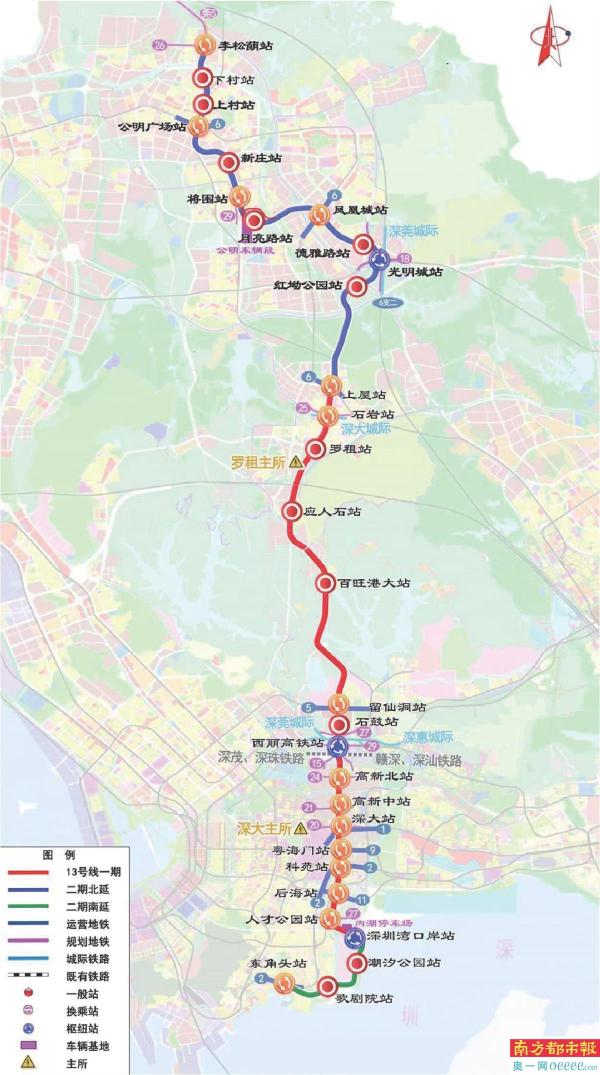
Group 1 - Shenzhen plans to open four new metro lines by the end of the year, including the west extension of Line 5, Phase III of Line 8, Phase II of Line 11, and Phase I of Line 13 operated by MTR (Shenzhen) [2] - The total length of the new metro lines will add up to 635 kilometers, with the number of stations increasing to 441, enhancing the scale of the urban rail transit network [2] - The first phase of Line 13, which connects Shenzhen Bay Port Station to Shangwu Station, spans 22.441 kilometers and includes 16 stations, linking key areas such as the Houhai Central District and the High-tech Park [3] Group 2 - The west extension of Line 5, measuring 2.88 kilometers, will add three new stations and connect the bustling core area of Luohu, significantly easing transfer pressure at Huangbeiling Station [3] - Line 11's second phase will extend from Gangxia North Station to Hongling South Station, covering 2.3 kilometers, and will enhance cross-district travel efficiency for residents [4] - Phase III of Line 8 will serve as a backbone transit line, extending approximately 3.69 kilometers from Xiaomeisha Station to Xiyong Station, improving public transport services in the eastern districts [4]