深圳地铁5号线西延段

Search documents
四条地铁新线同步开通 深圳实现“区区通地铁”
Nan Fang Ri Bao Wang Luo Ban· 2025-12-29 09:01
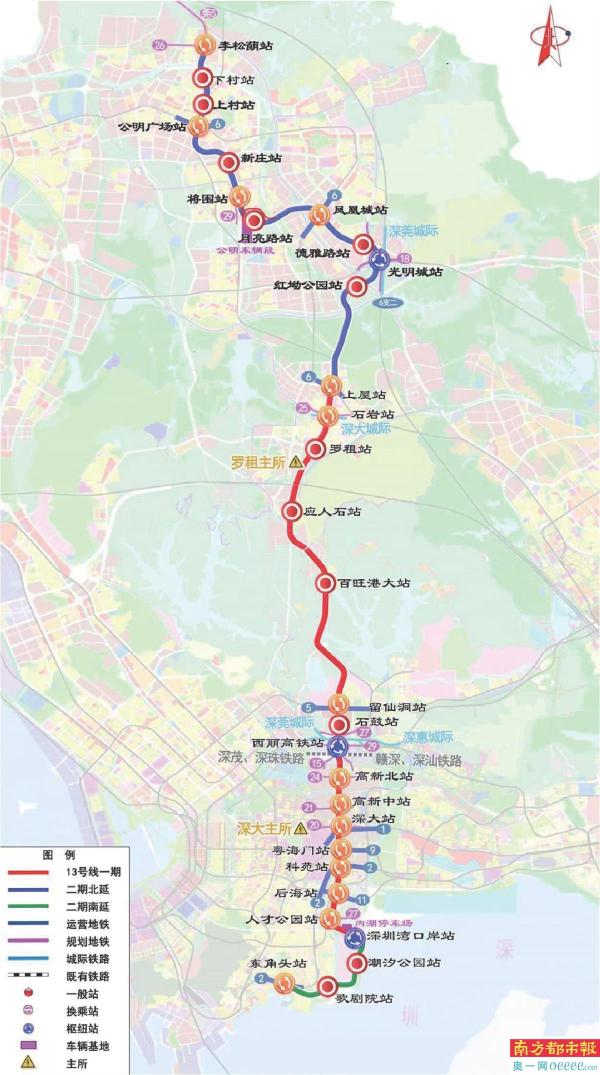
Core Points - Shenzhen's new metro lines have opened, increasing the total operational length of urban rail transit to 634.5 kilometers with 441 stations, maintaining the highest network density among mainland cities at 0.32 kilometers per square kilometer [1] - The four new lines (segments) opened total approximately 24.9 kilometers, enhancing the backbone network of urban rail transit [1] - The 5th line west extension connects to the core business district of Luohu, alleviating transfer pressure at Huangbeiling Station [1] - The 11th line's second phase creates an "efficiency corridor," allowing direct travel from Bao'an to Luohu in 30 minutes [1] - The 8th line's third phase ends the lack of metro service in Dapeng New District, facilitating tourism [1] - The 13th line's first phase north section activates a vertical traffic artery in western Shenzhen [1] Line Details - The 13th line's north section is the longest among the newly opened segments, spanning approximately 16 kilometers with 9 stations, connecting existing stations and enhancing north-south transit [1] - The 8th line's third phase extends from Xiaomeisha Station to Xiyong Station, addressing the transportation gap in Dapeng and linking key urban areas [2] - The new lines collectively improve access to both urban centers and coastal resources, supporting commuting and tourism in Shenzhen's eastern region [2]
深圳地铁一日“四喜临门”
Shen Zhen Shang Bao· 2025-12-29 08:36
Core Insights - Shenzhen's subway system is experiencing significant expansion, with 2025 marking a record year for new line openings, totaling six new lines, enhancing the city's transportation network and achieving "district-to-district" connectivity [1][2][3] Group 1: New Line Openings - On December 28, 2025, four new subway lines (5th Line West Extension, 8th Line Phase III, 11th Line Phase II Hongling South Section, and 13th Line Phase I North Section) were officially opened, contributing to a total of six new lines for the year [1][2] - The total operational mileage of Shenzhen's rail transit has increased to 634.5 kilometers, with 441 stations, maintaining the highest network density among mainland cities in China at 0.32 kilometers per square kilometer [1][2] Group 2: Connectivity and Urban Development - The new lines enhance connectivity across the city, particularly improving east-west transit corridors and addressing passenger flow pressures in key areas such as Luohu [2][3] - The 8th Line Phase III ends the lack of subway service in Dapeng New District, while the 5th Line West Extension alleviates congestion in the Luohu core area [2][4] Group 3: Impact on Daily Commute - The new lines are expected to significantly reduce commuting times for residents, with reports of up to one hour saved for daily commutes [4] - Daily average ridership is projected to exceed 900 million passengers following the opening of the new lines, reflecting the growing reliance on subway transport [4] Group 4: Integration with Existing Infrastructure - The 11th Line Phase II will enhance capacity by 20% during peak hours and improve connections with existing lines, providing more efficient cross-district travel options [4][5] - The 13th Line Phase I North Section will facilitate quicker access to key areas, reducing travel time to Shenzhen Bay Port to 37 minutes [5][6]

城市轨交年底集中开通,地铁建设审批收紧
第一财经· 2025-12-17 06:28
Core Viewpoint - The article discusses the recent surge in urban rail transit construction in various cities in China, particularly highlighting the opening of new lines in Chengdu and other cities, while also indicating a potential slowdown in future expansion due to stricter approval standards from the government [3][10]. Summary by Sections Recent Openings - Chengdu's Metro Line 13 and Line 30 are set to officially open on December 16, 2025, increasing the city's total rail transit mileage to over 750 kilometers, ranking it fourth nationally [3][5]. - In addition to Chengdu, multiple cities, including Shenzhen and Nanjing, are also set to open new metro lines, contributing to a significant increase in their operational rail lengths [7][8]. Operational Data - By the end of 2025, cities with operational rail transit exceeding 500 kilometers will reach nine, with Beijing and Shanghai leading at over 800 kilometers [8]. - Chengdu's rail transit mileage has increased by 161.73 kilometers since 2020, while Guangzhou and Shenzhen have seen even larger increases of 207.9 kilometers and 212.4 kilometers, respectively [8]. Future Construction Trends - Future urban rail transit construction is expected to slow down, with stricter approval processes in place. For instance, Ningbo's plans for new rail lines are currently on hold due to insufficient passenger flow [10][12]. - The National Development and Reform Commission has implemented higher standards for new rail transit project approvals, which may affect previously approved but unimplemented projects [13]. Approval Standards - New guidelines stipulate that cities must meet specific financial and demographic criteria to qualify for rail transit project approvals, including a minimum public budget income of 300 billion yuan and a GDP of 3 trillion yuan [11]. - As of November, only 18 out of 54 cities with operational rail transit met the required passenger flow standards, indicating a broader issue with meeting the new approval criteria [12].

今年底共增6条地铁线(段)
Nan Fang Du Shi Bao· 2025-12-09 03:13
Group 1 - Shenzhen plans to open four new metro lines by the end of the year, including the west extension of Line 5, Phase III of Line 8, Phase II of Line 11, and Phase I of Line 13 operated by MTR (Shenzhen) [2] - The total length of the new metro lines will add up to 635 kilometers, with the number of stations increasing to 441, enhancing the scale of the urban rail transit network [2] - The first phase of Line 13, which connects Shenzhen Bay Port Station to Shangwu Station, spans 22.441 kilometers and includes 16 stations, linking key areas such as the Houhai Central District and the High-tech Park [3] Group 2 - The west extension of Line 5, measuring 2.88 kilometers, will add three new stations and connect the bustling core area of Luohu, significantly easing transfer pressure at Huangbeiling Station [3] - Line 11's second phase will extend from Gangxia North Station to Hongling South Station, covering 2.3 kilometers, and will enhance cross-district travel efficiency for residents [4] - Phase III of Line 8 will serve as a backbone transit line, extending approximately 3.69 kilometers from Xiaomeisha Station to Xiyong Station, improving public transport services in the eastern districts [4]