烈马

Search documents
江铃汽车2025年营收稳步增长 拟10派5.5581元
Shang Hai Zheng Quan Bao· 2026-03-30 02:59
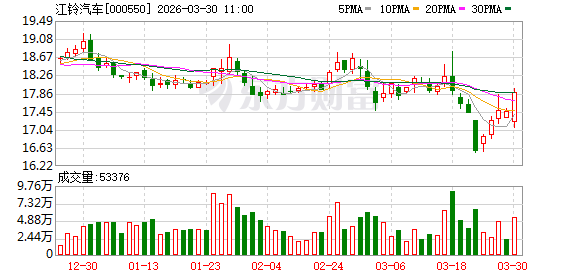
Group 1 - The core viewpoint of the articles highlights Jiangling Motors' strategic focus on quality improvement, new product development, cost control, and efficiency optimization in response to intensified market competition [2] - In 2025, the company achieved total vehicle sales of 377,253 units, a year-on-year increase of 10.56%, and total production of 378,338 units, up 9.71% from the previous year [2] - The company's revenue for 2025 reached 39.17 billion yuan, reflecting a 2.07% increase year-on-year, while R&D expenses decreased by 7.5% to 1.216 billion yuan [2] - Jiangling Motors plans to distribute a cash dividend of 5.5581 yuan per 10 shares (including tax) for the year [2] - In the automotive market segments, Jiangling's light commercial vehicle products hold the largest market share, while its pickup trucks rank second and light trucks seventh [2] - The company has set a production capacity of 320,000 units for 2025, achieving a capacity utilization rate of 118% [2] - Jiangling Motors aims to achieve sales of 430,000 units and revenue of 42 billion yuan in 2026 [2] Group 2 - For 2026, the company plans to accelerate the development of new energy vehicles, focusing on logistics and passenger transport markets with the introduction of high-capacity, long-range commercial models [3] - The company aims for significant growth in its new energy business through key technology and multi-business collaboration, while also enhancing asset risk management [3] - Jiangling Motors intends to expand its overseas business by implementing a "dual brand + dual channel" export strategy, improving product competitiveness, and exploring untapped markets [3] - The company will enhance its overseas brand management and service levels through customer service initiatives and localized operations [3]


应对车市变局,宝马、丰田、福特齐掀渠道革命
Hua Xia Shi Bao· 2025-10-22 06:36
Core Viewpoint - Traditional automotive giants such as BMW, Toyota, and Ford are undergoing significant channel transformations to adapt to changing market dynamics and competition from domestic brands [1][2][3] Group 1: Channel Transformation Trends - BMW plans to abandon the traditional dealership model by 2027, shifting to a direct sales approach that emphasizes control over the sales process [2][3] - Toyota is implementing a "single city, single store" strategy, consolidating its dealerships to enhance efficiency and reduce costs while maintaining dual-brand service [2][3] - Ford has established a wholly-owned sales service company in Shanghai to unify its sales channels, aiming to maximize efficiency and reduce internal conflicts among dealers [3] Group 2: Market Impact and Consumer Experience - The channel transformations are improving consumer experiences by allowing customers to view multiple vehicle types in a single location, thus eliminating the need to visit multiple dealerships [4] - Ford's channel integration has led to increased profitability for dealers by offering a wider range of vehicles, enhancing customer attraction and retention [4] Group 3: Industry-Wide Characteristics - The industry is moving towards a "light asset, heavy operation" model, with companies like Lincoln reducing store sizes and investment requirements significantly [5] - Companies are adopting a "fill-in layout" strategy, adjusting dealership numbers based on regional market conditions to optimize resource allocation [5] - The traditional 4S dealership model is being re-evaluated, with a focus on sales and after-sales services rather than the previous all-in-one approach [5] Group 4: Strategic Recommendations - Manufacturers are encouraged to enhance product competitiveness through technological innovation and to explore new channel models for better collaboration with dealers [6] - Dealers should adapt to channel changes by improving service capabilities and operational efficiency, including staff training and expanding business areas like used car sales and automotive finance [6]



在中国亏麻了之后,福特终于知道该合并了
3 6 Ke· 2025-09-29 00:23
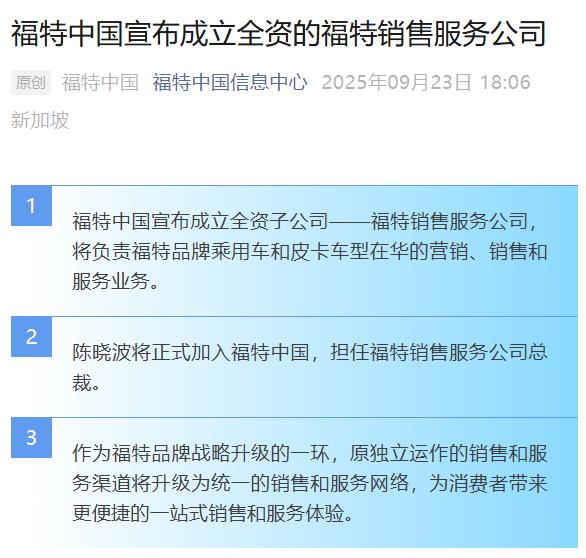
Group 1 - Ford has announced the establishment of a wholly-owned subsidiary in Shanghai to manage marketing, sales, and service for its passenger cars and pickup trucks in China, with operations starting on October 1 [1] - Previously, Ford sold cars in China primarily through joint ventures, specifically Changan Ford and Jiangling Ford, with the latter dating back to 1995 [3][6] - Ford's sales peaked in 2016 at 1.27 million units but saw a significant decline to 560,000 units by 2019 due to product gaps and competitive pressures [9] Group 2 - The transition from commercial to passenger vehicles at Jiangling Ford has not been successful, with reported net losses of 106 million, 839 million, and 677 million yuan from 2022 to 2024 [22] - Ford's strategy to unify its sales channels for Changan Ford and Jiangling Ford aims to eliminate internal competition and streamline operations, similar to Mazda's previous consolidation efforts [25] - The company is also adjusting its product strategy by introducing previously hidden models like the Ranger and Mustang to cater to niche markets, which may serve as a self-rescue strategy [27][30]