热塑性薄膜

Search documents
为机器人贴上“电子皮肤”
Zhong Guo Hua Gong Bao· 2026-01-23 06:16
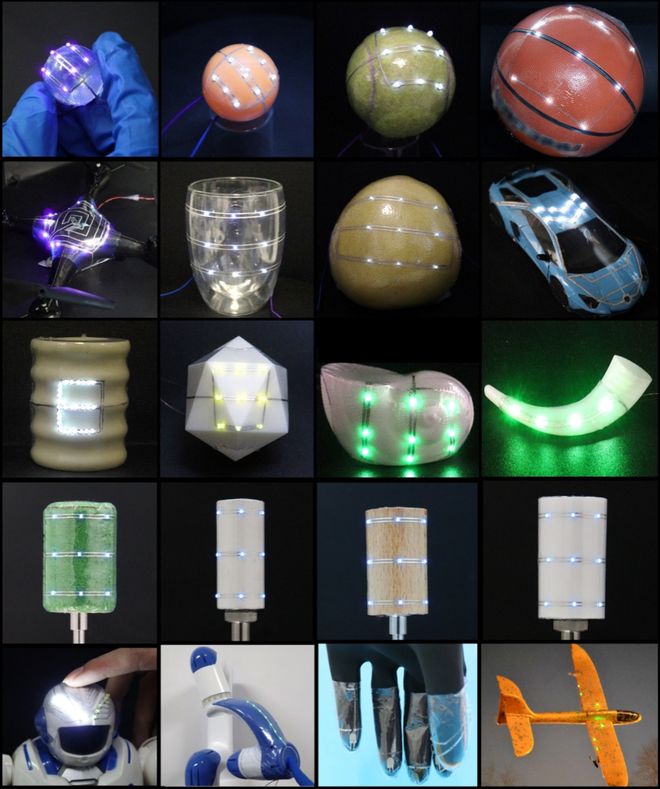
Core Viewpoint - The development of a new "shrink preparation strategy" utilizing liquid metal circuits and thermoplastic films enables the creation of high-performance electronic devices that can conform to complex three-dimensional surfaces, marking a significant advancement in flexible electronics and smart sensing applications [2][3]. Group 1: Technology Innovation - The research team has introduced a method that allows electronic circuits to adhere tightly to irregular surfaces, overcoming challenges faced in flexible electronics [2]. - Traditional 3D printing methods are costly and slow, while conventional attachment techniques struggle with complex surfaces, prompting the innovation of using thermoplastic films as a base [2]. - The team developed a semi-liquid metal material with high conductivity and good flow properties to prevent breakage during the shrinkage process, enabling circuit printing on flat films [2]. Group 2: Performance and Adaptability - The circuit can adaptively conform to three-dimensional surfaces after being treated with warm water or hot air at approximately 70 degrees Celsius, completing the process in about 5 seconds [2]. - Experimental results indicate that the circuit maintains stable conductivity even after 5000 cycles of bending or twisting, demonstrating excellent durability [2]. Group 3: Application Potential - The technology opens new application spaces in various fields, including embodied intelligence, where customized tactile sensor arrays have been developed for robotic arms and heads, providing robots with sensitive "electronic skin" [3]. - A smart glove integrating pressure and temperature sensors has been created, achieving a 97% accuracy rate in object recognition through touch, facilitated by deep learning algorithms [3]. - Potential applications extend to smart agriculture, aerospace, and smart healthcare, enabling functions such as fruit preservation, wing de-icing, and health monitoring, even on surfaces where traditional adhesives fail [3].

精密电路可化身“热缩保鲜膜”包裹万物
Ke Ji Ri Bao· 2026-01-15 00:57
Core Insights - The research introduces a "thermal shrinkage preparation strategy" using liquid metal circuits and thermoplastic films, enabling complex electronic circuits to conform to various shapes like shrink wrap, thus advancing high-performance electronic devices from flat to three-dimensional forms [1] Group 1: Research and Development - The collaboration between Tianjin University and Tsinghua University Shenzhen International Graduate School has led to a significant breakthrough in flexible electronics, addressing the challenge of manufacturing high-performance circuits on irregular surfaces [1] - Traditional 3D printing methods are costly and slow, while conventional attachment methods struggle with complex surfaces; the new approach utilizes common thermoplastic films that shrink when heated, allowing for tight wrapping around objects [1] - The team developed a semi-liquid metal material with high conductivity and good fluidity to overcome the brittleness of ordinary metals during the shrinking process, enabling circuit printing on flat films [1] Group 2: Application Potential - The technology has broad application potential across various industries, including smart agriculture, aerospace, and smart healthcare [2] - In smart agriculture, thin circuits can be attached to fruits and vegetables to monitor temperature and humidity during storage and transportation [2] - In aerospace, customized integrated heating circuits can be developed for aircraft wings to enhance de-icing efficiency [2] - In smart healthcare, the technology can be used to create fingertip pulse sensors or smart bandages for precise health monitoring [2]
我国科研人员让精密电路像“保鲜膜”一样能包裹万物
Xin Hua She· 2026-01-12 12:27
Core Viewpoint - The research teams from Tianjin University and Tsinghua University have developed an innovative "heat shrink preparation strategy" using liquid metal circuits and thermoplastic films, which represents a significant breakthrough in the field of flexible electronics and smart sensing [1][4]. Group 1: Technology and Innovation - The new technology allows for the creation of high-performance circuits on irregular 3D surfaces, addressing challenges such as conformal fitting, precision control, material compatibility, and reliability [1][4]. - The research team utilized common thermoplastic films as a substrate, which shrink upon heating to tightly wrap around objects, while also developing a semi-liquid metal material with high conductivity and good flow properties to prevent breakage during the shrinking process [4]. Group 2: Applications and Potential - This technology has been successfully applied to create tactile sensor arrays for robotic arms and heads, giving robots a sensitive "electronic skin" [4]. - The potential applications extend to various industries, including: - Smart agriculture, where thin circuits can be attached to fruits and vegetables to monitor temperature and humidity during storage and transportation [4]. - Aerospace, where the technology can be used to create integrated heating circuits for aircraft wings to efficiently remove ice [4]. - Smart healthcare, enabling the development of intelligent bandages for comfortable and precise health monitoring [4].