
电堆

Search documents
京津冀燃料电池汽车示范城市群完成首轮示范任务
Ren Min Ri Bao· 2026-01-28 22:11
Core Viewpoint - The Beijing-Tianjin-Hebei fuel cell vehicle demonstration city cluster has successfully completed its first round of demonstration tasks ahead of schedule by December 31, 2025, showcasing significant advancements in technology and infrastructure for fuel cell vehicles [1] Group 1: Technological Innovations - The demonstration city cluster has achieved key innovations in critical components such as fuel stacks, membrane electrodes, and bipolar plates, filling the domestic application gap for carbon paper [1] - A leading full industrial chain system has been established in Daxing District, Beijing, positioning it as a national leader in the fuel cell vehicle sector [1] Group 2: Vehicle Promotion and Infrastructure - The cluster has exceeded vehicle promotion and mileage assessment requirements, with a total of 5,322 fuel cell vehicles promoted [1] - A total of 50 hydrogen refueling stations have been built, creating a leading hydrogen environment for fuel cell vehicles in the country [1] Group 3: Policy Support - A comprehensive policy support system has been established, with 83 policies implemented, covering aspects such as top-level design, technological innovation, industrial implementation, promotion application, hydrogen energy assurance, and safety regulation [1]
燃料电池车产业进展如何
2025-12-29 01:04
Summary of Fuel Cell Vehicle Industry Conference Call Industry Overview - The fuel cell vehicle industry in China is currently in a demonstration introduction phase driven by government policies, with expectations to accelerate towards scaling and commercialization during the "14th Five-Year Plan" period [1][2] - As of October 2025, the number of fuel cell vehicles in China exceeded 31,000, but it is still short of the target of 50,000 by the end of 2025, primarily due to an immature industry chain, high hydrogen costs, a limited number of hydrogen refueling stations, and tight cash flow for companies [1][4] Key Points and Arguments - The government has issued a total of 5.1 billion RMB in reward funds across three batches to alleviate financial pressures on companies, but firms like Yihuatong, Reshaping Energy, and Guohong Hydrogen Energy still face negative operating cash flow challenges and require ongoing policy support [1][4] - The manufacturing cost of fuel cell systems has significantly decreased from 11,000 RMB per kW in 2019 to between 2,400 and 3,900 RMB per kW by 2024, representing a reduction of 17% to 25% [1][5] - Fuel cell vehicles have advantages in heavy-duty trucks, including long range, heavy load capacity, and low-temperature adaptability, with potential applications in rail transport, urban passenger ships, and cogeneration in the commercial vehicle sector [1][6] Policy Support and Development Path - Fuel cell vehicles are a crucial entry point for hydrogen energy applications, particularly in the bus sector, where fixed routes facilitate government support [2] - The government has a clear top-level design for the fuel cell vehicle industry, with policies aimed at establishing a complete hydrogen fuel cell industry chain within four years through demonstration city clusters [2][3] - New demonstration city cluster reward policies are expected to be introduced to transition the industry from demonstration promotion to large-scale commercialization [2][9] Challenges and Future Outlook - Despite a decline in fuel cell vehicle insurance volume by 35.9% year-on-year in the first ten months of 2025, the industry is anticipated to mature rapidly in the next five years due to ongoing policy support and potential new funding [4][9] - The construction of hydrogen refueling stations has been slow, with approximately 500 stations built to date, but a comprehensive energy station model combining various energy sources may help mitigate losses from hydrogen refueling [8] Cost Control and Technological Advancements - Significant progress has been made in cost control within the fuel cell vehicle industry, with core components like fuel cell stacks seeing costs drop from 2,200 RMB per kW in 2019 to below 1,000 RMB [5] - Future cost reductions are expected through breakthroughs in domestic production of key materials and increased production volumes, which will enhance scale effects [5] Conclusion - The fuel cell vehicle industry in China is at a critical juncture, with substantial government support and technological advancements paving the way for future growth, despite current challenges in market performance and infrastructure development [1][9]
亿华通20250926
2025-09-28 14:57
Summary of YiHuaTong Conference Call Company Overview - YiHuaTong focuses on the research and manufacturing of fuel cell systems and core components, primarily for commercial vehicles, achieving multiple innovations in technology aimed at reducing costs and improving reliability, durability, and maintainability [2][3][4] Management and Ownership - The management team has extensive experience in the automotive industry, with key personnel previously employed at well-known companies like XinYuan Power [2][4] - Major shareholders include Zhang Guoqiang (15.73%), Hong Kong Central Clearing Limited (15.43%), and strategic investor Dongxu Optoelectronics [6] Financial Performance - YiHuaTong's financial performance has been volatile, with a reported revenue of 70 million yuan in 2025, a 53.2% year-over-year decline [7] - The net profit loss for 2024 was 460 million yuan, nearly doubling from the previous year, with a loss of 160 million yuan in the first half of 2025 [7][10] Cost Reduction Achievements - The price of the fuel cell system per kilowatt has significantly decreased from approximately 20,000 yuan in 2019 to between 3,000 and 4,000 yuan currently, attributed to the localization of various components [8] Market Dynamics - The hydrogen vehicle market experienced rapid growth from 2021 to 2023 due to government policies, but sales plateaued in 2024, with a 45.6% year-over-year decline in commercial vehicle sales in the first eight months of 2025 [9][10] - The structure of the commercial vehicle market has shifted dramatically, with the proportion of trucks rising from 44.2% in 2021 to 94.1% in 2025 [11][12] Competitive Position - YiHuaTong held a 19.4% market share in fuel cell vehicle sales in 2024, ranking first in the industry, but this dropped to 10.4% in the first half of 2025 due to a focus on cash flow over order fulfillment [4][19] Research and Development Advantages - The company has a comprehensive product system for fuel cells, covering various applications and power ranges, and has established a vertically integrated R&D system [13][16] - YiHuaTong has surpassed many industry peers in patent metrics and has contributed to the formulation of national standards [16] Strategic Partnerships - Collaborations with companies like Toyota and Shanghai Shenli have enhanced YiHuaTong's competitive edge in core technology and market position [14] Future Outlook - Despite challenges such as cash flow pressure and declining gross margins, YiHuaTong is expected to improve cash flow with policy adjustments and has a strong technological foundation for future growth [15][21] - The company plans to develop next-generation integrated R&D platforms and expand into hydrogen production applications [23] Industry Trends - The hydrogen industry is projected to face challenges in meeting national targets for fuel cell vehicle ownership, with a current estimate of 30,000 to 40,000 vehicles by 2025 [21][22] - Future government policies and market dynamics will be crucial for the industry's growth and cost reduction [20][22]

湖北武汉培育发展氢能产业
Chang Jiang Ri Bao· 2025-06-24 00:23
Core Insights - Hydrogen energy is viewed as a "ultimate energy" due to its zero emissions and high energy efficiency, with significant potential in the transportation sector [1] - The establishment of hydrogen energy demonstration lines in Hubei province reflects the region's commitment to developing the hydrogen industry through practical applications [1][2] - The Wuhan Economic and Technological Development Zone has become a hub for hydrogen energy, housing 70% of the city's high-end equipment R&D and manufacturing core enterprises [3] Group 1: Hydrogen Energy Applications - Three hydrogen fuel heavy-duty trucks are currently in operation along the Hanyi Expressway, showcasing the practical use of hydrogen energy in logistics [1] - The hydrogen fuel trucks can be refueled in just 10 minutes and have a range of 400 kilometers, contributing to a reduction of 100 tons of CO2 emissions annually for a typical usage of 100,000 kilometers [1] - The Hubei hydrogen energy demonstration line has been operational since March, with approximately 30 hydrogen fuel trucks making daily trips [1] Group 2: Industry Development - The National Electric Power Investment Corporation established the Central China Hydrogen Energy Industry Base in Wuhan, focusing on the R&D and production of core components for fuel cells [2] - The base has achieved an annual production capacity of 5,000 hydrogen fuel cell stack systems, with over 500 units sold nationwide in 2023 [2] - The hydrogen energy industry in Wuhan has reached a scale of 15.5 billion yuan in 2023, with 16 key enterprises contributing to a complete industry chain from hydrogen storage to vehicle production [2] Group 3: Future Prospects - The opening of the Wuhan Hydrogen Technology Industrial Park and the announcement of five new hydrogen projects with over 3 billion yuan in investment mark a new development phase for the hydrogen industry in Wuhan [2] - The local government anticipates a promising future for the hydrogen industry as application scenarios continue to expand [3]
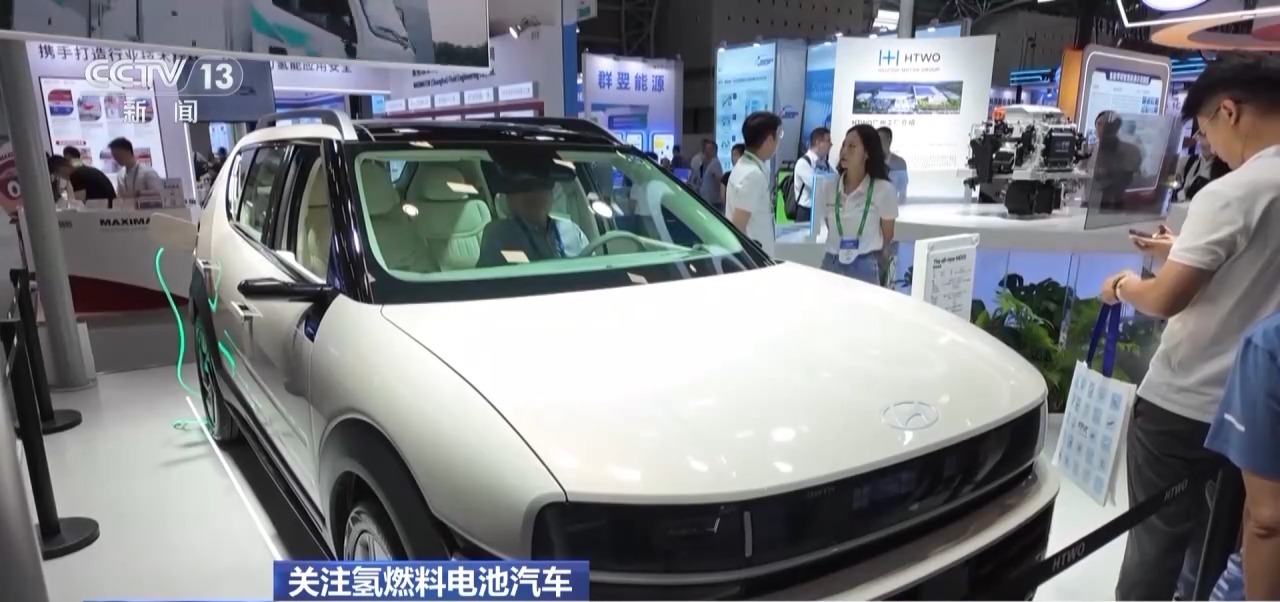
氢燃料电池汽车“组团破圈” 出租、物流、环卫全都“氢”装上阵
Yang Shi Xin Wen· 2025-06-19 00:42
Core Insights - The 2025 International Hydrogen Energy and Fuel Cell Vehicle Conference was held in Shanghai, showcasing nearly 300 domestic and international companies focusing on new products and technologies in hydrogen fuel cell vehicles [1] - Significant advancements in hydrogen fuel cell technology were highlighted, including a new hydrogen hybrid passenger vehicle that has demonstrated over 10,000 kilometers of operation [3] - The latest generation of hydrogen fuel cell passenger vehicles has improved its range from 550 kilometers to 700 kilometers, with a refueling time of just 5 minutes [4] Technology Advancements - A newly developed catalyst has enhanced the stability and durability of fuel cells, improving overall performance by 10% to 15% [6] - A titanium-based bipolar plate has been introduced with a lifespan expected to exceed 30,000 hours and a cost reduction of over 30% [6] - The conference featured the world's largest hydrogen fuel cell mining truck, capable of carrying 260 tons and equipped with five 200 kW fuel cells [9] Environmental Impact - The 260-ton hydrogen mining truck can reduce carbon dioxide emissions by 3,000 tons annually and save approximately 30 million yuan in fuel costs over its lifecycle [11] - Hydrogen fuel cell vehicles are recognized for their zero emissions, long range, and strong low-temperature adaptability, making them a key pathway for decarbonizing the transportation sector [12] Market Applications - Hydrogen fuel cell vehicles are being applied in various sectors, including heavy-duty transport, cold chain logistics, and municipal sanitation, with significant operational mileage achieved [12][14] - In Guangdong, a refrigerated truck with a 90 kW fuel cell system operates an average of over 200 kilometers daily, showcasing the versatility of hydrogen fuel cell technology [14] Policy Support - The Chinese government has increased policy support for hydrogen fuel cell vehicles, facilitating the industry's transition to large-scale development [15] - New pilot cities have been added to support the hydrogen energy sector, indicating a growing commitment to the development of hydrogen fuel cell vehicles [15] Industry Outlook - Experts suggest that the current market may represent a turning point for hydrogen energy, with expectations of stable growth in the next three to five years [14] - The establishment of a complete ecological loop is essential for reducing costs across all stages of fuel cell vehicle deployment, aiming for large-scale commercial operation [17]

汉缆股份(002498) - 002498汉缆股份投资者关系管理信息20250512
2025-05-12 09:30
Group 1: Company Performance and Strategy - The company has experienced slight fluctuations in net profit over the past three years, with performance targets not fully met due to a strategy focused on selecting high-quality customers and orders [4] - In 2024, the company aims to enhance its capabilities in the power industry by collaborating with national technology innovation platforms on projects such as 500kV submarine cables and direct current cable materials [4] - The company has won multiple bids for significant national hydropower projects and continues to maintain a leading position in high-voltage product procurement [4] Group 2: Environmental and Technological Initiatives - The company is actively implementing carbon reduction measures, including the use of photovoltaic power, with a reported generation of 13.81 million kWh in 2024 and the purchase of 3,000 MWh of green certificates [1] - The company is advancing its digital transformation through various projects, enhancing efficiency in process management and procurement [2] - The company is committed to using environmentally friendly materials in its products, leading industry trends with the adoption of polypropylene and halogen-free materials [3] Group 3: Talent and Organizational Development - The company emphasizes talent development as a foundation for high-quality growth, implementing strategies for talent recruitment, assessment, and performance management [5] - A "talent training camp" model has been established to cultivate backup talent and enhance organizational effectiveness [5] Group 4: Market Challenges and Responses - The company is closely monitoring upstream market uncertainties to manage operational risks related to raw material price fluctuations [5] - The decline in sales of submarine cables in 2024 is attributed to project fluctuations and intense market competition, with first-quarter sales reported at 150 million [6] Group 5: Future Outlook and Shareholder Engagement - The company plans to maintain its strategy of selecting high-quality customers and orders while enhancing customer service and experience [3] - The company is considering share buybacks and has a commitment to adhere to legal profit distribution policies while balancing future development needs [6][9]
