牛油果(Avocado)模型

Search documents
Meta的AI反击战:“牛油果”模型计算效率提升百倍,号称迄今最强基座
3 6 Ke· 2026-02-06 04:06
Core Insights - Meta has developed a new generation large language model named "Avocado," which is claimed to be the company's most powerful pre-trained model to date, achieving significant advancements in knowledge, visual perception, and multilingual performance without fine-tuning [1] - The model "Avocado" reportedly offers a tenfold efficiency improvement over the Llama 4 "Maverick" version and a hundredfold improvement compared to the unreleased "Behemoth" version, attributed to higher quality data, infrastructure investments, and the adoption of "deterministic training" methods [1] - Meta's anticipated capital expenditures for AI are projected to surge to between $115 billion and $135 billion by 2026, making these efficiency gains crucial for managing costs while competing with rivals [1] Group 1 - Meta's CTO Andrew Bosworth described the newly formed team's model as "excellent," but noted that the technology is not yet fully mature and requires significant fine-tuning before it can be made available to users [2] - Bosworth acknowledged that 2025 will be a chaotic year for building infrastructure and ensuring computational resources, but he believes that the substantial investments are beginning to yield returns [2] - The company has faced setbacks in its AI development history, including delays in the release of the Llama 4 model due to performance issues, which led to a major strategic shift in its AI approach [2] Group 2 - CEO Mark Zuckerberg expressed a pragmatic and forward-looking view on the outputs from the Super Intelligence Lab, indicating that the initial models will be promising and will demonstrate the company's rapid progress [3] - The leak of the internal memo and subsequent confirmation at the Davos forum signal that Meta is attempting to convey a clear message about its AI research breakthroughs following a restructuring and record investments [3] - Both the "Avocado" model and the initial models described as "excellent" carry the hope for Meta to turn around its AI strategy and regain competitive ground [3]

Meta上亿年薪的研究员们,却在偷师中国开源模型
Guan Cha Zhe Wang· 2025-12-11 10:17
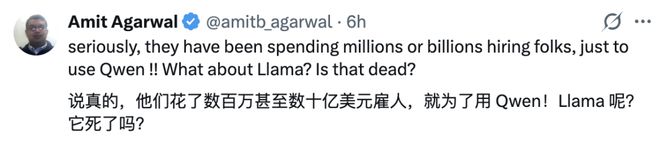
Core Insights - Meta is forming a new team called TBD Lab to develop a closed-source AI model named "Avocado," utilizing third-party models from Google, OpenAI, and Alibaba, with a launch expected in spring 2024 [1] - The rise of Chinese open-source models, such as Alibaba's Qwen, signifies a shift in the competitive landscape, challenging Meta's previous dominance in the open-source AI space [1][4] Group 1: Meta's Strategic Shift - Meta's flagship open-source model, Llama 4, has underperformed, leading to a decline in its status as a leader in the open-source community [2][3] - The release of high-performance models from competitors like DeepSeek and Alibaba has contributed to Meta's loss of dominance, with Llama 4 failing to gain developer approval [3][4] - Meta's recent financial reports show a lack of focus on Llama, indicating a strategic pivot towards new AI initiatives [5] Group 2: Competitive Pressures - The number of derivative models and downloads for Alibaba's Qwen has surpassed those of Meta's Llama, highlighting a significant shift in market leadership [4] - Meta's recruitment of high-profile AI talent, including Alexandr Wang, reflects a desperate attempt to regain competitive ground against rivals like OpenAI [5][6] - The acknowledgment of reliance on Chinese models for training new AI systems represents a significant reversal for Meta, which has previously positioned itself against perceived Chinese technological threats [10][11] Group 3: Market Reactions - Following the news of Meta's new AI strategy, Alibaba's stock saw a pre-market increase of 4%, closing with a 2.53% gain, indicating positive market sentiment towards Chinese AI developments [1] - Analysts have expressed skepticism about Meta's future in AI, contrasting its trajectory with that of Alphabet, suggesting that Meta's strategic direction is now uncertain [10]