玉兔号月球车

Search documents
探月,永无止境
Ren Min Ri Bao· 2026-01-12 07:43
Core Viewpoint - The article highlights China's significant achievements in lunar exploration, showcasing the successful missions of the "Yutu" rover and "Chang'e 6" as milestones in the country's space capabilities and national pride [1]. Group 1: Lunar Exploration Achievements - The "Yutu" rover successfully conducted its first lunar surface scientific exploration on January 14, 2014, marking China's first operational spacecraft on the moon [1]. - The "Chang'e 6" mission, set to return lunar samples from the far side of the moon in July 2025, represents a groundbreaking achievement in lunar research and exploration [1]. Group 2: National Pride and Technological Advancement - The successful return of lunar samples from the moon's far side has significantly enhanced national pride and demonstrated China's growing space capabilities and comprehensive national strength [1]. - The article emphasizes the relentless pursuit and exploration efforts of Chinese space personnel over the past 20 years, contributing to steady progress in lunar exploration [1].
探月,永无止境(创新图录·历史跨越)
Ren Min Wang· 2026-01-11 22:43
Core Insights - China's lunar exploration program has achieved significant milestones, including the successful landing of the "Yutu" rover on the moon and the "Chang'e 6" mission, which marked the first-ever sample return from the moon's far side, showcasing the country's advancements in space technology and exploration capabilities [4]. Group 1: Lunar Exploration Achievements - The "Yutu" rover successfully conducted its first lunar scientific exploration on January 14, 2014, marking a historic moment for China's space endeavors [2]. - The "Chang'e 6" mission completed the world's first sample return from the moon's far side in June 2024, with research results revealing the evolutionary history of the moon's far side expected in July 2025 [4]. Group 2: Technological and National Pride - The achievements in lunar exploration reflect China's growing space capabilities and serve as a benchmark for the nation's overall strength, significantly enhancing national pride among its citizens [4]. - The successful return of lunar samples from the far side represents a historic first for humanity, contributing to the understanding of lunar geology and evolution [4].


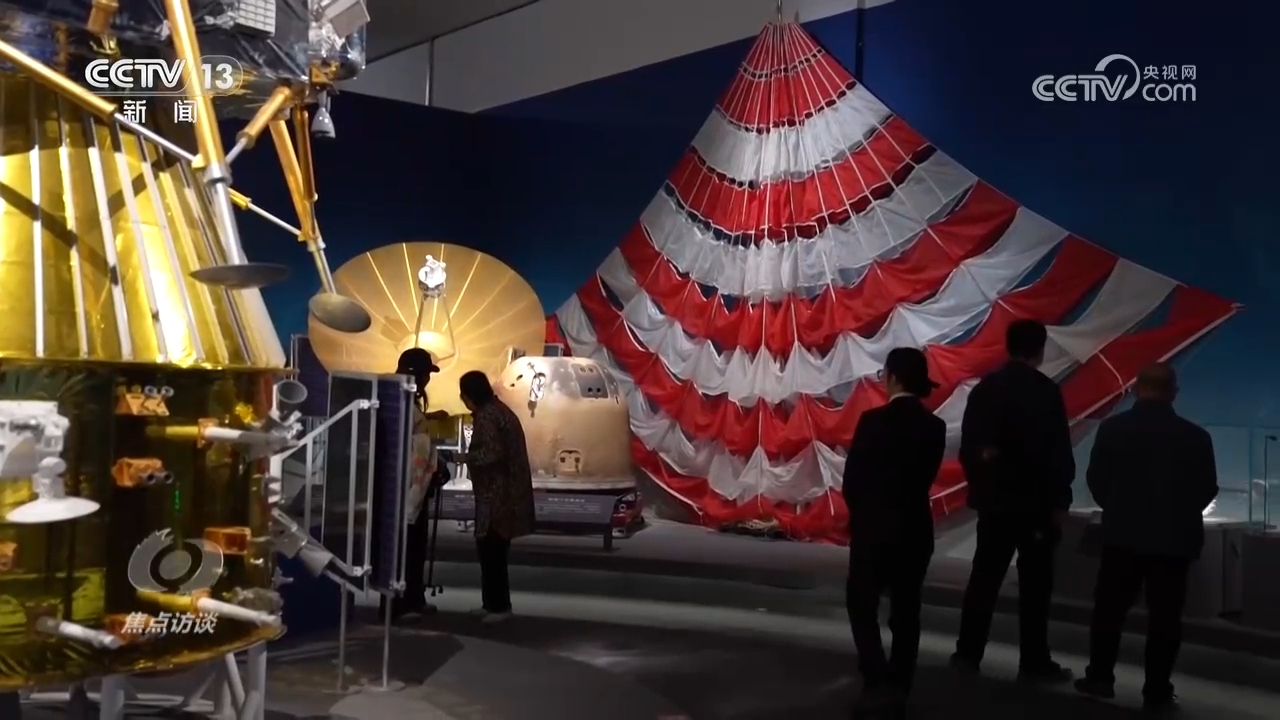
焦点访谈|从“跟跑”“并跑”到部分“领跑”,一起去看20年探月传奇
Yang Shi Wang· 2025-04-24 13:18
Core Viewpoint - The article highlights the significant achievements and future plans of China's lunar exploration program, particularly in the context of the 20th anniversary of the lunar exploration initiative and the ongoing exhibition showcasing its milestones [1][24]. Group 1: Lunar Exploration Milestones - The Chang'e program began in 2004 with a three-step strategy: orbiting, landing, and returning [6]. - Chang'e 1, launched on October 24, 2007, marked China's first lunar satellite, making China the fifth country to launch a lunar probe [4]. - Chang'e 3 successfully landed on the moon on December 14, 2013, carrying the Yutu rover, which set a record for the longest operational time on the lunar surface [8]. - Chang'e 4 achieved the first soft landing on the far side of the moon on January 3, 2019, a historic milestone in lunar exploration [8][11]. Group 2: Technological Innovations and Challenges - The Chang'e 5 mission, launched on November 24, 2020, successfully returned 1,731 grams of lunar samples to Earth on December 17, 2020, marking China's first retrieval of extraterrestrial materials [13]. - The mission involved a complex design with four spacecraft components, showcasing advancements in technology and engineering [13]. - The lunar samples collected have led to over 100 scientific papers, including the discovery of a new mineral named "Chang'e Stone" [19][21]. Group 3: Future Plans and International Collaboration - Future missions include Chang'e 7, aimed at exploring the lunar south pole for water, and Chang'e 8, which will focus on establishing communication and energy systems on the moon [22]. - The program emphasizes international collaboration, inviting other countries and research institutions to participate in lunar exploration efforts [22]. - The overarching goal is to advance lunar exploration and support the construction of a lunar space station over the next 10 to 20 years [22].