玉斧

Search documents
我是岁月的信使
Xin Lang Cai Jing· 2026-02-26 20:43
Group 1 - The article discusses the historical significance and craftsmanship of jade bi, an ancient ceremonial artifact, highlighting its evolution from practical tools to symbols of power and identity in rituals [1][2]. - The production process of jade bi involved meticulous techniques, including selecting fine jade, shaping it through striking and grinding, and drilling precise holes, showcasing the advanced skills of ancient craftsmen [2][3]. - Various styles of jade bi emerged over time, such as linked bi (联璧), double bi (重圈璧), and tooth-shaped bi (牙璧), indicating the increasing complexity and artistry in jade craftsmanship [3]. Group 2 - The jade bi serves as a cultural messenger, containing stories of the Hake civilization, and is currently displayed in the Hulunbuir History Museum, emphasizing its role in preserving historical narratives [3].
揭秘5800年前的“超级工程”(感知文化里的中国)
Ren Min Ri Bao· 2026-02-03 02:16
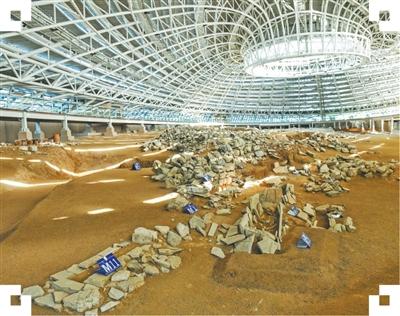
Core Insights - The archaeological site of Niuhe Liang is the largest known site group of Hongshan culture, revealing significant advancements in understanding the origins of Chinese civilization, pushing the timeline back by 500 to 600 years [7][10] Group 1: Archaeological Discoveries - The Niuhe Liang site covers nearly 60 square kilometers with 51 confirmed archaeological points, making it the largest known site group of Hongshan culture [8] - Recent excavations at the first site, where the Goddess Temple is located, revealed a large architectural complex consisting of at least nine platforms, with a main building area of approximately 60,000 square meters, dating back about 5,800 years [8][9] - New types of sacrificial relics, including fire sacrifice remains, have been discovered, indicating a relatively complete ritual activity system within the Hongshan culture [9] Group 2: Cultural Significance - The findings at Niuhe Liang are considered to rewrite the narrative of the origins of Chinese civilization, marking it as the earliest known form of civilization in the region, dating back approximately 5,800 years [10] - The archaeological evidence suggests that the Hongshan culture, represented by Niuhe Liang, did not disappear around 5,000 years ago but rather expanded westward and southward, integrating with the Central Plains civilization [10] Group 3: Tourism and Cultural Heritage - The Niuhe Liang National Archaeological Park has become a significant cultural tourism destination in Liaoning, with visitor numbers reaching approximately 200,000 in 2025, setting a historical record [12][13] - The park includes various important venues and has enhanced its exhibition design based on the latest archaeological findings, providing immersive experiences for visitors through VR technology and interactive exhibits [12][13] - Ongoing preservation efforts are in place to protect the 51 archaeological points, ensuring comprehensive security measures are implemented [13]

人民日报丨探访牛河梁,寻找红山古国 揭秘5800年前的“超级工程”(感知文化里的中国)
Ren Min Ri Bao· 2026-02-03 01:41
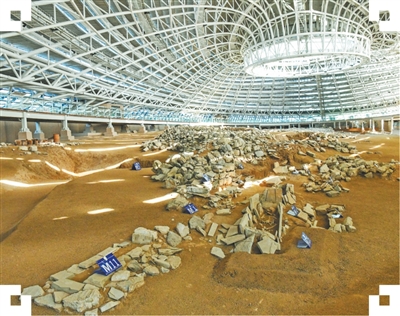
Core Viewpoint - The archaeological discoveries at the Niuhe Liang site in Liaoning Province, which date back approximately 5800 years, have pushed back the timeline of Chinese civilization's origins by five to six hundred years, highlighting the significance of the Hongshan culture as the largest known archaeological site of its kind [4][9]. Group 1: Archaeological Significance - The Niuhe Liang site is the largest known archaeological site of the Hongshan culture, covering nearly 60 square kilometers with 51 confirmed sites [6]. - Recent excavations have revealed a large architectural complex consisting of at least nine platforms, with the main structure covering about 60,000 square meters, indicating advanced organizational capabilities of the Hongshan people [6][8]. - The site features sophisticated engineering solutions, such as a dual water drainage system, showcasing the early architectural principles that may have influenced later Chinese architecture [8]. Group 2: Cultural Insights - The discoveries at Niuhe Liang have redefined the narrative of the origins of Chinese civilization, marking it as the earliest known form of civilization in the region [9]. - The findings suggest that the Hongshan culture, which thrived from over 6500 years ago to around 5000 years ago, may have expanded and integrated with other civilizations rather than disappearing [9]. - Recent discoveries in Hebei Province, such as the Zhengjiagou site, provide new insights into the continuity and evolution of the Hongshan culture [9]. Group 3: Tourism and Cultural Heritage - The Niuhe Liang National Archaeological Park has become a prominent cultural tourism destination in Liaoning, with visitor numbers steadily increasing, reaching approximately 200,000 in 2025 [11][12]. - The park features various facilities, including museums and interactive exhibits, enhancing visitor engagement with the ancient culture [11]. - Ongoing preservation efforts are crucial for maintaining the integrity of the 51 archaeological sites within the park, ensuring that cultural heritage is protected while promoting tourism [11].