
用户生成内容(UGC)

Search documents
吴恩达解读 AI 天价薪酬:资本堆起的1亿美元不是情绪
3 6 Ke· 2025-08-08 07:16
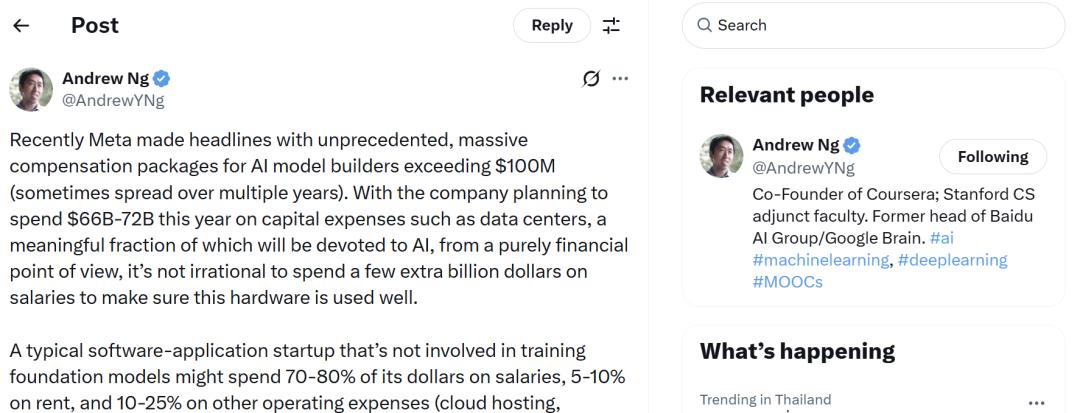
Core Insights - Meta has offered over $100 million in compensation packages to AI model developers, which has caused a significant stir in the tech industry. Although these salaries are typically paid out over several years, they are still notable enough to make headlines [2][6] - This move is part of a larger strategy, as Meta plans to invest between $66 billion and $72 billion in capital expenditures this year, with a substantial portion allocated to building AI infrastructure [2][6] - The compensation structure in AI companies contrasts sharply with traditional software startups, where 70% to 80% of budgets are typically spent on employee salaries. In AI model companies, salaries represent a smaller portion of overall costs [3][8] Investment Strategy - High salaries are not merely emotional expressions but are strategic investments. Companies building AI foundational models tend to have fewer employees but require high capital investment, creating a natural environment for offering substantial salaries [3][4] - Meta's approach is not unique; Netflix also follows a similar model, planning to invest $18 billion in content while maintaining a relatively low employee count of 14,000, allowing for higher-than-market salaries [3][9] Industry Dynamics - The compensation logic for AI companies has diverged from traditional businesses. Capital-intensive firms can leverage capital to attract talent, while labor-intensive companies must rely on a larger workforce to maintain operations [4][9] - Meta's AI training system is becoming a critical and costly part of its business, which includes various platforms like Facebook, Instagram, and WhatsApp. The rise of AI-generated content (AIGC) poses both a threat and an opportunity to the existing user-generated content (UGC) model [4][8] Competitive Landscape - Other platforms like TikTok and YouTube are also recognizing the potential of AIGC to reshape the social media landscape, leading them to invest heavily in AI strategies and high salaries for talent acquisition [4][9] - Hiring key talent not only secures future contributions but may also provide insights into competitors' technological strategies, making high salaries a rational business choice as long as they do not harm company culture [5][9] Historical Context - The trend of offering high salaries in capital-intensive industries is not new. For instance, Netflix's approach has fostered a unique corporate culture that emphasizes teamwork over familial bonds [3][9] - A decade ago, models were created to optimize the balance between hiring employees and purchasing GPUs for AI expansion, indicating a shift towards hardware-centric spending in the industry [5][9] Conclusion - The current landscape reflects a significant opportunity for those involved in AI development, as they are positioned at a pivotal moment in technological evolution, deserving of fair compensation for their contributions [10]


预算去哪了?2025广告投放正在被三股力量重塑
Jing Ji Guan Cha Bao· 2025-07-02 03:16
Group 1 - The advertising industry is undergoing a profound transformation driven by three main forces: the rise of retail media, the shift in content dynamics, and macroeconomic uncertainties [1][3][7] - Retail media has surpassed traditional television as the largest advertising channel, with global spending reaching $163 billion compared to television and streaming's $155 billion [3][4] - The share of retail media in global advertising has increased to 15.7%, overtaking television's 15.1% [3][4] Group 2 - User-generated content (UGC) is becoming mainstream, with advertising budgets for UGC expected to exceed traditional media content for the first time, reaching $184.9 billion in 2025, a 20% increase year-over-year [5][6] - Brands are shifting their focus from traditional advertising to more authentic and relatable content, recognizing the influence of content creators over traditional media [5][6] Group 3 - The overall growth of the advertising market is slowing, with Magna revising its global advertising growth forecast for 2025 from 6.1% to 4.9% and WPP Media from 7.7% to 6% [7] - Economic and political uncertainties, including trade policy negotiations and geopolitical risks, are impacting advertisers' confidence [7][8] Group 4 - The future of advertising will belong to those who understand structural changes, as media and content dynamics evolve alongside macroeconomic factors [8][10] - Brands must adapt to these changes by understanding the new landscape, focusing on data precision, and recognizing the importance of emotional and cultural contexts [10][11]