资本密集型企业

Search documents
投资者终于开始重视传统“资本密集型”企业,不只是因为数据中心
华尔街见闻· 2026-02-28 04:47
Core Viewpoint - The article discusses the shift of investment towards "hard assets" in the AI era, emphasizing the appeal of capital-intensive entities such as utilities, infrastructure, and industrial capacities due to their high physical barriers and low obsolescence risk [1][7]. Group 1: Investment Trends - Since late February, a basket of HALO stocks has been on the rise, indicating a growing investor interest in these assets [2]. - Goldman Sachs predicts that changes in U.S. tariff policies could lead to a decrease in actual tariff rates by approximately 100 basis points, providing additional support for transactions involving physical assets [3]. - The easing of costs for infrastructure and industrial companies reliant on physical imports will further strengthen the market's inclination towards tangible assets in the short term [4]. Group 2: Valuation Shifts - Investors are assigning higher valuations to traditional capital-intensive companies and extending their focus to supply chain and broader economic sectors [5]. - The current technological growth is increasingly dependent on physical assets like data centers and energy supplies, marking a significant shift from the software and platform models that dominated the market for the past 25 years [6][7]. Group 3: Characteristics of Preferred Assets - Companies defined as optimal "HALO" targets possess two key characteristics: high reconstruction costs and regulatory barriers, along with long-term economic value [8][9]. - Specific sectors of focus include electric grids, pipelines, utilities, transportation infrastructure, critical machinery, and long-cycle industrial capacities [9][13]. Group 4: Challenges for Soft Assets - The rise of hard assets comes alongside ongoing pressure on soft assets, with software, media, consulting, and certain financial sectors facing market reevaluation [10]. - Concerns about AI potentially disrupting these sectors and enabling low-cost competitors to undermine traditional business models are prevalent [11]. - However, not all software companies are equally affected, and those demonstrating historical expertise in delivering quality AI outcomes may still present stable or improving fundamentals [12].



高盛:投资者终于开始重视传统“资本密集型”企业
智通财经网· 2026-02-28 03:27
Core Viewpoint - Investors are re-evaluating capital-intensive assets in the "old world," with a shift from data centers to a broader range of physical economy supply chains, driven by the AI era's demand for "hard assets" [1][4]. Group 1: Investment Trends - Goldman Sachs reports that capital is flowing towards "hard assets" such as power grids, pipelines, utilities, transportation infrastructure, and critical industrial capacity, which are difficult to replicate and have high physical barriers [1][4]. - Since late February, a basket of HALO stocks has been on the rise, supported by changes in U.S. tariff policies that may lower actual tariff rates by approximately 100 basis points [3]. - The market is increasingly favoring traditional capital-intensive companies, extending this trend to supply chain and broader economic sectors [3][5]. Group 2: Characteristics of HALO Assets - Goldman Sachs defines optimal HALO assets as those with high reconstruction costs, deep regulatory barriers, and long construction cycles, making them hard to disrupt or replace [5]. - The focus areas for these assets include power grids, pipelines, utilities, transportation infrastructure, critical machinery, and long-cycle industrial capacity [5]. Group 3: Impact on Soft Assets - While hard assets are gaining popularity, soft assets such as software, media, consulting, and certain financial sectors are under pressure, with significant declines in software and IT service stocks observed in February [6]. - Concerns about AI disrupting these sectors and enabling low-cost competitors are leading to a fundamental reassessment of their business models [6]. - However, not all software companies are equally affected, and those demonstrating a history of delivering high-quality AI outcomes may still be viable investments [6].

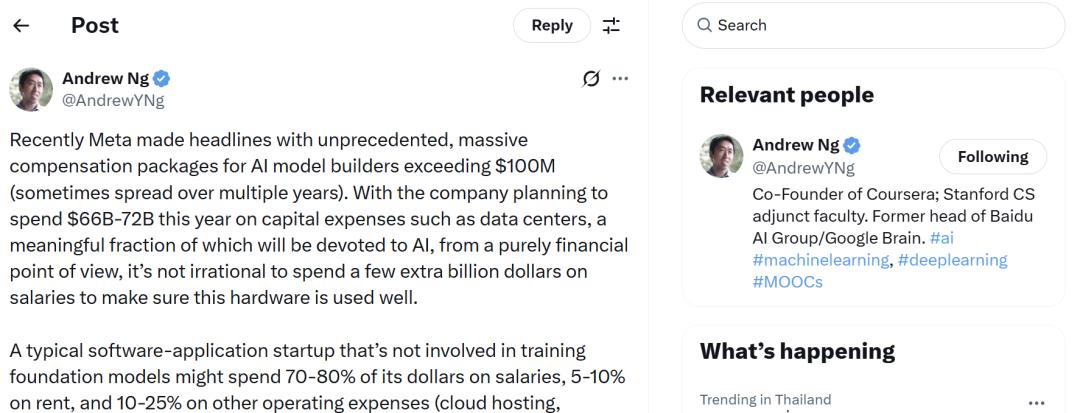
吴恩达解读 AI 天价薪酬:资本堆起的1亿美元不是情绪
3 6 Ke· 2025-08-08 07:16
Core Insights - Meta has offered over $100 million in compensation packages to AI model developers, which has caused a significant stir in the tech industry. Although these salaries are typically paid out over several years, they are still notable enough to make headlines [2][6] - This move is part of a larger strategy, as Meta plans to invest between $66 billion and $72 billion in capital expenditures this year, with a substantial portion allocated to building AI infrastructure [2][6] - The compensation structure in AI companies contrasts sharply with traditional software startups, where 70% to 80% of budgets are typically spent on employee salaries. In AI model companies, salaries represent a smaller portion of overall costs [3][8] Investment Strategy - High salaries are not merely emotional expressions but are strategic investments. Companies building AI foundational models tend to have fewer employees but require high capital investment, creating a natural environment for offering substantial salaries [3][4] - Meta's approach is not unique; Netflix also follows a similar model, planning to invest $18 billion in content while maintaining a relatively low employee count of 14,000, allowing for higher-than-market salaries [3][9] Industry Dynamics - The compensation logic for AI companies has diverged from traditional businesses. Capital-intensive firms can leverage capital to attract talent, while labor-intensive companies must rely on a larger workforce to maintain operations [4][9] - Meta's AI training system is becoming a critical and costly part of its business, which includes various platforms like Facebook, Instagram, and WhatsApp. The rise of AI-generated content (AIGC) poses both a threat and an opportunity to the existing user-generated content (UGC) model [4][8] Competitive Landscape - Other platforms like TikTok and YouTube are also recognizing the potential of AIGC to reshape the social media landscape, leading them to invest heavily in AI strategies and high salaries for talent acquisition [4][9] - Hiring key talent not only secures future contributions but may also provide insights into competitors' technological strategies, making high salaries a rational business choice as long as they do not harm company culture [5][9] Historical Context - The trend of offering high salaries in capital-intensive industries is not new. For instance, Netflix's approach has fostered a unique corporate culture that emphasizes teamwork over familial bonds [3][9] - A decade ago, models were created to optimize the balance between hiring employees and purchasing GPUs for AI expansion, indicating a shift towards hardware-centric spending in the industry [5][9] Conclusion - The current landscape reflects a significant opportunity for those involved in AI development, as they are positioned at a pivotal moment in technological evolution, deserving of fair compensation for their contributions [10]