
甲磺酸奥希替尼片(泰瑞沙)

Search documents
医药代表篡改报告骗保获刑,守护医保“救命钱”再敲警钟
2 1 Shi Ji Jing Ji Bao Dao· 2025-11-24 06:02
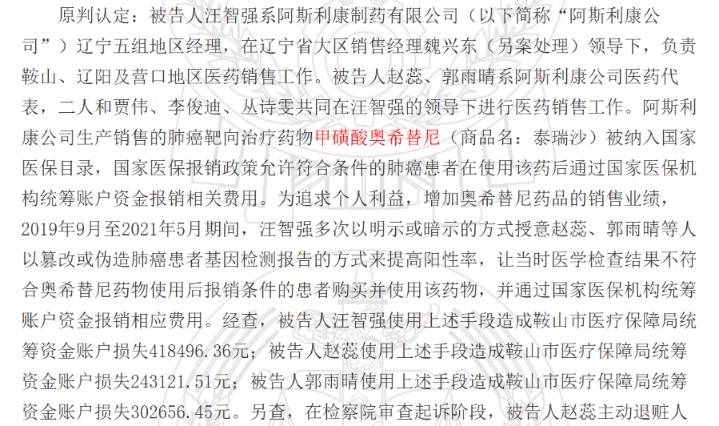
Core Viewpoint - The article highlights the increasing incidents of healthcare fraud in China, particularly involving the manipulation of genetic testing reports to illegally obtain reimbursements from the national medical insurance fund, which is crucial for patients' healthcare access [1][2]. Group 1: Fraud Cases - A pharmaceutical representative altered genetic test results to falsely qualify patients for a targeted cancer drug, resulting in a loss of 27,540 yuan to the national insurance fund [1]. - Multiple similar fraud cases have been identified, with amounts involved ranging from tens of thousands to hundreds of thousands of yuan [2]. - A regional manager and representatives from a pharmaceutical company were found guilty of manipulating test results, leading to losses of 418,496.36 yuan, 243,121.51 yuan, and 302,656.45 yuan respectively [5]. Group 2: Regulatory Response - The Chinese government has intensified its crackdown on healthcare fraud, with a focus on both pharmaceutical sales and hospital practices [7][8]. - New regulations have been introduced to manage external sample testing in public medical institutions, aiming to enhance oversight and ensure compliance with clinical needs and insurance policies [8][9]. - Technological advancements such as smart monitoring and drug traceability are being integrated into regulatory frameworks to improve the precision and effectiveness of fraud detection [10]. Group 3: Implications for Healthcare - The misuse of targeted cancer drugs not only jeopardizes patient safety and treatment efficacy but also places an additional financial burden on the healthcare system [6]. - Experts emphasize the need for stricter adherence to medical insurance policies and the establishment of robust internal management mechanisms within healthcare institutions to prevent fraud [9][10].

沃瑞沙和泰瑞沙联合疗法中国获批,二线治疗晚期非鳞非小细胞肺癌
Xin Jing Bao· 2025-07-01 04:57
Core Insights - AstraZeneca announced the approval of the combination therapy of Savolitinib (brand name: Worishe) and Osimertinib (brand name: Taris) by the National Medical Products Administration of China for treating locally advanced or metastatic non-squamous non-small cell lung cancer (NSCLC) patients with EGFR gene mutations and MET amplification after progression on EGFR tyrosine kinase inhibitors (TKIs) [1][2] Group 1 - Savolitinib is the first selective MET inhibitor approved in China, developed in collaboration with Hutchison China MediTech, and is indicated for adult patients with locally advanced or metastatic NSCLC with MET exon 14 alterations [1] - Osimertinib is an irreversible third-generation EGFR-TKI with confirmed clinical activity in treating NSCLC patients, including those with central nervous system metastases [1][2] Group 2 - The approval is based on the SACHI Phase III clinical trial data, which achieved the predefined primary endpoint of progression-free survival (PFS) in a pre-specified interim analysis [2] - The combination therapy was included in the breakthrough therapy designation by the National Medical Products Administration in 2024 and received priority review for its new drug application in 2025 [2] - The approval marks the third indication for Savolitinib in China, highlighting its significance in addressing complex challenges in lung cancer treatment [2]

