
甲醇燃料电池

Search documents
甲醇燃料电池全球市场规模、选型建议、产业链及发展趋势
QYResearch· 2026-03-19 01:08
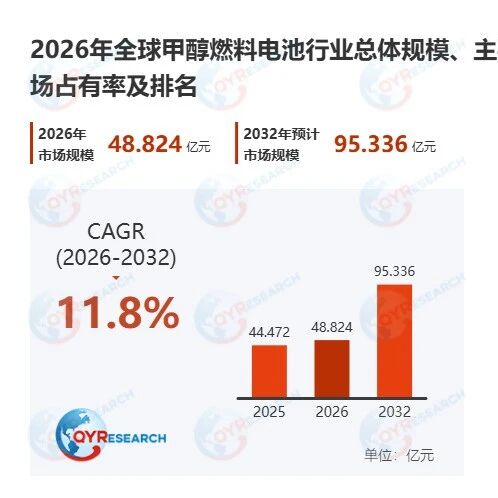
Market Overview - Methanol fuel cells convert chemical energy directly into electrical energy through electrochemical reactions, distinguishing them from traditional combustion methods [2] - They can be categorized into direct methanol fuel cells (DMFC) and reforming methanol fuel cells (RMFC), with the former being simpler and the latter offering higher power output but increased complexity [2] Structure and Technology - The main components of methanol fuel cells include the stack system, fuel supply system, air supply system, cooling and water management system, and control module [3] - Methanol fuel cells are more convenient for storage and transportation compared to hydrogen fuel cells, as methanol is a liquid at room temperature and pressure [3] - Key technological aspects include catalyst activity, electrolyte membrane performance, and fuel utilization efficiency, with advancements in materials technology contributing to miniaturization and portability [3] Application Fields - Methanol fuel cells are widely used in portable power sources, backup power, and small distributed generation systems, particularly in outdoor equipment and communication base stations [4] - They are also being explored for applications in drones, IoT devices, and remote monitoring systems due to their energy density and convenient fuel supply [4] Market Size - The methanol fuel cell market is projected to reach USD 654 million by 2025 and USD 718 million by 2026, with a compound annual growth rate (CAGR) of 11.8% over the next six years [6] Industry Chain, Policies, and Development Trends - The upstream supply chain includes methanol raw material supply, catalyst materials, and key components like proton exchange membranes [8] - The development of green and renewable methanol technologies is shifting the upstream material structure towards low-carbon solutions [8] - Downstream applications focus on portable power, backup power, and small distributed generation, with communication base stations being a significant market [8] - Industry policies supporting clean energy transitions and carbon reduction goals are crucial for the growth of methanol fuel cells [10] Development Trends - The industry is moving towards increasing power density, reducing precious metal catalyst usage, and extending lifespan [11] - Challenges include lower system efficiency compared to hydrogen fuel cells and the high cost of catalyst materials [11] - Methanol fuel cells are seen as advantageous in applications requiring convenient fuel storage and transportation [11] Entry Barriers - The methanol fuel cell industry has certain technical and capital barriers, requiring expertise in electrochemical materials, stack design, and system integration [12] - Establishing a stable customer base and experience with demonstration projects is essential for market entry [12]

共商绿色能源发展大计!2025北京甲醇能源峰会圆满落幕
Zhong Guo Qi Che Bao Wang· 2025-11-08 12:31
Core Insights - The "Beijing Methanol Energy Summit" held on November 7 focused on the entire methanol energy industry chain, discussing policy interpretation, technological innovation, industrial practices, and market outlook [1][3][8] - The summit aimed to create a platform for deep integration of production, education, research, and application in the methanol sector [1][3] Policy and Industry Development - The development of methanol energy relies heavily on policy guidance and practical exploration, with significant milestones achieved since the completion of methanol vehicle pilot projects in 2019 [3][10] - The successful hosting of the first Beijing Methanol Energy Summit in 2023 has further enhanced the industry's influence and public awareness [3][10] Technological Advancements - The methanol energy application ecosystem has expanded from early uses in vehicles and stoves to include ships, fuel cells, and power generation [7][31] - The global methanol industry is entering a phase of explosive growth, driven by rigid demand in shipping, chemicals, and transportation sectors [8][14] Market Dynamics - China is leading in methanol production and consumption, with over 60% of its renewable methanol projects being bio-methanol [14][18] - The methanol industry is expected to see a capacity growth rate of approximately 2.9% during the 14th Five-Year Plan, reaching 130 million tons per year by 2030 [18] Safety and Standards - The summit discussed the importance of developing standards for methanol fuel applications, particularly in shipping and thermal combustion [20][22] - Safety assessments indicate that the occupational health risks associated with methanol are currently at an acceptable level [37] Future Outlook - The methanol sector is poised to play a crucial role in the global energy transition, with ongoing technological breakthroughs and a growing array of application scenarios [45] - The collaboration among industry, academia, and research institutions is expected to accelerate the commercialization of green methanol technologies [45]
