电动车动力电池

Search documents
300多韩国人在美被抓,李在明要求全力迅速解决
Xin Hua She· 2025-09-07 03:02
Core Points - The U.S. law enforcement recently conducted a raid on a construction site of South Korea's Hyundai Motor Company in the U.S., resulting in the arrest of over 300 South Korean nationals [1][2] - U.S. President Trump expressed support for the operation, labeling the arrested individuals as "illegal foreigners" [4] - The raid is noted as the largest single-location enforcement action by the U.S. Department of Homeland Security to date, following months of investigation [2] Group 1: Incident Overview - The raid took place at a Hyundai Motor Group factory in Georgia, which is set to produce electric vehicle batteries in partnership with LG Energy Solution, scheduled to commence production next year [5] - A total of 475 individuals were arrested, most of whom were found to be in the U.S. illegally through various means, including illegal entry and overstaying visas [1][2] Group 2: Diplomatic Reactions - The South Korean Foreign Minister convened an emergency meeting to address the situation, expressing deep regret and a sense of responsibility for the arrested individuals [1] - South Korea's President has called for immediate efforts to resolve the incident, with potential plans to send a high-ranking official to the U.S. [1] Group 3: Implications - The enforcement action may create tension between the U.S. and South Korea, particularly as the two countries are still negotiating details of a bilateral trade agreement involving $350 billion in investments from South Korea to the U.S. [5]

中美经贸会谈后,汽车行业影响几何?
Guan Cha Zhe Wang· 2025-05-19 01:14
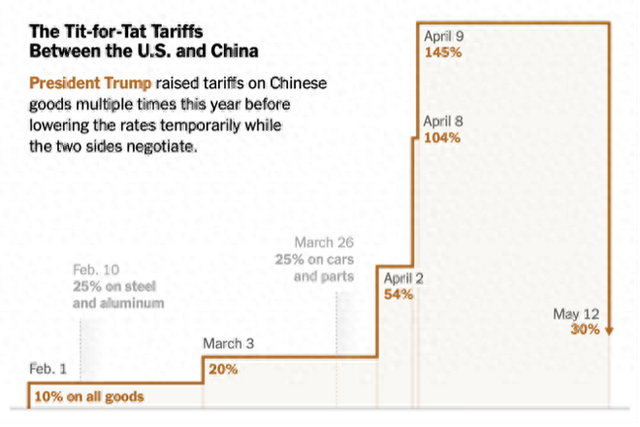
Group 1 - The core viewpoint of the article highlights that the tariffs imposed by the Trump administration have caused significant pain for American businesses, leading to a temporary pause in tariffs following the recent US-China trade talks [1][8] - Following the Geneva trade talks, both the US and China agreed to suspend certain tariffs for an initial period of 90 days, which has made Chinese automotive parts more attractive to the US market [1][9] - The automotive industry is optimistic about the trade talks, but there are concerns about the long-term stability of the tariff agreements due to the unpredictable nature of the Trump administration's policies [1][12] Group 2 - The US will suspend the 24% tariff on Chinese goods for 90 days while retaining a 10% tariff, and China will reciprocate by suspending its own tariffs on US goods [3][6] - Despite the temporary suspension, significant tariffs remain in place, particularly on electric vehicles, semiconductors, and automotive parts, with total tariffs on Chinese electric vehicles reaching as high as 132.5% [7][8] - The recent tariff adjustments have led to a recovery in trade between the US and China, with companies like Tesla planning to import Chinese parts for their production lines [9][11] Group 3 - The uncertainty surrounding future tariff policies continues to affect the confidence of automotive companies, with General Motors warning of a potential profit reduction of $4 billion to $5 billion due to tariffs [11][12] - Chinese automotive suppliers are exploring local production in the US to mitigate tariff impacts, but face challenges from USMCA regulations and the volatile political landscape [12][13] - The recent trade agreement is seen as a temporary measure, with experts warning that fundamental issues in US-China trade relations remain unresolved [14][15]