
电化学储能电池

Search documents
中国能建战新产业营收增16.75% 两海外项目获33.38亿融资支持
Chang Jiang Shang Bao· 2025-12-14 23:44
Core Viewpoint - Despite a decline in profits due to adjustments in the real estate market, China Energy Engineering Corporation (China Energy) demonstrates strong growth resilience, with significant increases in international business contracts and revenue [1][4]. Group 1: Financial Performance - In the first three quarters of 2025, China Energy achieved new contract amounts, operating revenue, and total profit of 992.775 billion yuan, 323.544 billion yuan, and 8.507 billion yuan, respectively, with year-on-year growth of 0.40%, 9.62%, and 0.09% [5]. - The international business revenue grew by 21.21%, with total profits increasing by 21.29% [5]. - The company reported a decrease in net profit attributable to shareholders by 12.43% in the same period, reflecting pressures from the real estate market [5][6]. Group 2: Strategic Developments - China Energy has established a wholly-owned subsidiary in the Netherlands to facilitate the development of two solar projects in Uzbekistan, with a total investment of approximately 4.711 billion yuan [2][3]. - The company signed financing agreements for these projects, securing loan amounts of 1.654 billion yuan and 1.684 billion yuan, totaling 3.338 billion yuan [3]. Group 3: Business Segments and Growth - The energy and water sectors, which are core businesses, saw revenue and total profit growth of 16.76% and 18.42%, respectively, contributing over 75% to the company's overall performance [6]. - Strategic emerging industries reported a revenue increase of 16.75%, accounting for 38.81% of total revenue, indicating a shift towards high-end industrial structure [7]. Group 4: Innovation and R&D - China Energy emphasizes technological innovation as a core driver for high-quality development, focusing on new energy systems and key technologies such as energy storage and hydrogen energy [6]. - In the first three quarters, R&D expenses reached 8.892 billion yuan, a year-on-year increase of 7.72%, with 1,496 patents granted, including 498 invention patents [6].

电网设备出海专家访谈
2025-10-27 15:22
Summary of Key Points from Conference Call Records Industry Overview - The global power grid infrastructure is facing a significant demand for upgrades, driven by aging equipment in Europe and North America, and the dual impact of renewable energy development and aging infrastructure in Asia, Africa, and Latin America [1][2][3] - The demand for modern, efficient, and sustainable smart grid systems is urgent across various regions due to the need for infrastructure modernization and the integration of renewable energy sources [3] Regional Investment Demand - **Europe**: Faces severe aging of grid equipment, with many devices over 40 years old. A projected investment of approximately €2 trillion is needed by 2050 to address these issues [5] - **North America**: Similar aging issues, compounded by a surge in power demand from data centers and AI, which may account for over 10% of total load in the coming years [3] - **Asia and Africa**: Rapid development is noted, with countries like Indonesia and Singapore needing significant upgrades to their grid systems to accommodate new energy structures [3] - **Latin America**: Brazil's grid infrastructure is lagging behind its investments in solar and wind projects, leading to power outages that affect economic activities [3] Chinese Power Equipment Companies - Chinese power equipment firms primarily export to Europe and the U.S. through local agents or single-unit sales, facing certification barriers. In non-European markets, they utilize direct sales and partnerships to expand market share [1][6] - The penetration rate of Chinese power equipment in Europe is low, estimated at around 5% in 2024, with projections of 7-8% in 2025. In Brazil, the penetration is estimated at 20-30% [11] - Chinese companies have a competitive edge in cost and delivery capabilities, but face challenges in brand recognition and trust in international markets [8][10] Market Opportunities and Challenges - The global demand for IGBT and related core components is high, particularly in flexible DC transmission projects, with supply shortages being a significant issue [9] - Chinese companies are capitalizing on the booming demand in the Middle East, South Asia, and East Asia, leveraging their cost advantages and flexible service offerings [10] - International competitors like Schneider, Siemens, and ABB are expanding production, particularly in transformer manufacturing, but face long construction cycles [7][8] Competitive Landscape - Chinese power equipment firms are increasingly recognized in the Middle East, with high-end products gaining acceptance, although they still face quality perception issues [7] - In contrast, Western companies maintain a strong foothold in the market due to established relationships and cultural recognition among local decision-makers [12] Future Outlook - The outlook for Chinese high-voltage direct current (HVDC) technology is promising, with significant projects already underway in Brazil and Saudi Arabia, showcasing China's competitive advantages in technology, equipment supply, and project management [14][15][16] - The global DC transmission project market is experiencing rapid growth, with China positioned as a key player, particularly in regions where they can offer comprehensive solutions [15][16]
关于加强电化学储能安全管理有关工作的通知
国家能源局· 2025-05-07 09:09
Core Viewpoint - The notification emphasizes the importance of enhancing safety management in electrochemical energy storage systems to prevent major accidents and ensure reliable operation throughout the project lifecycle [1][2][3]. Group 1: Safety Management Enhancements - The notification calls for improving the intrinsic safety level of battery systems through accelerated research and technological advancements in battery safety, as well as standardizing design and manufacturing processes [1]. - Project units are required to conduct comprehensive safety evaluations during the feasibility study phase and to perform safety checks post-construction or trial operation, ensuring timely rectification of any identified issues [2]. Group 2: Standards and Regulations - There is a push for the development and revision of standards related to the design, construction, acceptance, grid connection, and operation of electrochemical energy storage projects, with a focus on aligning with mandatory national standards for storage battery products [2][3]. - The notification outlines the necessity for all electrochemical energy storage projects to comply with regulatory requirements and clearly define safety management responsibilities during the project registration process [2]. Group 3: Interdepartmental Coordination - The notification stresses the need for enhanced communication and coordination among various departments, including energy, emergency management, industrial and information technology, market supervision, and fire rescue, to establish a collaborative working mechanism [3]. - It encourages the sharing of monitoring data and information regarding the construction and operation of electrochemical energy storage systems to address significant issues promptly [3]. Group 4: Corporate Responsibility - Project units are mandated to take full responsibility for safety management throughout the entire lifecycle of the project, from planning and design to construction, operation, and decommissioning [3]. - The notification highlights the importance of integrating safety considerations into all aspects of electrochemical energy storage development to promote high-quality growth in the sector [3].

重磅!五部门发布加强电化学储能安全管理有关工作的通知
中关村储能产业技术联盟· 2025-05-07 08:13
Core Viewpoint - The article discusses the recent notification from the National Energy Administration regarding the enhancement of safety management in electrochemical energy storage projects, emphasizing the need for improved safety standards, inter-departmental collaboration, and the establishment of clear responsibilities for safety oversight [1][3][5]. Group 1: Safety Management Enhancements - The notification aims to elevate the inherent safety levels of battery systems and encourages the industrial and information technology departments to accelerate research on battery safety and promote technological advancements in electrochemical energy storage [3][4]. - It mandates that project units conduct comprehensive safety evaluations during the feasibility study phase and perform safety checks post-construction or trial operation, ensuring the reliability of projects throughout their lifecycle [4]. Group 2: Standardization and Regulation - The notification calls for the refinement of standards and regulations related to the design, construction, acceptance, grid connection, and operation of electrochemical energy storage stations, with a focus on aligning with national mandatory standards for storage battery products [4][5]. - It emphasizes the necessity for all electrochemical energy storage projects to comply with legal and regulatory requirements for filing, ensuring that safety responsibilities are clearly defined in the project documentation [4][5]. Group 3: Inter-Departmental Collaboration - The notification highlights the importance of inter-departmental collaboration and information sharing, advocating for joint research, training, inspections, and law enforcement among relevant departments [2][5]. - It proposes the establishment of a mechanism for reporting and jointly addressing fire incidents related to electrochemical energy storage [2][5]. Group 4: Corporate Responsibility - Project units are required to take on the primary responsibility for safety management throughout the entire project lifecycle, from planning and design to construction, operation, and decommissioning [5]. - The notification stresses the need for a robust safety culture within companies, including regular risk assessments and the establishment of emergency response capabilities to prevent safety incidents [5].
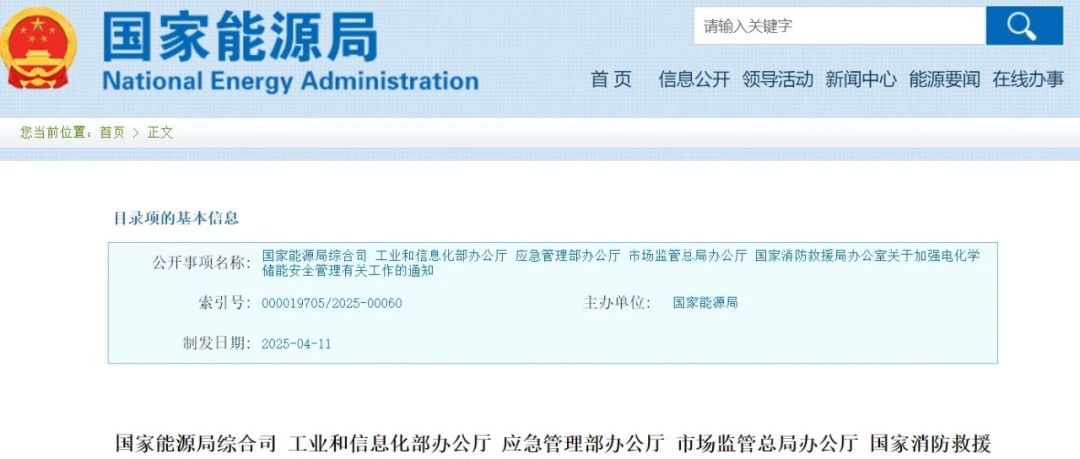
五部门:加强电化学储能安全管理有关工作,提升电池系统本质安全水平
news flash· 2025-05-07 07:27
Core Viewpoint - The notice issued by multiple government departments emphasizes the importance of enhancing safety management in electrochemical energy storage systems to prevent major accidents and ensure high-quality development in the sector [1][2][5]. Group 1: Safety Management Enhancements - The notice calls for improving the inherent safety level of battery systems and accelerating research on battery safety by the industrial and information technology departments [2][3]. - It highlights the need for comprehensive safety condition evaluations and facility assessments for electrochemical energy storage projects during feasibility studies and post-construction [3][4]. Group 2: Standardization and Regulation - There is a push to further refine standards and regulations related to the design, construction, acceptance, grid connection, and operation of electrochemical energy storage stations [3][4]. - The notice mandates that all electrochemical energy storage projects must comply with legal and regulatory requirements for filing and clearly define safety responsibilities [4][5]. Group 3: Interdepartmental Coordination - The notice stresses the importance of interdepartmental collaboration and information sharing among energy, emergency management, industrial and information technology, market supervision, and fire rescue departments [4][5]. - It encourages the establishment of mechanisms for joint research, training, inspections, and enforcement to enhance safety monitoring and response to major issues [4]. Group 4: Corporate Responsibility - Companies involved in electrochemical energy storage projects are required to take on primary responsibility for safety management throughout the project lifecycle, from planning to decommissioning [4][5]. - The notice emphasizes the need for rigorous safety hazard identification and risk management to ensure safe operations and prevent accidents [4].