真空磁吸手机支架

Search documents
2025中国产业带发展趋势报告
Sou Hu Cai Jing· 2026-01-15 08:05
Core Insights - In 2025, China's industrial belts will enter the AI-native era, where AI evolves from a cost-reduction tool to a central intelligence for supply chain transformation, facilitating a historic shift from "digitalization" to "intelligence" [1][6][10] - The macroeconomic environment is transitioning to an "effective supply" era, with policies, capital, and markets favoring companies that create real value, moving away from price competition towards product and service quality [12][13][14] - Regional development is characterized by a gradient pattern of "East high, Central fast, West broad," with Eastern regions housing intelligent factories, Central regions experiencing rapid digital growth, and Western regions forming new supply forces based on unique categories [25][26] Industry Trends - The three high-growth sectors identified are instant retail, customization, and cross-border trade, each leveraging core advantages of speed, specialization, and proximity to achieve scale [34][36] - The top ten active industries include pharmaceuticals, hardware tools, and bags, with a shift in competition focus from "product supply" to "scene response," indicating a demand for tailored solutions [39][40] - AI is deeply integrated across the entire process of research and design, production, supply chain management, and marketing, as evidenced by successful case studies of companies transforming from price wars to value-driven strategies [2][46] Future Outlook - The industrial belts are expected to transition from the "AI add-on" phase in 2024-2025 to the "AI symbiosis" phase in 2026-2027, ultimately achieving an "AI-native" state post-2028 [2][12] - Companies must embrace AI, ensure product quality and fulfillment certainty, and strategically position themselves in dual circulation markets to capitalize on industry dividends [2][12] - The B2B sector is projected to concentrate growth on companies that can deliver stable orders, direct user connections, and self-developed products, with only the top 1% of businesses meeting efficiency, compliance, and certainty standards expected to thrive [22][23][24]

《2025年度新品牌发展报告》发布,广州创业活力三年蝉联榜首
Guang Zhou Ri Bao· 2026-01-13 02:23
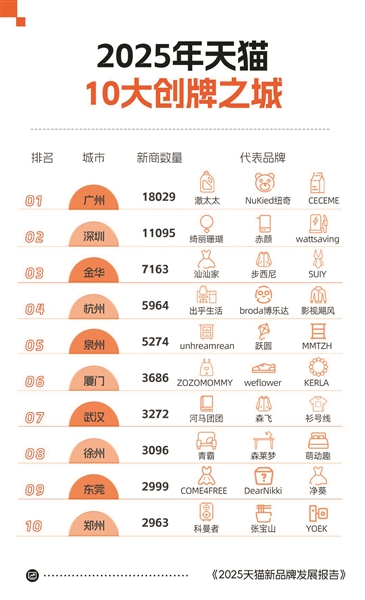
Core Insights - Guangzhou has become a hub for entrepreneurs, with one in five residents being a business owner and one in seven being an entrepreneur, showcasing its vibrant entrepreneurial ecosystem [4][5]. Group 1: Entrepreneurial Growth - In 2025, over 18,000 new businesses opened on Tmall in Guangzhou, doubling the number from 2023, indicating a significant increase in entrepreneurial activity [2][6]. - The total number of market entities in Guangzhou reached 4.15 million by the third quarter of 2025, a year-on-year increase of 14.89%, with 2.76 million being enterprises [5][6]. - Guangzhou has maintained its position as the leading city for entrepreneurial vitality for three consecutive years, reflecting a robust entrepreneurial environment [5][6]. Group 2: E-commerce and Market Dynamics - Guangzhou led the creation of new brands on Tmall in 2025, with 18,029 new merchants, highlighting its strong presence in the e-commerce sector [6][8]. - The city's entrepreneurial ecosystem is supported by a stable supply of new brands and a favorable industrial environment, which enhances its competitive edge in e-commerce [6][8]. Group 3: Supportive Policies and Ecosystem - Guangzhou has implemented a comprehensive entrepreneurial support system that integrates policy, funding, industry, and talent, creating a strong attraction for entrepreneurs [9][10]. - The city has introduced various entrepreneurial policy packages, including guaranteed loans and subsidies, to encourage business formation and growth [9][10]. Group 4: Innovation and Industry Trends - The entrepreneurial landscape in Guangzhou is shifting towards high-end manufacturing and cutting-edge technology, with significant growth in sectors like biomedicine, intelligent equipment, and software [14][15]. - New registrations in strategic industries such as low-altitude economy and artificial intelligence have seen remarkable growth rates, indicating a trend towards innovation [14][15]. Group 5: Success Stories and Impact - Notable companies that emerged from Guangzhou's entrepreneurial scene include Yunzhou Biotechnology and Wenyuan Zhixing, which have become leaders in their respective fields [11][12]. - The city has produced 13 unicorns and numerous high-tech enterprises through its annual innovation and entrepreneurship competitions, demonstrating its capacity to nurture successful startups [10][11].

让生意经营开启“智驾模式”,1688成AI+电商试验田
Sou Hu Cai Jing· 2025-10-20 08:27
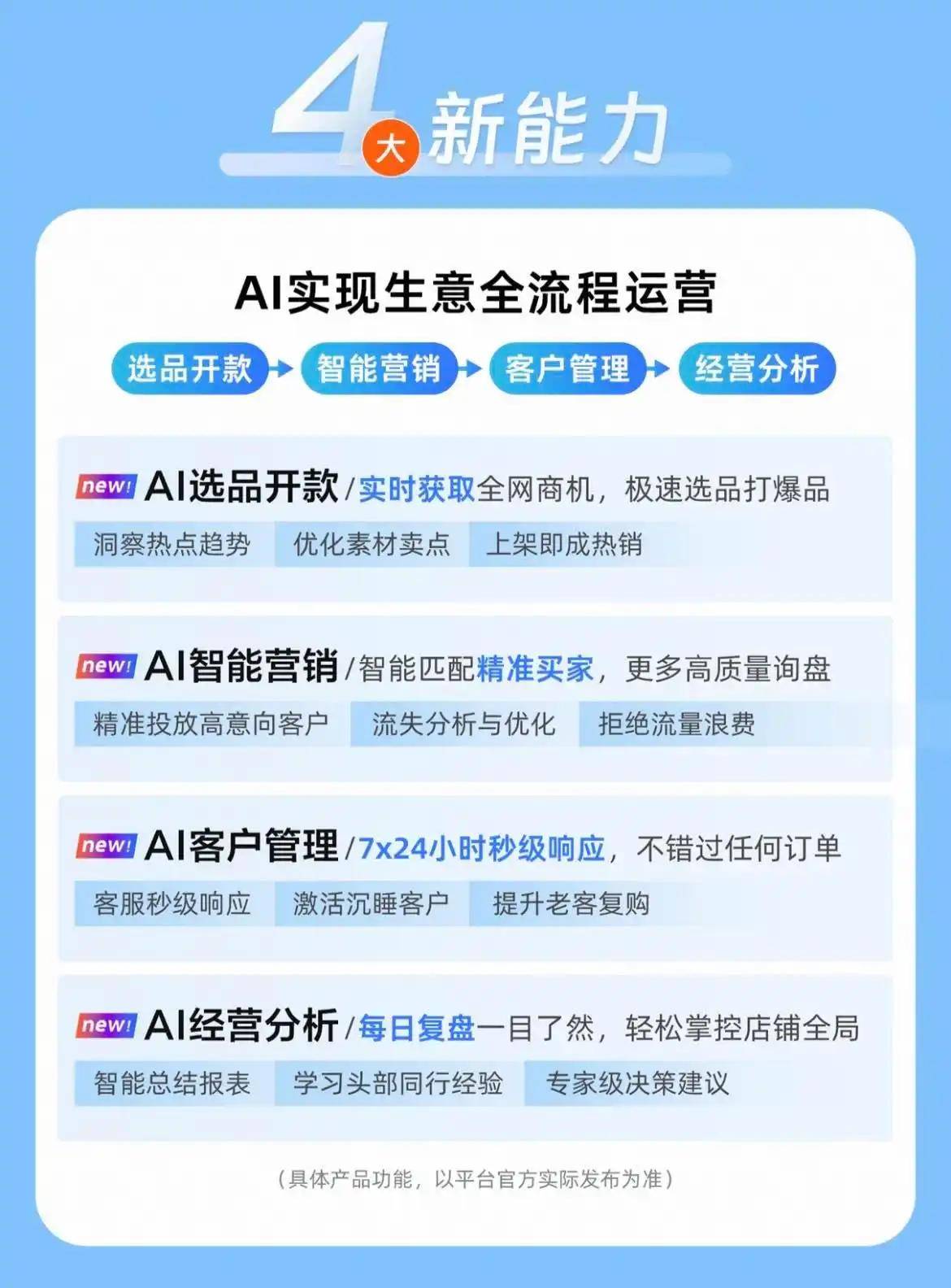
Core Insights - The article discusses the integration of AI in e-commerce, particularly highlighting Alibaba's "Integrity AI Version" on the 1688 platform, which aims to enhance operational efficiency for merchants [1][5][10] Group 1: AI Implementation in E-commerce - The year 2025 marks the end of the "Big Model War," with AI becoming a key player in e-commerce, as major companies like Amazon and Alibaba explore its applications [1] - The recent Tmall Double 11 event is noted as the first fully AI-integrated event, focusing on traffic distribution, consumer experience, and e-commerce operations [1] - The "Integrity AI Version" is designed to automate over 50% of daily operational tasks for merchants, acting as a professional "digital employee" [5][9] Group 2: Features and Benefits of "Integrity AI Version" - The platform offers capabilities in AI product selection, intelligent marketing, customer management, and operational analysis, significantly reducing operational costs and improving efficiency [5][10] - Merchants using the AI version have reported a reduction in team size from 5+ to 2, leading to a sharp decrease in operational costs [7] - Data indicates that merchants using AI for over six months experience a 30% reduction in operational costs and a 20% increase in inquiries and new buyers [9] Group 3: Market Dynamics and User Adoption - The platform has seen a 55% year-on-year growth in active buyers, with the number surpassing 100 million, making it the first ToB platform in China to reach this scale [9] - The diverse buyer base includes traditional retailers, social media influencers, and various new professional groups, enhancing the platform's attractiveness to merchants [9] - The "Integrity AI Version" lowers the entry barrier for new merchants, allowing them to compete effectively with established players [9][10]