
软件与互联网

Search documents
策略周报:外部风浪仍在,A股聚焦三类资产-20260329
East Money Securities· 2026-03-29 13:29
Strategy Insights - The report highlights that external geopolitical tensions, particularly the ongoing conflict between the US and Iran, continue to impact global capital markets, with rising oil prices contributing to inflationary pressures and recession expectations [8][19] - Despite these challenges, Chinese assets are expected to demonstrate resilience, with the potential for opportunities arising from the energy transition and sectors less correlated with oil prices, such as pharmaceuticals and innovative drugs [8][19] Asset Allocation - The report suggests focusing on three categories of assets: 1. Beneficiaries of the overseas energy crisis, particularly in the Chinese renewable energy sector, including wind, solar, energy storage, lithium batteries, and new energy vehicles [8][19] 2. Resilient assets that are weakly correlated with oil prices, such as pharmaceuticals, banking, real estate, and public utilities [8][19] 3. High-growth assets that can withstand valuation pressures, including semiconductor equipment, optical modules, PCBs, and optical fibers, while also noting the risks of external demand downgrades [8][19] Industry Focus - Key industries to watch include the renewable energy supply chain, innovative pharmaceuticals, banking, real estate, coal, natural gas, and semiconductor equipment [8][19] - The report emphasizes that the market's core trading narrative revolves around the volatility of oil prices driven by geopolitical tensions, which could lead to significant sectoral differentiation based on oil price sensitivity [19][20] Geopolitical and Economic Context - The report indicates that the most pessimistic phase of geopolitical risks may be receding, with diplomatic efforts from the US to stabilize the situation, which could alleviate some market pressures [8][10] - It also notes that while the US economy faces internal pressures, the likelihood of a significant escalation in conflict remains, impacting market sentiment and economic forecasts [10][19] External Demand and Market Dynamics - The report warns that external demand remains a critical variable for domestic industry profitability, with potential weaknesses in global consumption and production impacting sectors reliant on exports [23] - It suggests that industries with strong global competitiveness and pricing power will continue to show resilience, despite the current geopolitical and economic uncertainties [23]
阿里巴巴-W(09988):看好全栈AI能力在Agentic范式下的业务机遇
国投证券(香港)· 2026-03-23 11:51
Investment Rating - The report maintains a "Buy" rating for Alibaba with a target price of HKD 196 (USD 200) [7][26]. Core Insights - Alibaba's cloud revenue growth accelerated to 36% year-on-year in the December quarter, with a future target of exceeding USD 100 billion in AI and cloud revenue over the next five years, implying a compound annual growth rate of over 40% [1][3]. - The company's total revenue for the December quarter was CNY 284.8 billion, a year-on-year increase of 1.7%, slightly below market expectations [2][23]. - Adjusted net profit for the December quarter was CNY 16.7 billion, a decline of 67% year-on-year, primarily due to investments in instant retail [2][17]. Financial Performance - The report indicates that Alibaba's cloud segment revenue grew by 35% year-on-year, with AI-related product revenue experiencing triple-digit growth for ten consecutive quarters [3][13]. - The adjusted EBITA profit for the cloud segment increased by 25% year-on-year, while the adjusted EBITA profit margin for the cloud segment was reported at 9.0% [2][19]. - The financial forecast for FY2026 estimates a revenue increase of 9.7% for the Chinese e-commerce group and 35% for the cloud segment [5][25]. Segment Analysis - The Chinese e-commerce group's revenue is projected to grow by 9.7% in FY2026, while the cloud segment is expected to see a 35% increase [5][25]. - Instant retail revenue grew by 56% year-on-year in the December quarter, contributing to a significant increase in active buyers [4]. - The international digital commerce segment's revenue growth slowed to 4% year-on-year [21][22]. Valuation - The report employs a sum-of-the-parts (SOTP) valuation method, adjusting the target price based on the performance of different segments, with a target price of HKD 196 for Alibaba [26][27]. - The valuation considers the competitive advantages and growth prospects of each segment, with specific multiples applied to forecasted revenues and earnings [26][27].

快手-W(01024):看好可灵AI商业化潜力释放,首予买入
国投证券(香港)· 2026-03-03 07:47
Investment Rating - The report initiates a "Buy" rating for Kuaishou (1024.HK) with a target price of HKD 86, indicating a potential upside of 42% from the current price of HKD 60.75 [1][7]. Core Insights - The report highlights the strong commercialization potential of Kuaishou's Keling AI, projecting that by December 2025, Keling AI will have over 60 million global users and generate monthly revenue exceeding USD 20 million, leading to an annual recurring revenue (ARR) of USD 240 million [2]. - The estimated market size for video generation models could reach USD 17 billion to USD 38 billion by 2030, with a long-term potential of USD 90 billion, indicating significant growth opportunities in the video generation sector [2][16]. - Kuaishou's total revenue is expected to reach CNY 142.2 billion in 2025 and CNY 156.6 billion in 2026, with a year-on-year growth of 12% and 10% respectively [3][5]. Financial Forecast - Total revenue projections for Kuaishou are CNY 1,422 billion for 2025 and CNY 1,566 billion for 2026, with online marketing revenue expected to grow by 12% and 11% respectively [3][12]. - Adjusted net profit is forecasted to be CNY 20.4 billion in 2025 and CNY 22.4 billion in 2026, reflecting a year-on-year increase of 15% and 10% [3][5]. - The report anticipates that Kuaishou's operating expenses will primarily increase due to R&D investments to support Keling AI's development [3][12]. Valuation - The report employs a Sum-of-the-Parts (SOTP) valuation method, assigning a target price of HKD 86, derived from a 12x P/E ratio for the core business and a 30x P/S ratio for Keling AI [4][15]. - The core business is valued at HKD 70 per share, while Keling AI contributes HKD 16 per share to the target price [4][15]. - The overall valuation for Kuaishou is approximately HKD 376 billion, corresponding to a 2026 P/E ratio of 14.7x [15][17]. Company Overview - Kuaishou has a monthly active user (MAU) base exceeding 730 million, with a daily active user (DAU) count of 420 million as of Q3 2025, indicating a stable user growth trajectory [21][27]. - The company has transitioned to a revenue model where online marketing services now account for 57% of total revenue, surpassing live streaming as the primary revenue source [36][41]. - Kuaishou's gross margin stands at 54% as of Q3 2025, benefiting from the high-margin online marketing services [41].

OECD首席经济学家顾问:AI投资还未泡沫化,挑战在应用落地
2 1 Shi Ji Jing Ji Bao Dao· 2026-02-14 11:24
Group 1 - The core viewpoint of the articles highlights the ongoing turmoil in the US stock market driven by AI-related fears, with the Nasdaq experiencing a weekly decline of 1.77% and major tech stocks like Amazon and Microsoft dropping over 20% from recent highs, entering a technical bear market [1] - The seven major tech companies have significantly raised their capital expenditure expectations for the year, leading to market skepticism about whether such massive spending will yield sufficient returns [1] - The rapid evolution of AI is perceived as a potential disruptor across various industries, including software, creative sectors, and finance, prompting a shift of funds from tech stocks to traditional manufacturing sectors [1] Group 2 - Tomasz Kozluk, an advisor to the OECD Chief Economist, anticipates that AI could contribute 1 percentage point to global GDP or productivity growth over the next decade, with initial structural transformations in the economy before explosive growth occurs later [2] - The benefits of AI adoption will vary across different economies, with those that embrace AI technology and excel in knowledge-intensive services expected to see the most significant gains, while countries lagging in AI application will experience smaller benefits [2] - The main challenge for AI currently lies not in its disruptive potential but in its widespread application, which requires building trust among enterprises and users, while also addressing potential bottlenecks such as energy supply and workforce skills [2]
4万个工作岗位,如何改变一个400万人口城市的命运?
虎嗅APP· 2026-02-01 13:11
Core Insights - The article discusses how the establishment of 40,000 jobs by Microsoft in the Seattle area transformed the city's economic landscape, attracting numerous high-tech companies and creating a thriving innovation ecosystem [4][5][9]. Group 1: Economic Impact of Job Creation - Microsoft's relocation to Redmond in 1979 created 40,000 jobs, which served as a catalyst for Seattle's tech boom, attracting other companies like Amazon [4][5]. - The presence of high-tech firms has led to a "multiplier effect," where each new software engineer at Amazon generates five additional service jobs in the area [7][9]. - By 2023, the GDP of the Greater Seattle area surpassed $400 billion, ranking it among the top global cities in economic output [9]. Group 2: Innovation and Talent Attraction - Seattle has become a major tech hub, housing companies like Microsoft, Amazon, and Starbucks, and fostering a vibrant startup ecosystem [8]. - The article emphasizes the importance of "star scientists" in establishing biotechnology clusters, suggesting that regions with leading researchers attract more talent and companies [21][24]. - The success of innovation economies relies heavily on attracting and retaining top talent, which can be achieved through strategic investments and incentives [27][30]. Group 3: Adaptability and Entrepreneurial Spirit - The ability to adapt to changing market conditions is crucial for sustaining economic growth, as demonstrated by Silicon Valley's evolution from hardware to software and digital services [33][36]. - Entrepreneurial spirit is identified as a key driver of innovation, serving as both the starting point and the ultimate goal of innovation ecosystems [40].




《2025年度新品牌发展报告》发布,广州创业活力三年蝉联榜首
Guang Zhou Ri Bao· 2026-01-13 02:23
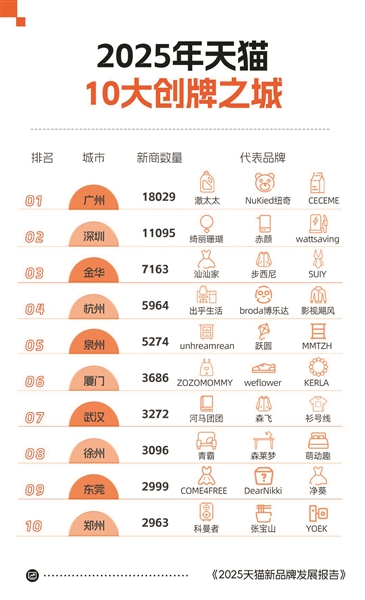
Core Insights - Guangzhou has become a hub for entrepreneurs, with one in five residents being a business owner and one in seven being an entrepreneur, showcasing its vibrant entrepreneurial ecosystem [4][5]. Group 1: Entrepreneurial Growth - In 2025, over 18,000 new businesses opened on Tmall in Guangzhou, doubling the number from 2023, indicating a significant increase in entrepreneurial activity [2][6]. - The total number of market entities in Guangzhou reached 4.15 million by the third quarter of 2025, a year-on-year increase of 14.89%, with 2.76 million being enterprises [5][6]. - Guangzhou has maintained its position as the leading city for entrepreneurial vitality for three consecutive years, reflecting a robust entrepreneurial environment [5][6]. Group 2: E-commerce and Market Dynamics - Guangzhou led the creation of new brands on Tmall in 2025, with 18,029 new merchants, highlighting its strong presence in the e-commerce sector [6][8]. - The city's entrepreneurial ecosystem is supported by a stable supply of new brands and a favorable industrial environment, which enhances its competitive edge in e-commerce [6][8]. Group 3: Supportive Policies and Ecosystem - Guangzhou has implemented a comprehensive entrepreneurial support system that integrates policy, funding, industry, and talent, creating a strong attraction for entrepreneurs [9][10]. - The city has introduced various entrepreneurial policy packages, including guaranteed loans and subsidies, to encourage business formation and growth [9][10]. Group 4: Innovation and Industry Trends - The entrepreneurial landscape in Guangzhou is shifting towards high-end manufacturing and cutting-edge technology, with significant growth in sectors like biomedicine, intelligent equipment, and software [14][15]. - New registrations in strategic industries such as low-altitude economy and artificial intelligence have seen remarkable growth rates, indicating a trend towards innovation [14][15]. Group 5: Success Stories and Impact - Notable companies that emerged from Guangzhou's entrepreneurial scene include Yunzhou Biotechnology and Wenyuan Zhixing, which have become leaders in their respective fields [11][12]. - The city has produced 13 unicorns and numerous high-tech enterprises through its annual innovation and entrepreneurship competitions, demonstrating its capacity to nurture successful startups [10][11].

AOSP源代码更新减缓,安卓正逐步走向封闭
3 6 Ke· 2026-01-12 12:11
Core Viewpoint - Google is shifting the Android ecosystem towards a more closed model, similar to iOS, by changing the AOSP code update frequency from quarterly to biannual, starting in 2026, which may limit third-party developers' influence on the platform [1][3]. Group 1: Changes in AOSP Update Frequency - Starting in 2026, AOSP source code updates will occur in the second and fourth quarters, rather than quarterly, to simplify development and enhance stability and security [3]. - This change is perceived by the developer community as a move to reduce the impact of third-party developers and limit the viability of third-party ROMs [3][5]. Group 2: Impact on Third-Party ROMs - The extended update cycle means that third-party ROMs will face delays in receiving bug fixes and updates, which could lead users to prefer Google's native Android or partner ROMs that receive timely updates [5][6]. - Historically, third-party ROMs like MIUI and LineageOS have thrived on AOSP, but the new update schedule may hinder their ability to provide timely fixes, as seen with past bugs that were quickly patched for third-party ROMs [3][5]. Group 3: Google's Strategy and Developer Relations - Since Android 6, Google has been reducing the scope of AOSP by moving many features to Google Play, making it harder for third-party ROMs to operate effectively [6][8]. - Google has transitioned to an internal development model, limiting access to AOSP branches for external developers, which means future updates will be less accessible until Google completes them [8][10]. - Although Google will still accept code contributions from external developers, the increased interval for checking code submissions from three months to six months is likely to discourage participation [10].


冯忠华孙志洋到天河区调研
Guang Zhou Ri Bao· 2026-01-11 02:00
Core Viewpoint - The leadership in Guangzhou emphasizes the need for accelerated economic development and high-quality growth as part of the "14th Five-Year Plan" implementation, focusing on innovation, urban development, and enhancing public services [2][4]. Group 1: Economic Development - The leadership stresses the importance of setting ambitious goals and actively pursuing project investments and business attraction to stimulate economic growth [4]. - There is a focus on enhancing the integration of technology and industry, particularly in emerging sectors like artificial intelligence, software, and robotics [4]. Group 2: Urban Development - The need for comprehensive urban planning and the improvement of service facilities in key areas is highlighted to support high-quality development [3]. - The city aims to optimize urban space and enhance the quality of urban functions through urban renewal and targeted area development [4]. Group 3: Public Services and Community Welfare - The leadership is committed to improving public services and ensuring the well-being of citizens by addressing safety concerns and enhancing community engagement [4][5]. - There is an emphasis on providing quality public services and ensuring social stability while promoting community development [4].
广州:加快建设先进制造业强市,到2035年工业增加值翻一番
Sou Hu Cai Jing· 2026-01-08 11:04
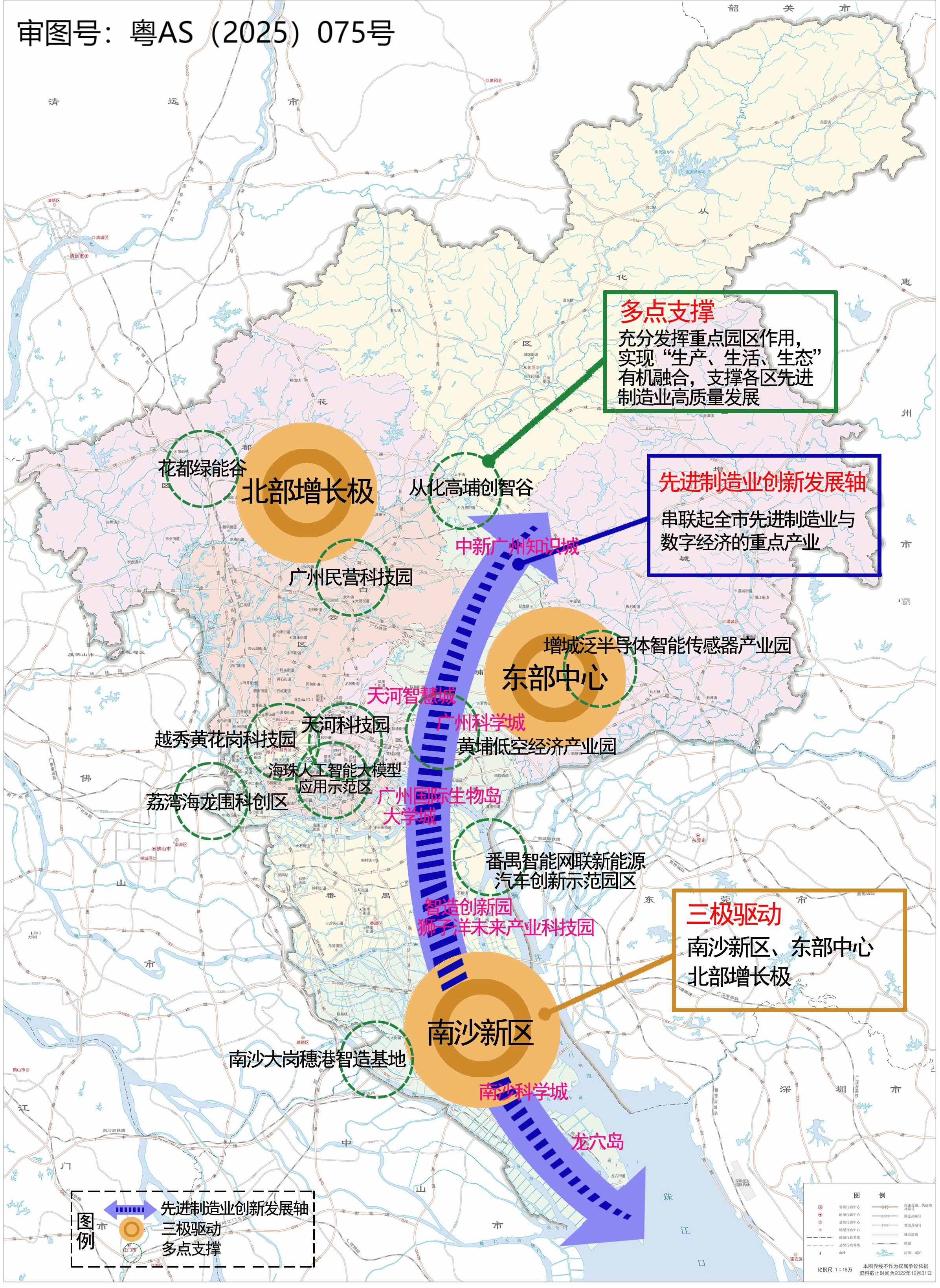
Core Viewpoint - Guangzhou aims to accelerate the construction of an advanced manufacturing city by 2035, targeting a doubling of industrial added value and focusing on the "12218" modern industrial system, integrating advanced manufacturing with modern services, and promoting digital and green transformations [2][14]. Group 1: Key Industrial Directions - The plan emphasizes the development of 15 strategic industrial clusters and six emerging pillar industries, including smart connected new energy vehicles, ultra-high-definition video and new displays, biomedicine and health, green petrochemicals and new materials, software and the internet, and intelligent equipment and robotics [2][38]. - Five strategic leading industries will be cultivated, including artificial intelligence, semiconductors and integrated circuits, new energy and new energy storage, low-altitude economy and aerospace, and biomanufacturing [3][38]. - Four characteristic advantageous industries will be strengthened, such as fashion consumer goods, rail transit, shipbuilding and marine engineering, and intelligent construction and industrialized buildings [4][38]. Group 2: Implementation Strategies - The plan outlines five major projects: industrial agglomeration, industrial innovation, intelligent manufacturing traction, integrated development, and supply chain optimization [14][34]. - Six action plans are proposed, including structural optimization, investment leap, talent attraction and cultivation, digital empowerment, spatial innovation, and element guarantee [14][34]. Group 3: Development Foundations - Guangzhou has a solid manufacturing base, being the most complete industrial city in South China, with significant advantages in technological innovation, green development, and international cooperation [19]. - The city ranks 8th globally in the "Nature Index - Research Cities" and has a robust innovation ecosystem, including numerous national and provincial manufacturing innovation centers [20][27]. Group 4: Opportunities and Challenges - The plan identifies major opportunities from national strategies, such as the manufacturing power strategy and the development of the Guangdong-Hong Kong-Macao Greater Bay Area, which enhances Guangzhou's role as a manufacturing hub [24][18]. - Challenges include the pressure from global economic downturns, the need for industrial upgrades, and competition from other metropolitan areas [28][29]. Group 5: Future Goals - By 2030, the advanced manufacturing city construction is expected to reach significant milestones, with a focus on optimizing industrial structure and enhancing quality and efficiency [36]. - By 2035, Guangzhou aims to solidify its status as an advanced manufacturing city, achieving breakthroughs in key technologies and maintaining a leading position in the global value chain [36][38].
专访爱尔兰投资局张哲伟:爱尔兰可扮演中企走出去的“安全港”
2 1 Shi Ji Jing Ji Bao Dao· 2026-01-06 11:40
Group 1: Core Insights - Ireland is the only English-speaking country in the EU using the Euro, facilitating Chinese companies' access to the entire EU market [1] - The visit of Irish Prime Minister Martin to China from January 4 to 8 is significant for the future development of China-Ireland and China-EU relations [3][4] - The bilateral trade volume between China and Ireland has quadrupled since the establishment of a mutually beneficial strategic partnership in 2012, with a projected trade volume of $23.42 billion in 2024 [2] Group 2: Trade and Investment Dynamics - China is Ireland's fourth-largest trading partner, and Ireland has maintained a trade surplus with China for several years [5] - In 2023, China's direct investment in Ireland reached $380 million, with a total investment stock of $2.04 billion by the end of the year [6] - The trade structure between China and Ireland is highly complementary, with China importing high-value, knowledge-intensive products from Ireland and exporting machinery and textiles [2][5] Group 3: Opportunities and Challenges - The cooperation prospects between China and the EU are vast, particularly in green transition and digital governance, despite existing trade frictions [3][6] - Ireland's stable investment environment and favorable tax policies, including a corporate tax rate of 12.5%, make it an attractive destination for foreign investment [8] - The shift in Chinese investment in Ireland has diversified from primarily financial services to include high-tech, internet, pharmaceuticals, and aerospace sectors [7]