短剧智能体

Search documents
马化腾:微信不搞AI全家桶,将继续坚持去中心化;千问回应AI电话订餐功能被质疑有真人操作;阶跃星辰完成超50亿元人民币B+轮融资丨邦早报
创业邦· 2026-01-27 00:30
Core Insights - Tencent's Chairman Ma Huateng expressed concerns about the security of Doubao phone, emphasizing the risks of using black market plugins for screen recording, which he deemed unsafe and irresponsible [3] - Doubao phone assistant responded by assuring users that it adheres to user authorization and compliance principles, ensuring data security through encryption and strict protection measures [4] - StepFun, a Shanghai-based AI startup, completed over 5 billion RMB in Series B+ financing, setting a record for the largest single financing in China's large model sector in the past 12 months [4] - Ma Huateng stated that Tencent will not pursue an "AI all-in-one" approach for WeChat, opting instead for a decentralized strategy that balances user needs and privacy [4] - Tencent's AI assistant "Yuanbao" is undergoing a new version beta test, introducing social features like "Yuanbao Club" for users to engage in shared activities [4] - Qwen3-Max-Thinking, Alibaba's flagship AI model, was launched, achieving performance comparable to top international models like GPT-5.2 and Gemini 3 Pro, with over a trillion parameters [11][12] Financing and Investment - StepFun's financing round included participation from various institutional investors, with plans to enhance foundational model development and accelerate AI+ terminal strategies [4] - CoreWeave received an additional $2 billion investment from NVIDIA to build AI computing power exceeding 50 billion watts by 2030 [10] - Su Yan Electronics completed a Pre-A+ round financing of several million yuan, led by Boyuan Capital [10] - Ji Tai Intelligent raised 75 million yuan in a new financing round, with a post-financing valuation of 775 million yuan [10] Industry Developments - The number of motor vehicles in China is projected to reach 469 million by 2025, with 355 million being cars, and the number of drivers expected to hit 559 million [13] - The total number of new energy vehicles in China is expected to reach 43.97 million by the end of 2025, accounting for 12.01% of all vehicles [13] - The global laptop shipment is forecasted to decrease by 14.8% in Q1 2026 due to rising prices of CPUs and memory [13]




周鸿祎剧透360将发布“短剧智能体” ,用户输入剧本即可生成漫剧大片
Xin Lang Cai Jing· 2026-01-26 09:28
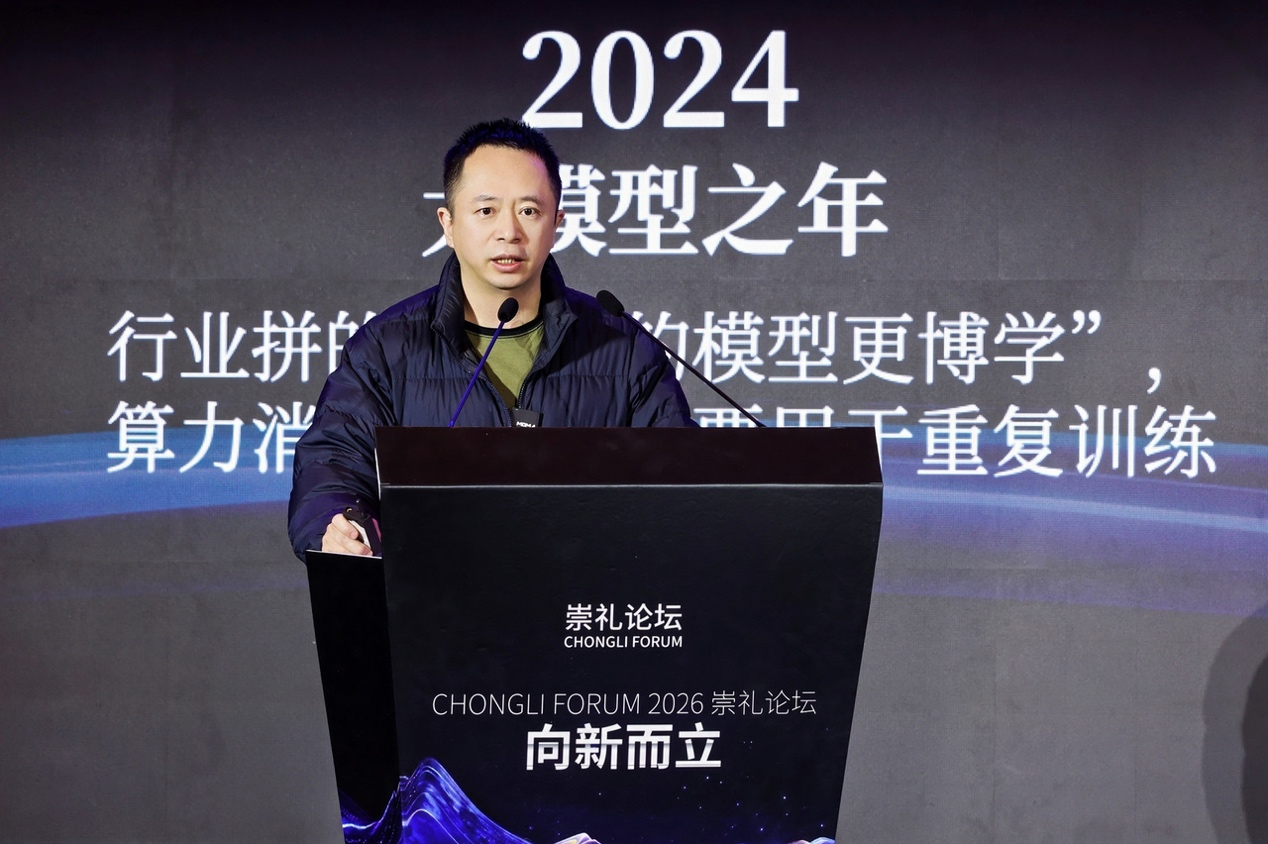
Core Insights - The core prediction is that by 2026, the world will enter the "hundred billion intelligent agent" era, with China positioned to seize this strategic opportunity [1][6] - The year 2024 is identified as the year of pursuing large models, while 2025 will be a transition and upgrade period [1][6] Group 1: Five Forces Model - The "Five Forces Model" is introduced, which includes "Electricity—Computing Power—Intelligence + Human Power—Productivity" [3][8] - General computing power must be transformed into specialized intelligence to avoid the illusion of "computing power surplus" [3][8] - The transformation relies on industry experts injecting unique "tacit knowledge" into models, enabling intelligent agents to address real-world pain points [3][8] Group 2: Computing Power Market - There is a common misconception in the industry that "training computing power" and "inference computing power" are the same; training power is the entry ticket for large companies, while the real demand will be for inference power [3][8] - The consumption of computing power is expected to grow exponentially, potentially increasing by 1 billion times over the next decade, driven by applications in complex tasks like short drama production and education [3][8] Group 3: Product Launch - 360 Group plans to launch a "short drama intelligent agent" aimed at significantly lowering the barriers to content creation, allowing ordinary users to generate large-scale content from simple inputs [4][9] - The product has been tested by the founder, demonstrating its capability to empower individual creators in the new media space [4][9] Group 4: Intelligent Agent Economy - The concept of the "intelligent agent economy" is emphasized, predicting a fundamental change in how humans interact with software and the internet [4][9] - The internet is expected to split into two: one serving humans for information consumption and entertainment, and another serving intelligent agents for high-frequency data exchange and task execution [4][9] Group 5: E-commerce and Service Industry Transformation - The traditional "human finds goods" model will shift to an intelligent agent proxy model, where agents will handle tasks like price comparison and payment automatically [5][10] - New trust and settlement systems will emerge, focusing on verifying agent identities and ensuring transaction security, which will leverage technologies like blockchain and smart contracts [5][10] Group 6: Strategic Opportunity for China - China possesses strong electrical infrastructure, a complete industrial system, and excellent open-source model ecosystems, positioning it well to capitalize on the hundred billion intelligent agent era [5][10] - Companies are encouraged to foster an "AI-native" culture to evolve individuals into "super individuals" while maintaining safety standards to mitigate risks associated with collective intelligence [5][10]

周鸿祎剧透三六零将发“短剧智能体” 输入剧本即可生成漫剧大片
Zheng Quan Shi Bao Wang· 2026-01-26 09:12
Core Insights - The founder of 360 Group, Zhou Hongyi, predicts that by 2026, the world will enter the "hundred billion intelligent agent" era, and China is well-positioned to seize this strategic opportunity [1][4] - 360 Group is set to launch a "short drama intelligent agent" that allows users to generate large-scale animated films from scripts, significantly lowering the barriers to content creation [1][2] Group 1: AI Evolution and Market Dynamics - Zhou Hongyi believes that 2024 will be a year focused on large models, while 2025 will be a transition period. Large models, primarily in the form of "chatbots," struggle to address complex business problems directly [1] - The "five-force model" proposed by Zhou includes "electricity—computing power—intelligence + human power—productivity," emphasizing that converting general computing power into specialized intelligence is crucial for practical applications [1] - The industry often confuses "training computing power" with "inference computing power," with the latter expected to see exponential growth in demand as intelligent agents are applied to complex tasks like short drama production and education [2] Group 2: Transformation of Internet and Business Models - The rise of intelligent agents will fundamentally change how humans interact with software and the internet, leading to a bifurcation into two types of internet: one for human use and another for intelligent agents [3] - Traditional e-commerce models will shift from "humans finding goods" to an agent-based model where intelligent agents handle the entire transaction process, resulting in increased transactions occurring between agents rather than between humans and screens [3] - New trust and settlement systems will emerge in the intelligent agent economy, necessitating advancements in identity verification, transaction security, and automated settlement, which will leverage technologies like blockchain and smart contracts [3] Group 3: China's Strategic Position - China possesses robust electrical infrastructure, a complete industrial system, and excellent open-source model ecosystems, positioning it to capitalize on the opportunities presented by the hundred billion intelligent agent era [4] - There is a call for companies to foster an "AI-native" culture, transforming individuals who embrace AI into "super individuals," while also emphasizing the importance of maintaining safety standards to mitigate risks associated with collective intelligence [4]
周鸿祎:2026年将迎“百亿智能体”时代,中国有能力把握战略机遇
Jin Rong Jie· 2026-01-26 06:03
Core Insights - The core viewpoint of the articles revolves around the evolution of artificial intelligence from "large models" to "intelligent agents," predicting that by 2026, the world will enter an era of "100 billion intelligent agents" with China positioned to seize this strategic opportunity [1][5]. Group 1: AI Evolution and Market Predictions - 2024 is identified as the year for pursuing large models, while 2025 will be a transition period. Large models, primarily functioning as "chatbots," struggle to address complex business problems directly. The upgrade to intelligent agents is essential for practical application [3]. - The "Five Forces Model" is introduced, emphasizing the transformation of general computing power into specialized intelligence through the integration of industry expertise and human oversight, which is crucial for solving real-world issues [3]. - The distinction between "training computing power" and "inference computing power" is highlighted, with the latter expected to drive significant demand growth. The consumption of computing power may increase by 1 billion times over the next decade, leading to a bifurcation in the chip market [3][4]. Group 2: Intelligent Agent Economy - The upcoming release of a "short drama intelligent agent" by 360 aims to democratize content creation, allowing users to generate extensive media content simply by inputting scripts or novels, thus enhancing individual productivity [4]. - The concept of the "intelligent agent economy" is discussed, predicting a fundamental change in how humans interact with software and the internet, leading to a division into two types of internet: one for human use and another for intelligent agents [4]. - The traditional "human finds goods" model in e-commerce is expected to shift to an intelligent agent proxy model, where agents will autonomously handle tasks such as price comparison and transactions, resulting in agent-to-agent interactions [4]. Group 3: Trust and Settlement Systems - New trust and settlement systems will emerge in the intelligent agent economy, focusing on verifying agent identities and ensuring transaction security, which will leverage technologies like blockchain and smart contracts [5]. - The construction of identity authentication, contract signing, and payment settlement systems based on intelligent agents is identified as a core direction for the infrastructure of the intelligent agent economy [5]. - China is noted to have a robust power infrastructure and a complete industrial system, positioning it well to capitalize on the strategic opportunities presented by the era of 100 billion intelligent agents [5].