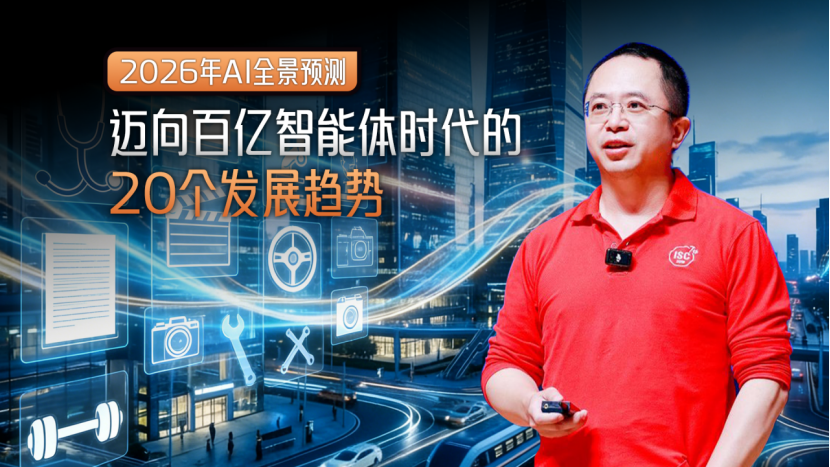
百亿智能体时代

Search documents
周鸿祎剧透三六零将发“短剧智能体” 输入剧本即可生成漫剧大片
Zheng Quan Shi Bao Wang· 2026-01-26 09:12
Core Insights - The founder of 360 Group, Zhou Hongyi, predicts that by 2026, the world will enter the "hundred billion intelligent agent" era, and China is well-positioned to seize this strategic opportunity [1][4] - 360 Group is set to launch a "short drama intelligent agent" that allows users to generate large-scale animated films from scripts, significantly lowering the barriers to content creation [1][2] Group 1: AI Evolution and Market Dynamics - Zhou Hongyi believes that 2024 will be a year focused on large models, while 2025 will be a transition period. Large models, primarily in the form of "chatbots," struggle to address complex business problems directly [1] - The "five-force model" proposed by Zhou includes "electricity—computing power—intelligence + human power—productivity," emphasizing that converting general computing power into specialized intelligence is crucial for practical applications [1] - The industry often confuses "training computing power" with "inference computing power," with the latter expected to see exponential growth in demand as intelligent agents are applied to complex tasks like short drama production and education [2] Group 2: Transformation of Internet and Business Models - The rise of intelligent agents will fundamentally change how humans interact with software and the internet, leading to a bifurcation into two types of internet: one for human use and another for intelligent agents [3] - Traditional e-commerce models will shift from "humans finding goods" to an agent-based model where intelligent agents handle the entire transaction process, resulting in increased transactions occurring between agents rather than between humans and screens [3] - New trust and settlement systems will emerge in the intelligent agent economy, necessitating advancements in identity verification, transaction security, and automated settlement, which will leverage technologies like blockchain and smart contracts [3] Group 3: China's Strategic Position - China possesses robust electrical infrastructure, a complete industrial system, and excellent open-source model ecosystems, positioning it to capitalize on the opportunities presented by the hundred billion intelligent agent era [4] - There is a call for companies to foster an "AI-native" culture, transforming individuals who embrace AI into "super individuals," while also emphasizing the importance of maintaining safety standards to mitigate risks associated with collective intelligence [4]

周鸿祎2026年20个AI预言:百亿智能体时代到来
Zheng Quan Shi Bao Wang· 2026-01-09 11:56
Group 1: Infrastructure Transformation - The AI industry is shifting from a focus on training large models to employing AI for practical problem-solving through inference applications, leading to a projected "hundredfold" increase in inference computing demand by 2026 [1] - The dominance of Nvidia in the AI chip market will be challenged, resulting in a dual-track industry structure where Nvidia leads training while multiple vendors compete in inference [1] - The core bottleneck for development will transition from computing chips to stable and sufficient power supply, escalating global tech competition into an "energy war," with China leveraging its "East Data West Computing" initiative and green power capabilities [1] Group 2: Model Intelligence Evolution - AI is expected to evolve from a "static tool" to a "continuously evolving system," with a new paradigm of "general foundation + industry specialization + real-time evolution" by 2026 [2] - Chinese open-source models, such as DeepSeek and Tongyi Qianwen, are emerging as core forces in the global AI ecosystem, creating a "siphoning effect" on global intellectual resources [2] - The shift towards open-source will democratize AI technology, enabling countries along the "Belt and Road" to build "sovereign models" as a digital infrastructure base [2] Group 3: Social Integration Deepening - By 2026, AI will possess mature long-term memory capabilities, evolving into a "second brain" that records and understands personal and work data [3] - "Silicon-based digital employees" will be integrated into the workforce, forming mixed teams with human employees, necessitating a shift in management roles from "commanders" to "business coaches" [3] Group 4: Economic and Security Transformation - The emergence of "hundred billion intelligent agents" will redefine economic interactions, with a focus on "automated economy between intelligent agents" replacing traditional apps as service entry points [5] - A new silicon-based regulatory framework will be required, including identity verification for intelligent agents, blockchain contracts, and "AI-native insurance" innovations [5] - AI safety will transition from an optional consideration to a critical priority, emphasizing the need for verifiable AI decision-making and a traceable system [5] Group 5: Opportunities for China - By 2026, AI is anticipated to penetrate every aspect of the economy and society, with China positioned to capitalize on this opportunity due to its robust industrial chain, solid computing and energy foundation, and active open-source ecosystem [6]

周鸿祎预言2026年将迈入“百亿智能体时代” AI竞争焦点从参数转向落地
Zhong Guo Jing Ying Bao· 2026-01-09 09:16
Core Insights - The year 2026 is predicted to be defined as the "Year of Hundred Billion Intelligent Agents," with a shift in AI competition focus from "parameter comparison" to "practical application" [1] - AI industry dynamics will fundamentally change, with a move towards "reasoning applications" that directly employ AI to solve real-world problems, leading to a significant increase in demand for computing power [1][2] - The chip market is expected to transition from a single-dominant player (NVIDIA) to a dual-track model, emphasizing both training and diverse reasoning capabilities [1] Infrastructure and Market Dynamics - The demand for reasoning tasks is projected to grow by "hundred-fold" in the short term, surpassing the scale and growth of training computing power [1] - The energy supply will become the core bottleneck, leading to an escalation in global technological competition characterized as an "energy war" [1] - China's early advantage is highlighted through the "East Data West Calculation" national project and its green power capabilities [2] Model Evolution and Open Source - The evolution of AI models is expected to transition from "static tools" to "continuously evolving systems," with a new paradigm of "general foundation + industry specialization + reasoning evolution" [2] - Chinese open-source models, such as DeepSeek and Tongyi Qianwen, are becoming central to the global AI ecosystem, creating a "siphoning effect" on global intellectual resources [2] - The shift towards open-source AI is democratizing technology, particularly benefiting countries involved in the "Belt and Road" initiative [2] Social Integration and Workforce Changes - By 2026, AI is anticipated to develop mature long-term memory capabilities, evolving into a personal "second brain" and becoming an extension of human consciousness [2] - The integration of "silicon-based digital employees" into the workforce will lead to a mixed team of carbon-based and silicon-based entities, resulting in a flatter organizational structure [2] - Companies that can effectively translate industry know-how into AI-learnable knowledge will establish a significant competitive moat [2] Economic and Security Implications - The integration of hundred billion intelligent agents into the economy will rewrite business rules and security boundaries, marking a third leap in human commerce towards an "automated economy among intelligent agents" [3] - AI will replace apps as the core service entry point, necessitating the establishment of silicon-based regulatory frameworks, including identity verification and blockchain contracts [3] - AI security will transition from an elective concern to a critical priority, requiring the development of fully traceable systems and maintaining human oversight in key decision points [3]
周鸿祎发布2026年20个AI预言:我们正迈向百亿智能体时代
Jin Rong Jie Zi Xun· 2026-01-09 06:34
Core Insights - The article presents a comprehensive forecast for the development of artificial intelligence (AI) in 2026, predicting a transition to a "hundred billion intelligent agents" era, where AI will be deeply integrated into the economy and society, shifting the focus from model parameters to practical applications [1] Group 1: Infrastructure Transformation - The AI industry will experience a fundamental shift from "training competition" to a "reasoning revolution," with a significant increase in demand for reasoning capabilities, expected to grow by "hundredfold" in the short term, surpassing training capabilities [3] - The dominance of Nvidia in the AI chip market will be challenged, leading to a dual-track industry structure where Nvidia leads training while multiple vendors share the reasoning market [3] - The core bottleneck for development will shift from computing power to stable and sufficient energy supply, with China leveraging its "East Data West Computing" initiative and green energy capabilities to gain a competitive edge [3] Group 2: Model Intelligence Evolution - AI is predicted to evolve from a "static tool" to a "continuously evolving system," with a new paradigm of "general foundation + industry specialization + reasoning evolution" replacing the traditional "pre-training + fine-tuning" model [4] - Chinese open-source models, such as DeepSeek and Tongyi Qianwen, are emerging as core components of the global AI ecosystem, creating a "siphoning effect" on global intellectual resources [4] - Edge AI is expected to see explosive growth, with devices capable of offline independent decision-making becoming the "last line of defense" for AI security [4] Group 3: Social Integration Deepening - AI will fundamentally reshape relationships between individuals and organizations, evolving into a "second brain" that records, understands, and utilizes personal data [5] - "Silicon-based digital employees" will be integrated into the workforce, requiring managers to transition from "commanders" to "business coaches," leading to flatter organizational structures [5] - Individuals who can define problems and direct intelligent agents will become central to the workforce, marking the onset of the "super individual" era [5] Group 4: Economic and Security Rule Reconstruction - The integration of hundred billion intelligent agents into the economy will rewrite commercial rules, leading to an "automated economy" where intelligent agents negotiate and transact directly [6] - A new silicon-based rule system will be necessary, including identity verification for intelligent agents and innovations like blockchain contracts and "AI-native insurance" [6] - AI security will become a critical concern, necessitating a full traceability system and maintaining human oversight in key decision-making processes [6] Group 5: Opportunities for China in the "Hundred Billion Intelligent Agents" Era - China is well-positioned to seize strategic opportunities in the "hundred billion intelligent agents" era due to its complete industrial chain, robust computing and energy foundation, and active open-source ecosystem [7] - The predictions provide a clear roadmap for technological evolution while highlighting the urgent need for proactive restructuring of industry logic, security paradigms, and governance systems [7]