
粮食储备服务

Search documents
低温“助攻”粮库保粮 4000吨粮食住进“天然冰箱”
Feng Huang Wang Cai Jing· 2026-01-26 05:49
Core Insights - The recent cold wave has allowed Ningbo Yinzhou Grain Storage Company to utilize natural cooling for grain preservation, achieving a stable temperature of 3°C in their storage facilities [1][2] - The company has implemented large-scale mechanical ventilation to prevent mold and pest issues in stored grain, which is crucial for maintaining quality and minimizing losses [1] - The use of intelligent and green technologies in grain storage is emphasized to ensure food safety, especially with the upcoming Spring Festival [2] Group 1 - The grain storage facility has successfully reduced the temperature of 4000 tons of grain by 4°C overnight through mechanical ventilation, which is more cost-effective than using air conditioning [1] - The current temperature of the grain is maintained at 5°C or below, meeting the "quasi-low temperature storage" standard [2] - The mechanical ventilation system helps achieve uniform temperature distribution within the grain piles, addressing common issues of uneven heating from drying processes [2] Group 2 - The company is focused on ensuring that stored grain is well-preserved, easily accessible, and safe for consumer use, particularly as the Spring Festival approaches [2] - The integration of smart technology in grain storage operations is part of a broader strategy to enhance food security [2]
2026年中储粮将持续发力 兜牢农民“种粮卖得出”底线
Xin Hua She· 2026-01-18 01:55
Core Viewpoint - The China Grain Reserves Group aims to enhance grain procurement and storage management in 2026, focusing on stabilizing the market and ensuring farmers can sell their crops effectively [1] Group 1: Grain Procurement and Management - In 2026, the company will strengthen the coordination of various types of grain reserves and procurement to stabilize the market and expectations while promoting development [1] - The company has achieved full coverage of technical defense and control for nearly 1,000 direct and branch warehouses, improving the effectiveness of information-based supervision [1] - The implementation of the minimum purchase price policy will be a key responsibility to ensure farmers can sell their grain [1] Group 2: Technological Advancements - The company has adopted advanced equipment, technologies, processes, and materials to control grain storage loss to within 1% [1] - There has been a significant improvement in green storage, technological storage, and intelligent storage levels [1] - The company plans to shift from traditional management to a focus on smart governance, leveraging big data, cloud computing, and artificial intelligence to enhance the entire lifecycle of grain reserve management [1]
“粮食安全看山东”之济南:推动改革创新,夯实安全根基
Zhong Guo Fa Zhan Wang· 2025-11-12 07:19
Core Insights - The Jinan Development and Reform Commission has made significant progress in improving local grain reserve management systems and enhancing storage capacity since the start of the 14th Five-Year Plan [1][2][3] Group 1: Management System Improvements - The local reserve management system has been continuously improved with the issuance of various regulations and guidelines to ensure compliance in storage management practices [1] - Specific management documents include the "Jinan Local Reserve Grain Management Measures" and "Implementation Details for Local Reserve Grain Business Management" [1] Group 2: State-Owned Enterprise Reforms - The reform of state-owned grain enterprises has been notably effective, with the establishment of Jinan Jiliang Group Co., Ltd. in November 2021, optimizing the organizational and assessment systems of local state-owned grain enterprises [2] - Further reforms are planned for 2025 in accordance with provincial guidelines to deepen the reform of state-owned grain enterprises [2] Group 3: Storage Capacity Enhancements - Significant improvements in grain storage capacity have been achieved, with the completion of three new storage projects adding a total of 50.3 million tons of standard storage capacity [2] - Upgrades to green storage facilities have also been made, enhancing low-temperature storage capabilities and adding advanced grain handling equipment [2] Group 4: Management Level Improvements - The comprehensive storage loss rate for local reserves has been maintained at an average of 0.7% since the 14th Five-Year Plan, exceeding provincial quality development assessment standards [3] - The city is committed to further enhancing grain safety supervision and ensuring food security responsibilities are met [3]
“粮食安全看山东”之广饶:科技赋能筑牢粮食安全屏障
Zhong Guo Fa Zhan Wang· 2025-10-28 03:34
Core Insights - The company has focused on enhancing grain storage efficiency, ensuring smooth circulation, and maintaining storage safety through reforms, technological empowerment, and institutional foundations [1][2][3] Mechanism Reform - The company has restructured its functions by separating policy and operational roles, aligning with higher-level requirements, and establishing clear boundaries for policy-based and operational grain management [1] - The company is now under the county economic development group, which oversees its investment responsibilities while receiving regulatory guidance from the county's development and reform bureau [1] Technological Innovation - Over 2 million yuan has been invested in an information management system that integrates the entire grain storage process, significantly improving efficiency [1] - The unloading process has seen efficiency improvements of over 200% compared to traditional methods due to the installation of hydraulic unloading platforms with automatic cleaning screens [1] - A video analysis system has been connected to the provincial grain dynamic monitoring platform, enhancing transparency in inventory, quality, and flow [1] Green Storage Upgrade - The company has utilized support policies to enhance storage quality by equipping warehouses with advanced ventilation and temperature control systems [2] - Smart grain storage systems have been implemented in warehouses to precisely regulate internal temperature and humidity [2] - Structural improvements have been made to some steel-roofed warehouses to enhance cooling and insulation [2] Emergency Assurance - The company has established a comprehensive emergency response mechanism, detailing grain distribution processes and responsibilities during emergencies [2] - Regular safety training and emergency drills are conducted to ensure preparedness [2] - During the pandemic, the company managed wheat supply to stabilize prices and support local flour processing enterprises [2] Institutional Construction - The company has implemented a unified management approach for storage, operations, finance, and safety production, following a structured four-step work method [2] - A safety production management manual has been developed, outlining responsibilities, emergency plans, and operational procedures [2] Future Outlook - The company plans to continue enhancing grain security policies in Shandong and aims to construct a new 10,000-ton warehouse by 2026 to strengthen local grain security [3]
粮食安全看山东”之莘县:巩固粮食安全“压舱石
Zhong Guo Fa Zhan Wang· 2025-09-25 09:32
Core Insights - Food security is a crucial foundation for national security, and grain storage facilities play a vital role in ensuring food safety [1][2][3] Group 1: Grain Storage Management - The Shandong Xincheng National Grain Reserve has implemented a standardized management system covering all aspects of grain storage, including entry and exit, storage management, safety protection, and personnel assessment [1] - The storage capacity of the reserve has increased from 15,000 tons to 60,000 tons through upgrades and the replacement of old facilities, significantly improving grain quality retention rates [1] - Investment in smart storage technologies has been made, including a seamless data connection with the provincial grain supervision cloud platform [1] Group 2: County-Level Grain Reserves - County-level grain reserves are essential for regional emergency supply, with a total reserve of 10,000 tons achieved by increasing reserves by 5,000 tons in 2018 [2] - A dynamic rotation mechanism for stored grain has been established to ensure freshness and quality, enhancing resilience against market fluctuations and natural disasters [2] Group 3: Quality Control and Agricultural Support - A specialized team conducts regular quality inspections of stored grain, maintaining loss rates below 1%, significantly lower than the industry average [3] - The reserve provides post-harvest services to farmers, helping them reduce losses by approximately 15% through quality testing and storage guidance [3] - Future efforts will focus on stringent food safety measures and enhancing the reserve's contributions to national food security [3]
武汉江北粮库下月竣工投运
Chang Jiang Ri Bao· 2025-06-26 00:23
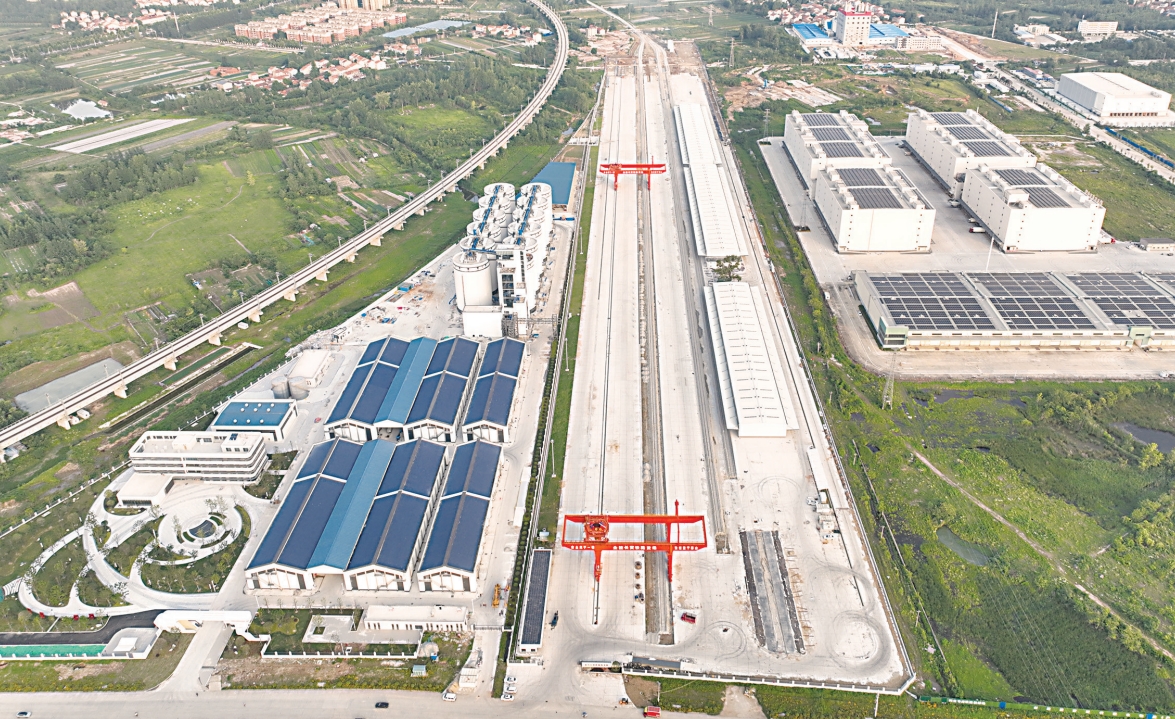
Core Points - The National Grain Modern Logistics (Wuhan) Base is set to become a major grain logistics hub in Central China, with a total investment exceeding 6 billion yuan and covering an area of approximately 2000 acres [3][4] - The base will feature a total grain storage capacity of 400,000 tons upon completion, making it the largest distribution center for northern grain transportation and imported grain transshipment in the Central China region [4] Group 1 - The Wuhan government reserve grain warehouse project (Jiangbei) is expected to be operational next month, with a total storage capacity of 150,000 tons [1] - The logistics base includes a dedicated railway line of approximately 5.4 kilometers that connects to the Jingjiu and Jingguang railways, facilitating a comprehensive grain logistics network [3] - The base has already completed the construction of a 200,000-ton cold storage facility and a provincial grain emergency reserve center, which are now operational [3][4] Group 2 - The logistics base is part of the national "14th Five-Year Plan" for grain development, with plans to expand the area to 10.75 square kilometers [3] - The combined storage capacity of the grain logistics park and the second phase of the Jin控长贸 International Cold Chain Logistics Park will be able to supply the city of Wuhan for 50 days based on average consumption rates [4]

深粮控股: 深圳市深粮控股股份有限公司第十一届董事会第十五次会议决议公告
Zheng Quan Zhi Xing· 2025-05-20 13:33
Meeting Details - The 15th meeting of the 11th Board of Directors of Shenzhen Shengliang Holdings Co., Ltd. was held on May 20, 2025, at 2:40 PM in Shenzhen, with both in-person and remote attendance [1]. - The meeting was chaired by Chairman Wang Zhikai and complied with the relevant provisions of the Company Law and Articles of Association [1]. Resolutions Passed - The Board approved the proposal to sign a lease agreement for the Shenshan Grain Reserve Warehouse (Phase I) with the Shenzhen Development and Reform Commission. The lease is for a period of 5 years [1]. - The average annual rent for the Shenshan Grain Reserve Warehouse (Phase I) is estimated to be approximately 101 million yuan, with a total rent not exceeding 505 million yuan over the five-year period [1]. Voting Results - The resolution regarding the lease agreement received 8 votes in favor, with no votes against or abstentions [1].
