精灵宝可梦

Search documents
日经BP精选——“推活”大研究:日本人气最高的娱乐品牌是?
日经中文网· 2026-03-31 02:50
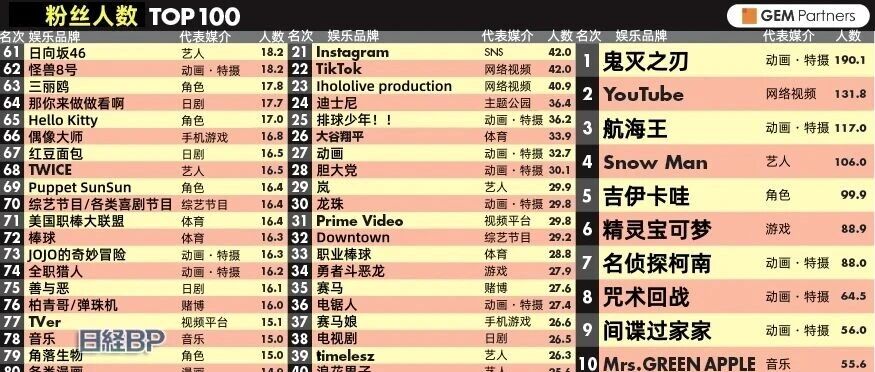
Core Viewpoint - The article highlights the popularity of various entertainment brands in Japan, with "Demon Slayer" emerging as the top brand due to a significant increase in fan numbers following the release of its latest film [5]. Group 1: Entertainment Brand Rankings - "Demon Slayer" has seen its fan base double compared to the previous year, reaching a record high due to the success of the film "Demon Slayer: Infinity Castle Chapter - Akaza Returns" [5]. - The rankings are based on data from GEM Partners, which calculated the average fan numbers over the last six months (August 2025 to January 2026) [5]. - Other notable brands in the top rankings include "Snow Man" in the artist category, "Gigi Kawaii" in the cartoon character category, and "Pokémon" in the mobile game category, all maintaining their top positions from the previous year [6].

2025最赚钱IP排行榜出炉,没有哪吒?也没有LABUBU?
3 6 Ke· 2026-02-03 02:37
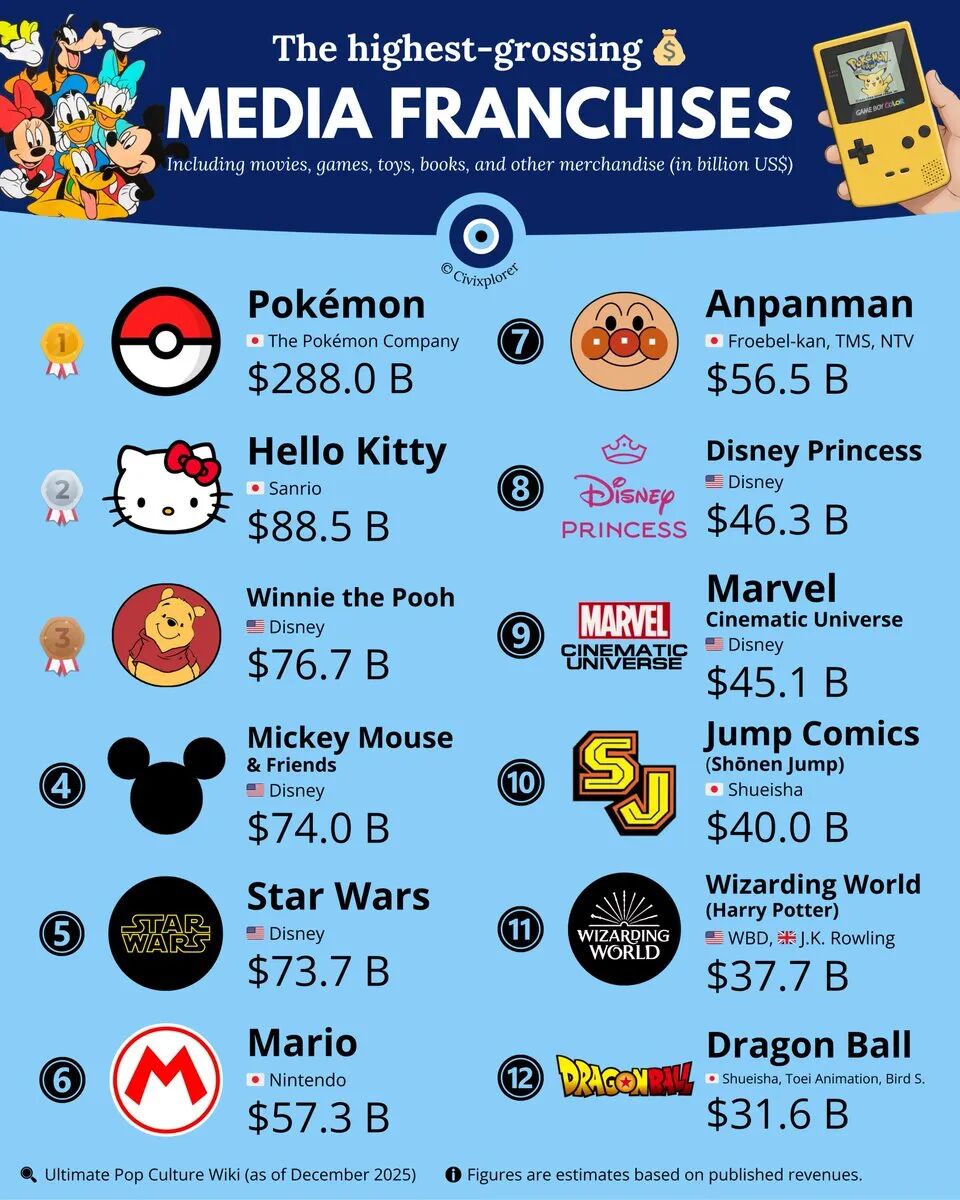
Group 1 - The article discusses the "Global Most Profitable Media Franchise Ranking" released by Civixplorer, highlighting that "Pokémon" leads with total revenue of $288 billion, significantly surpassing "Hello Kitty" by nearly $200 billion [1][19] - The ranking includes other franchises such as "Winnie the Pooh," "Mickey Mouse," "Star Wars," "Mario," "Bread Superhero," "Disney Princess Series," "Marvel," and "JUMP Comics" in the top ten [1] - Notably, no Chinese IPs made it to the list, with popular franchises like "Nezha," "Genshin Impact," and "LABUBU" failing to compete against top global IPs [1][20] Group 2 - Civixplorer is not a recognized data analysis company but rather a self-media platform with low credibility, lacking official certification and authority [4][6] - The data source for the ranking is identified as "Ultimate Pop Culture Wiki," which is a fan-edited platform, raising concerns about the reliability and professionalism of the data [7][10] - Significant discrepancies exist between Civixplorer's figures and those from more authoritative sources like Wikipedia, indicating potential inaccuracies in the reported revenues [10][19] Group 3 - The article mentions that while Chinese IPs like "Nezha" and "Genshin Impact" are gaining popularity, they still lag behind international IPs in terms of revenue and cultural impact [20][29] - The revenue estimates for Chinese IPs are provided, with "Nezha" at $175 million, "Genshin Impact" at $100 million, and "LABUBU" at $27 million, indicating their struggle to match the top global franchises [20][27] - The article emphasizes the need for a more nuanced understanding of the Chinese IP landscape, acknowledging both its growth and the challenges it faces in achieving global recognition [29]




2025年最赚钱IP:没有哪吒,没有原神,也没有Labubu
3 6 Ke· 2026-01-12 09:13
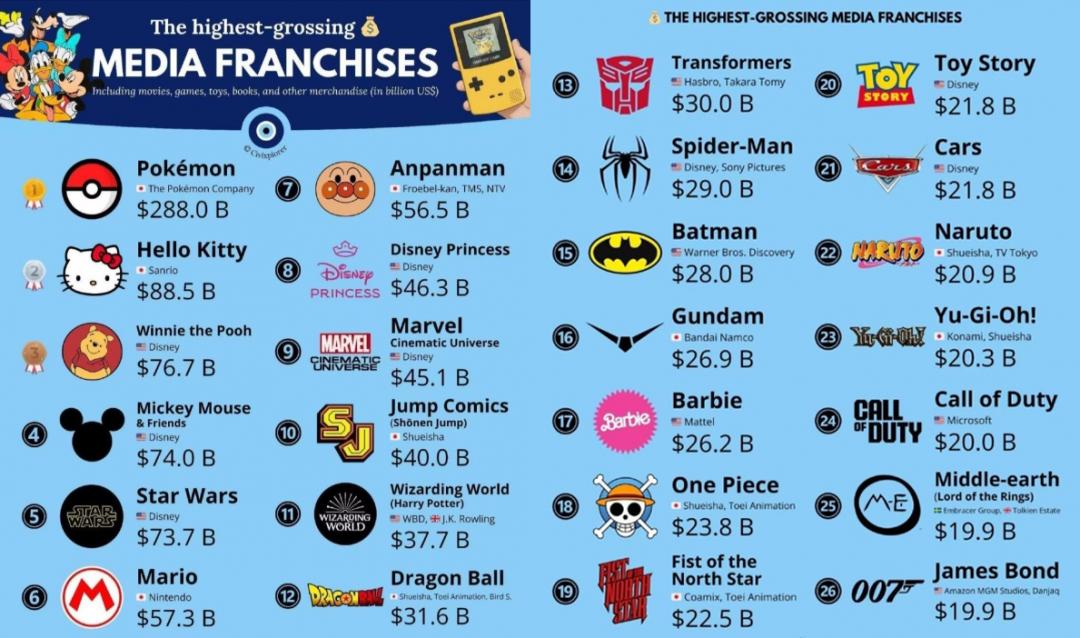
Core Insights - The ranking of the "most profitable media franchises" reveals that Pokémon leads with a total revenue of $288 billion, significantly surpassing Hello Kitty, which stands at $88.5 billion [1][3][5] - The data covers various revenue streams including games, movies, television, toys, trading cards, books, and merchandise, and is based on statistics up to December 2025 [1][3] Group 1: Top IP Rankings - Pokémon ranks first with $288 billion in total revenue, showcasing its dominance in the global market through various revenue streams [1][3] - Hello Kitty, in second place, has evolved from a cartoon character into a cultural symbol, generating $88.5 billion through a light-asset model that focuses on licensing [5] - Winnie the Pooh ranks third with $76.7 billion, slightly ahead of Mickey Mouse at $74 billion, indicating strong performance in the parent-child consumer market [7] Group 2: Other Notable IPs - The ranking includes other franchises like Star Wars and Mario, which are positioned reasonably, while the presence of classic IPs like Fist of the North Star at 19th place is surprising due to its sustained revenue from the Japanese market [7] - The James Bond franchise ranks last with $19.9 billion, with significant income derived from product placements in films [8] Group 3: Chinese IP Landscape - The absence of Chinese IPs in the ranking raises questions about their global market presence, with examples like Nezha and Genshin Impact being discussed for their potential future performance [11][13] - Nezha's box office revenue reached approximately $154.46 million domestically, with projections suggesting potential derivative sales could exceed $1 billion [13][15] - Genshin Impact's revenue is estimated at $5 billion, but its single revenue stream limits its competitiveness against top IPs [15] Group 4: Emerging Trends in Chinese IP - Labubu, under Pop Mart, generated $48.1 billion in revenue in the first half of 2025, indicating its status as a popular IP, though it still lags behind top global franchises [19] - The evolution of Chinese IPs reflects a shift towards emotional consumption and a growing market presence, as seen in the success of Nezha [20] - Future challenges for Chinese IPs include innovation, global operational experience, and addressing issues like piracy and cross-media storytelling [20]
韩国总统给游戏正名背后
3 6 Ke· 2025-10-28 05:20
Core Viewpoint - The South Korean government, under President Lee Jae-myung, has shifted its stance on the gaming industry, recognizing it as a vital cultural sector rather than a substance of addiction [1][8][36]. Group 1: Government's New Policies - President Lee Jae-myung has publicly redefined gaming, stating it should not be classified alongside addictive substances like drugs and alcohol, which has previously stifled the industry [8][9]. - The government has abolished the controversial Game Rating and Administration Committee's pre-approval system, which had complicated the game approval process [9][10]. - Financial support has been allocated for the development of AI games and to assist small and medium-sized gaming companies in expanding overseas [10][11]. - The government has proposed to delay the classification of "gaming disorder" as a disease, aiming to reduce the stigma associated with gaming [11][12]. Group 2: Historical Context and Industry Challenges - For over 20 years, the South Korean gaming industry faced strict regulations, including the "Cinderella Law" and the classification of games as addictive substances [17][18]. - Despite these challenges, the gaming sector remained a significant source of foreign exchange, but recent years have seen a decline in growth and profitability [18][20]. - In 2023, the gaming industry experienced its first decline in 14 years, with over 40% of gaming companies reporting no profits and an annual operating profit decrease of nearly 60% [18][20]. Group 3: Global Trends and Competitiveness - Other countries, such as Saudi Arabia and India, are increasingly recognizing the strategic importance of the gaming industry, integrating it into national development plans [22][23]. - The European Union has also begun to support its gaming industry through legislation aimed at fostering growth [25]. - South Korea's shift in policy is seen as a necessary response to the competitive landscape, where it risks losing its status as a leading gaming nation if it continues to view gaming negatively [28][29]. Group 4: Broader Implications of Gaming - The global gaming industry is valued at approximately $170 billion, surpassing the combined revenues of the music and film industries [39]. - Gaming is not merely an entertainment sector; it plays a crucial role in cultural output and national soft power [42]. - The technological advancements in gaming have significant spillover effects, influencing various fields such as AI, graphics, and communications [46][50].