
精灵G1机器人

Search documents
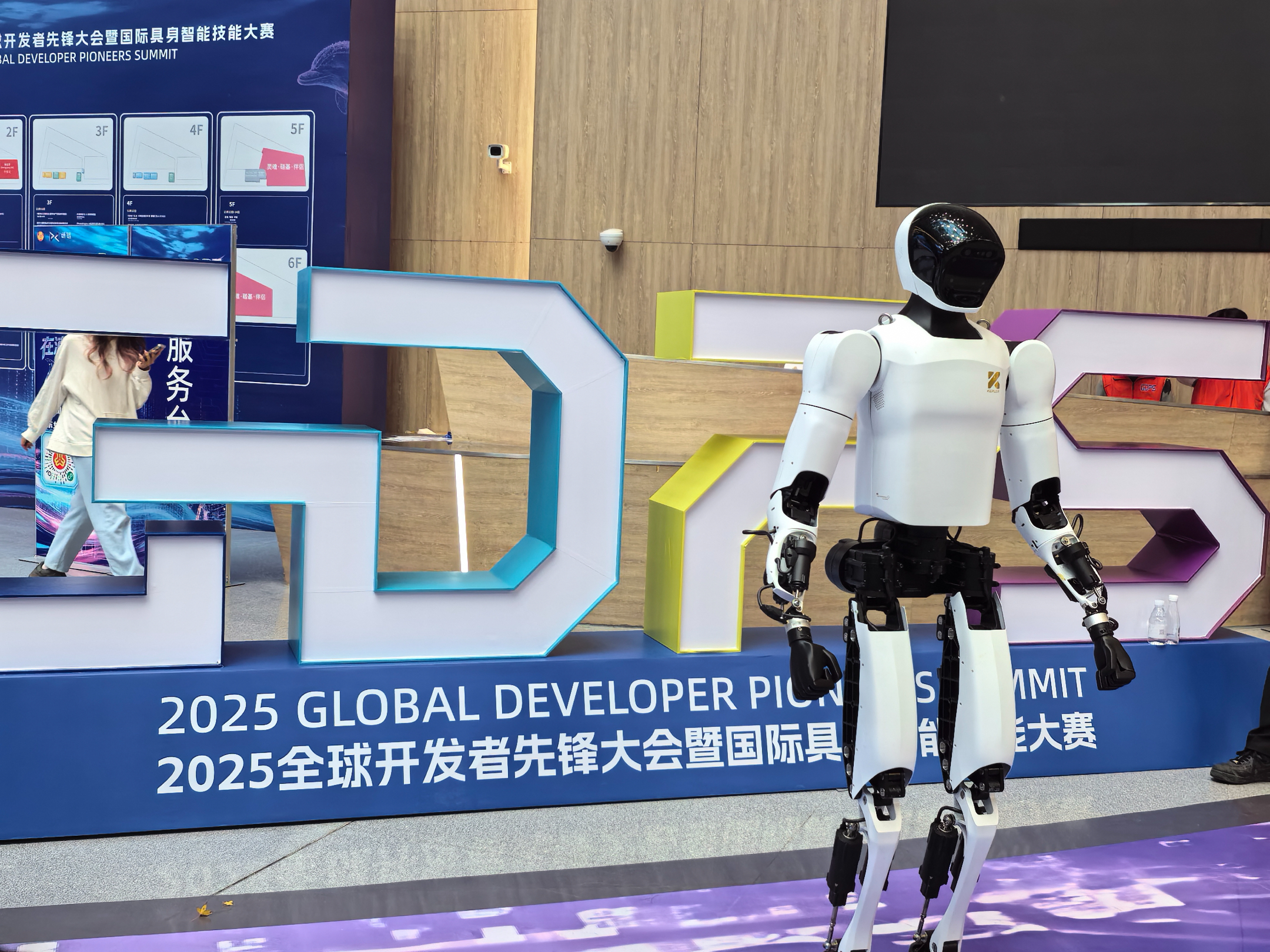
探营GDPS 2025:一场机器人的“狂欢派对”
Guo Ji Jin Rong Bao· 2025-12-14 02:50
Group 1 - The Global Developer Pioneer Conference and International Embodied Intelligence Skills Competition (GDPS 2025) is taking place in Shanghai, showcasing various robotic skills in a competitive environment [2][9] - The event is referred to as the "Robot Olympics," highlighting the intersection of advanced technology and real-life applications [2] - The competition features six main skill categories: industrial manufacturing, social services, home services, emergency rescue, medical care, and dexterous manipulation [9] Group 2 - In the emergency rescue competition, robots must navigate a 10m x 30m course, completing high-difficulty tasks that simulate real-life disaster scenarios, such as transporting heavy loads and navigating complex terrains [14] - The dexterous manipulation category includes a flower arrangement challenge, where robots must identify and arrange various types of flowers, testing their precision and adaptability [16][20] - The event also features humanoid robots, such as Fourier's N1, which showcases advanced movement capabilities and cultural performances, enhancing the overall experience [22][23] Group 3 - GDPS 2025 emphasizes the practical applications of embodied intelligence in various fields, assessing robots' operational precision, stability, and endurance in complex environments [23] - The event is supported by Zhiyuan Robotics, which provides operational robots for various competitions and promotes open-source projects to encourage broader participation in the embodied intelligence ecosystem [23]


深度|GDPS 2025,上海为顶尖开发者打造的“超级模拟器”
Z Potentials· 2025-12-13 11:09
Core Viewpoint - The GDPS 2025 event in Shanghai serves as a "rite of passage" for young developers, transitioning them from coding in controlled environments to solving real-world challenges, thus defining their future as top engineers [1][3]. Group 1: The Competition as a Testing Ground - The competition challenges participants to move beyond "Demo thinking" and embrace the complexities of the real world, with tasks that require high precision and adaptability [4][6]. - GDPS serves as a "pressure testing chamber," pushing participants to consider edge cases and hardware discrepancies that are often overlooked in academic settings [9]. - This experience marks a critical transition from "student thinking" to "engineering thinking," where debugging becomes a starting point for real-world applications [10]. Group 2: Ecosystem as Infrastructure - Shanghai provides a robust support system for young developers, addressing the common barriers of expensive hardware and complex testing environments [14]. - The event showcases leading Chinese companies, symbolizing Shanghai's commitment to building an open platform for global developers to innovate [15]. - Participants have access to advanced resources, such as the AimRT middleware and Lingqu OS system, enabling them to focus on core algorithm innovations [15][16]. Group 3: Networking as a Coordinate System - GDPS acts as a global connector, bringing together top young talents from around the world, fostering collaboration and innovation [19][20]. - The event opens direct communication channels with leading tech companies and labs, allowing outstanding performances to translate into job offers without traditional HR barriers [21]. - Shanghai's commitment to technology creates a strong sense of belonging among developers, providing a unified platform for collaboration [22][23]. Conclusion: Strategic Investment in Future Talent - GDPS 2025 represents more than just a competition; it is a carefully designed accelerator for the next generation of tech leaders, reflecting Shanghai's strategic investment in future talent [24]. - The event offers a pathway from coding to product development, enabling participants to thrive in a vibrant global tech network [25][26].

“人工智能+”,未来如何“加”出实效
Xin Hua She· 2025-07-30 05:44
Core Insights - The article discusses the rapid advancement and integration of artificial intelligence (AI) across various industries, highlighting the emergence of the "AI+" concept as a transformative force in sectors such as education, finance, and healthcare [1][2][4]. Group 1: AI Applications and Innovations - The 2025 World Artificial Intelligence Conference showcased over 3,000 cutting-edge exhibits, including more than 40 large models and 100 new products, indicating a significant application explosion driven by AI [1][2]. - Various AI applications were highlighted, such as AI glasses for visually impaired individuals and health applications developed by Ant Group, which offer over 100 AI functionalities [3]. - The robotics sector was a major highlight, featuring robots designed for specific tasks, such as sorting packages and engaging in interactive games with attendees [2]. Group 2: Industry Perspectives and Challenges - Industry leaders express a strong motivation to engage in AI transformation, driven by both excitement over technological advancements and anxiety about potential obsolescence [4][5]. - There is a noted dichotomy in attitudes towards AI projects, with some companies eager to implement AI quickly, while others experience stagnation due to limited application effectiveness [5]. - A call for a deeper understanding and a comprehensive transformation journey in AI adoption is emphasized, advocating for a balanced approach to expectations and reality [5]. Group 3: Future Directions and Governance - The concept of "Agent" in AI is emerging as a key focus, with companies exploring partnerships to expand AI applications in various consumer-facing scenarios [6]. - The cost of AI usage is expected to decrease, making it more accessible, as research and optimization efforts continue to evolve [6]. - Governance and safety in AI are critical, with industry leaders recognizing the importance of establishing guidelines to ensure responsible innovation and mitigate risks such as data bias and privacy concerns [7][8]. Group 4: Global Cooperation and Safety Measures - The article highlights the need for international collaboration to prevent AI from becoming uncontrollable, with suggestions for countries to work together on safety measures [8]. - China is positioned as a leader in AI governance, launching initiatives to promote safe and sustainable AI development globally [8]. - The integration of governance into AI development is seen as essential for ensuring that AI technologies can be safely incorporated into everyday life [7][8].