
纸和纸板

Search documents
【行业】中国造纸院牵头的多项国际标准取得新进展
Sou Hu Cai Jing· 2026-02-27 07:44
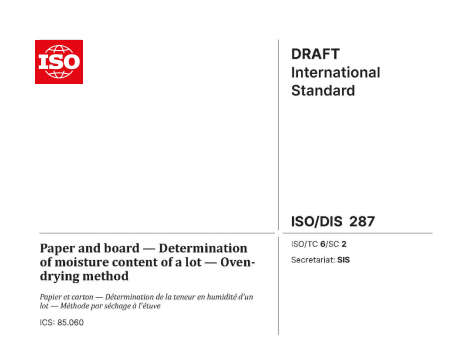
Group 1 - The China National Pulp and Paper Research Institute has made significant progress in international standardization in the paper industry, with ISO 287 successfully entering the Draft International Standard (DIS) stage [1] - The institute engaged in multiple technical exchanges and coordination with experts from Germany, France, and the United States, enhancing the accuracy and universality of moisture measurement for low-grammage paper [3] - Additionally, three other international standard projects led by the institute have entered the Committee Draft (CD) stage, showcasing its comprehensive strength and leadership in international standardization [5] Group 2 - The institute aims to continue its leading role by collaborating with domestic and international peers in the paper industry to promote the high-quality completion of these international standards [5] - The focus is on using standard innovation to drive technological advancement and promote the sustainable development of the global paper industry [5]

向“一棵树”要七十二般变化,山东加速造纸产业点“木”成金、跨界融合
Da Zhong Ri Bao· 2025-09-22 03:21
Core Viewpoint - The Shandong province is transforming its traditional paper industry into a high-end paper and biomass refining industry, focusing on diversification and green transformation through technological innovation and market segmentation [1][4]. Group 1: Industry Transformation - The Shandong province produces 1/6 of China's paper and paperboard, with a goal to enhance the industry by developing biomass refining and diversifying product offerings [1]. - The "Guidelines" issued by provincial authorities aim to accelerate the transformation of the paper industry into a leading domestic and globally competitive sector [1]. Group 2: Technological Innovation - The guidelines emphasize the importance of technological innovation across the entire paper industry chain, including pulping, biomass refining, and paper production [2]. - Key technological advancements include low-energy pulping, high-concentration pulping, and dry paper-making techniques [2]. - The province plans to enhance smart factory construction and implement real-time data collection and quality control in the production process [2][3]. Group 3: Market Segmentation - By 2024, China's per capita paper consumption is projected to reach 96.8 kg, indicating significant growth potential compared to developed countries [4]. - The guidelines encourage the development of specialized paper products, such as low-grammage high-strength packaging paper and medical-grade paper [4]. - There is a focus on non-paper products, including water treatment membranes and drug delivery systems, to meet the demands of various industries [4]. Group 4: Green and Sustainable Practices - Shandong's large paper companies are investing in green technologies to reduce pollution and improve water usage efficiency [7]. - The guidelines promote the development of advanced technologies in water conservation, environmental protection, and resource recycling [7]. - The province will support research and development in biomass refining and eco-friendly materials through financial incentives and collaboration with academic institutions [8].
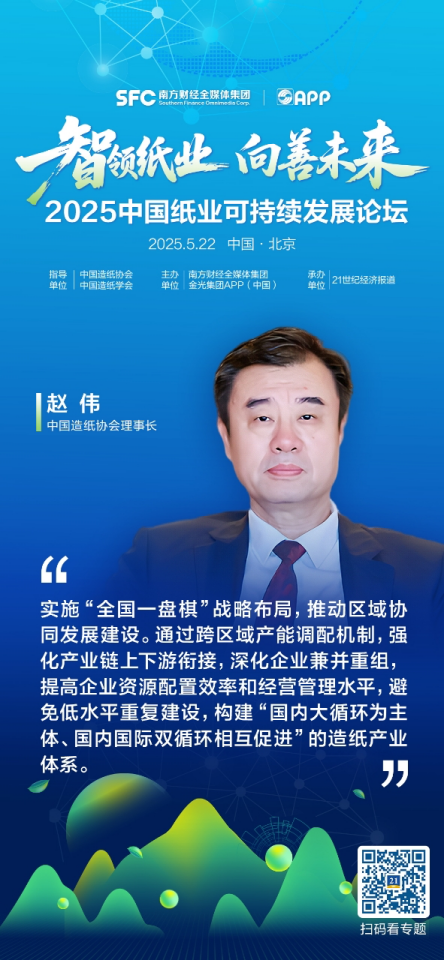
中国造纸协会理事长赵伟:从“以量取胜”到“因绿而生”,中国造纸业正在经历什么?
2 1 Shi Ji Jing Ji Bao Dao· 2025-05-28 02:01
Core Viewpoint - The Chinese paper industry is undergoing a significant transformation towards quality improvement and green manufacturing, driven by technological innovation and sustainable practices [4][5]. Group 1: Industry Characteristics - Characteristic 1: The paper industry serves as a dual pillar for cultural heritage and economic development, with 80,400 enterprises projected in 2024 and a main business revenue of approximately 1.5 trillion yuan, reflecting a narrowing gap in per capita paper consumption compared to developed countries [6]. - Characteristic 2: Intelligent manufacturing enhances industry competitiveness, with China's paper and board production maintaining a global share of 29% in 2024, and the top 30 enterprises accounting for nearly 70% of domestic output [6]. - Characteristic 3: Green consumption drives product structure upgrades, with significant growth in packaging paper and high-end consumer paper products, alongside increasing production of specialty paper and board [7]. - Characteristic 4: The industry adopts a circular economy model, with nearly 70 million tons of waste paper recycled and a reduction in water consumption to less than one-fourth of previous levels, setting international benchmarks [7]. Group 2: Sustainable Development Dimensions - Dimension 1: The industry needs to deepen the integration of forestry and paper production, enhance raw material supply, and expand the value chain through advanced technologies [10]. - Dimension 2: There is a push to improve biomass energy applications, aiming for breakthroughs in energy use and technology to support carbon neutrality and promote green consumption [10]. - Dimension 3: A "national unified strategy" is recommended to enhance regional collaboration, optimize resource allocation, and avoid redundant construction, fostering a dual circulation system in the paper industry [10]. - Dimension 4: Accelerating digital transformation is essential, leveraging new technologies to integrate with related industries and create a new industrial ecosystem driven by digitalization [11].
中国造纸学会理事长曹春昱:中国造纸消费市场需求至少还有30年以上的持续增长空间
2 1 Shi Ji Jing Ji Bao Dao· 2025-05-27 16:04
Core Viewpoint - The paper industry is not a sunset industry but rather a vibrant sector with significant potential and growth opportunities [1] Industry Development Outlook - The development of the paper industry is influenced by market demand, with key factors including economic development, population size, industrial structure, consumption patterns, policies, and resources [1] - The paper consumption trajectory in developed countries shows a continuous growth cycle of 30-40 years, indicating that China has substantial room for growth in per capita paper consumption [2] - With a projected annual compound growth rate of 3%, it will take at least 30 more years for China's paper consumption to reach the level of 200 kg per capita [3] National Policy and Support - Current national strategies provide both support and constraints for the paper industry, focusing on resource utilization, carbon reduction, quality improvement, advanced manufacturing, and digitalization [3] - Key areas receiving strong policy support include critical equipment, bamboo utilization, and high-performance paper-based materials, which are expected to become hotspots for future industry development [3] Future Development Directions - The future high-quality development of the paper industry is summarized into four main areas: 1. **Industry Safety**: Ensuring controllable supply of raw materials and exploring the reuse of processing residues and agricultural waste [4] 2. **Industry Structure**: Increasing industry concentration and exploring differentiated development paths in response to consumer upgrades [4] 3. **Industry Innovation**: Emphasizing independent innovation and collaboration to address current industry shortcomings [5] 4. **Industry Technology**: Focusing on green, low-carbon, and digital transformation as essential components for sustainable development and long-term competitiveness [5]