
网约公交车

Search documents
公交“突围”
Xin Lang Cai Jing· 2026-01-14 21:47
Core Viewpoint - The public transportation industry in Tianjin is undergoing significant changes, with a notable decline in bus ridership due to the rise of alternative transportation options such as subways, ride-hailing services, and personal vehicles. The industry must adapt to these changes to remain relevant and effective in meeting the needs of the public [4][6][7]. Group 1: Historical Context and Changes - In 2015, over 300 million bus rides were taken daily in Tianjin, but this number is projected to drop to 100-110 million by 2025, with over 50% of passengers being elderly [4]. - The transition from older vehicles to new energy models, such as hybrid and electric buses, has transformed the bus experience, making it quieter and more comfortable, but has also led to a decrease in passenger interaction [5][6]. - The bus passenger volume has decreased from over 1.1 billion rides annually a decade ago to less than 400 million today, highlighting a significant shift in public transportation dynamics [6][8]. Group 2: Challenges and Market Dynamics - The share of public buses in urban public transport has fallen from 54.1% in 2019 to 36.2% in 2024, indicating a substantial decline in bus usage [6]. - The emergence of diverse transportation options has led to a reduction in bus ridership, with many young people preferring subways for their punctuality and speed [7][8]. - The average distance of bus trips has decreased from approximately 8 kilometers to around 4 kilometers, reflecting changing commuting patterns and increased expectations for service quality [7][8]. Group 3: Strategic Adjustments and Innovations - The Tianjin bus company is optimizing its routes by focusing on reducing overlaps and enhancing connections with subway lines, aiming to improve service efficiency and passenger convenience [8][12]. - New bus lines, such as the 331 route, have been developed to meet specific community needs, demonstrating a proactive approach to market demand [10][11]. - The introduction of on-demand bus services and customized school bus routes has shown promising results, with significant increases in ridership and improved service delivery [14][17]. Group 4: Future Directions and Sustainability - The Tianjin bus company is exploring new business models, including integrating technology and innovative service offerings to enhance operational efficiency and customer satisfaction [18][19]. - The establishment of a new management company aims to optimize resources and develop new revenue streams while maintaining the core public service mission [19][20]. - The focus on balancing public service obligations with market-driven strategies is essential for the sustainable development of the public transportation sector in Tianjin [18][21].

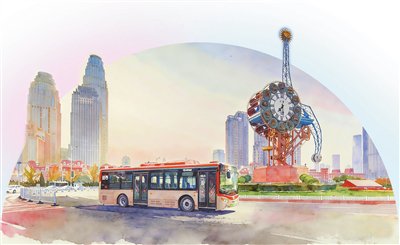
公交车也网约,行么
Jing Ji Ri Bao· 2025-11-20 00:20
Core Viewpoint - The introduction of ride-hailing bus services in cities like Shijiazhuang and Handan reflects a shift from traditional public transport to a more flexible, demand-driven model, leveraging technology to optimize resource allocation and reduce operational costs [1][2]. Group 1: Development of Ride-Hailing Bus Services - Cities across China, including Beijing and Xi'an, have been experimenting with ride-hailing bus services for several years, indicating a growing trend towards this innovative transport solution [1]. - The ride-hailing bus service allows citizens to book buses via mobile applications, providing a more tailored and efficient public transport experience [1]. Group 2: Challenges and Future Prospects - Despite filling gaps in traditional bus coverage and addressing last-mile connectivity issues, ride-hailing bus services are still in pilot phases and represent a small fraction of overall public transport usage [2]. - The transition to large-scale operations will require careful management of costs and operational efficiency, as well as improvements in infrastructure to support these services [2]. - Future developments should focus on enhancing public services and urban governance through more proactive ride-hailing bus operations, contributing to the creation of modern, resilient, and smart cities [2].
期待“网约公交车”跑得更稳更远
Qi Lu Wan Bao· 2025-11-18 01:07
Core Insights - The introduction of "online ride-hailing buses" in cities like Shijiazhuang and Handan represents an innovative model that combines the flexibility of ride-hailing services with the accessibility of public transportation, providing new ideas for urban public transport development [1][2] Group 1: Service Model - "Online ride-hailing buses" match dispersed and dynamic travel demands with idle bus capacity in real-time, breaking away from the traditional fixed-route and fixed-schedule operation model [1] - This service enhances travel convenience for citizens, especially in areas with insufficient conventional bus coverage, while also reducing costs compared to taxis [1] Group 2: Operational Efficiency - The model shifts from "people waiting for buses" to "buses finding people," which is crucial for improving service quality and optimizing resource allocation [1] - Balancing efficiency and accessibility is a key challenge, as the need for vehicles to detour to accommodate different passenger demands may affect travel times [2] Group 3: Sustainability and Integration - Future challenges include developing a sustainable business model that balances public service attributes with operational viability, requiring collaboration among government, enterprises, and society [2] - The positioning of "online ride-hailing buses" should be as a beneficial supplement to conventional buses and subways, fostering a complementary and differentiated development with taxis and ride-hailing services [2]
期待网约公交车织密民生幸福线
Zhong Guo Qi Che Bao Wang· 2025-11-14 08:16
Core Viewpoint - The introduction of "online bus services" in cities like Shijiazhuang, Handan, and Changsha represents a new approach to urban public transportation, combining flexibility and inclusivity to enhance the travel experience and address challenges faced by traditional bus services during off-peak hours and in low-traffic areas [1][2]. Group 1: Benefits of Online Bus Services - Online bus services significantly improve the travel experience by addressing the "last mile" issue, particularly for peak travel times related to schools, hospitals, and large communities, through efficient scheduling that connects key transport hubs with destinations [2][3]. - The time cost is greatly optimized; for instance, a 2-kilometer journey in Beijing that takes 10-20 minutes by bike or walking can be significantly reduced by using online bus services, making short commutes more efficient [2]. - The economic benefits are notable, with fares for online buses ranging from 2-3 yuan, providing a cost advantage over taxis and allowing citizens to enjoy convenient services at a low cost [2]. Group 2: Operational Advantages - Online bus services utilize intelligent scheduling systems to optimize resource allocation, effectively activating existing bus resources, reducing empty vehicle rates, and lowering operational costs [2][4]. - This service model fills gaps in traditional bus coverage, extending the reach of public transport services and enhancing overall service quality and user satisfaction, which in turn boosts ridership [2][4]. Group 3: Industry Context and Trends - The concept of online bus services is not entirely new, with various cities across the country already implementing similar flexible transport solutions, indicating a growing trend towards innovative public transport models [3][4]. - The introduction of online bus services reflects the struggles of public transport companies in adapting to changing travel demands and the need for innovative operational models to balance public service and market dynamics [4][5]. - The promotion of online bus services aligns with national policies aimed at reinforcing the priority of public transport, showcasing a commitment to enhancing urban mobility and service quality [5][6].
一键预约,精准派单!多地开通网约公交车
Yang Guang Wang· 2025-11-03 00:42
Core Viewpoint - The emergence of ride-hailing buses is transforming public transportation by offering flexible, on-demand services that cater to individual travel needs, contrasting with traditional fixed-route buses [1][3][10] Group 1: Service Features - Ride-hailing buses operate without fixed routes or stops, allowing passengers to book rides via mobile apps, which enhances convenience and responsiveness [1][3] - In cities like Yingtan, ride-hailing buses have been introduced with 20 vehicles, each accommodating 12 passengers, charging a flat fee of 3.99 yuan per trip, making it an economical choice for residents [2][9] - The service utilizes virtual stops, enabling passengers to select nearby pick-up points, thus improving accessibility and reducing wait times [7][8] Group 2: User Experience - Users report significant time savings and convenience, with one passenger noting a reduction of over 40 minutes in daily commute time due to the service's efficiency [9] - The service has gained popularity, with Yingtan's ride-hailing bus accumulating over 38,000 monthly orders and transporting 240,000 passengers from January to October this year [9] Group 3: Industry Impact - The introduction of ride-hailing buses aims to address the limitations of traditional bus services, enhancing public transport connectivity and meeting diverse passenger demands [9][10] - Experts suggest that ride-hailing buses should complement traditional public transport rather than replace it, as fixed-route buses provide stability and predictability for commuters [10] - The development of ride-hailing buses is seen as a response to technological advancements and a necessary evolution in urban public transport systems [10]
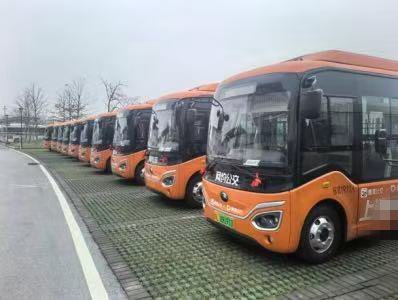
多地推出网约公交车!最快1分钟匹配司机,单程票价仅3元
2 1 Shi Ji Jing Ji Bao Dao· 2025-11-01 08:14
Core Insights - The article discusses the emergence of ride-hailing bus services in various cities across China, highlighting their potential as a new trend in urban transportation [1] Group 1: Service Overview - Ride-hailing bus services have been launched in multiple cities including Chengdu, Jiangsu, Hangzhou, Baoji, Chizhou, Xining, Dongguan, and Shijiazhuang [1] - These services allow users to match with drivers typically within 5 to 10 minutes, with some cases as quick as 1 minute [1] - The ride-hailing buses feature 12 seats and charge a single fare of 3 yuan, combining the flexibility of ride-hailing with the accessibility of public transport [1] Group 2: Operational Characteristics - The key characteristics of ride-hailing buses include "small-scale" operational vehicles and an "appointment-based" service model [1] - This model leverages mobile app reservations to facilitate dynamic ride-sharing, enhancing user convenience while maintaining public transport's inclusive nature [1]