
美国公司债券

Search documents
外资开年狂扫美国公司债 单月净买入速度创近三年新高
Xin Lang Cai Jing· 2026-02-02 23:09
Group 1 - Foreign investors purchased U.S. corporate bonds at the fastest pace in nearly three years in January, driven by stable yields and reduced hedging costs [1] - The average daily net inflow for January reached $332 million, the highest level since February 2023, despite a slowdown in buying during the last week of the month [1] - Concerns on Wall Street regarding a weaker dollar potentially leading to broader foreign capital withdrawal from U.S. assets have not materialized, as foreign allocation to corporate bonds remains resilient [1]

资金大迁徙!逃离“泡沫化”AI债券,华尔街巨头悄然涌入MBS避风港
智通财经网· 2025-12-01 23:28
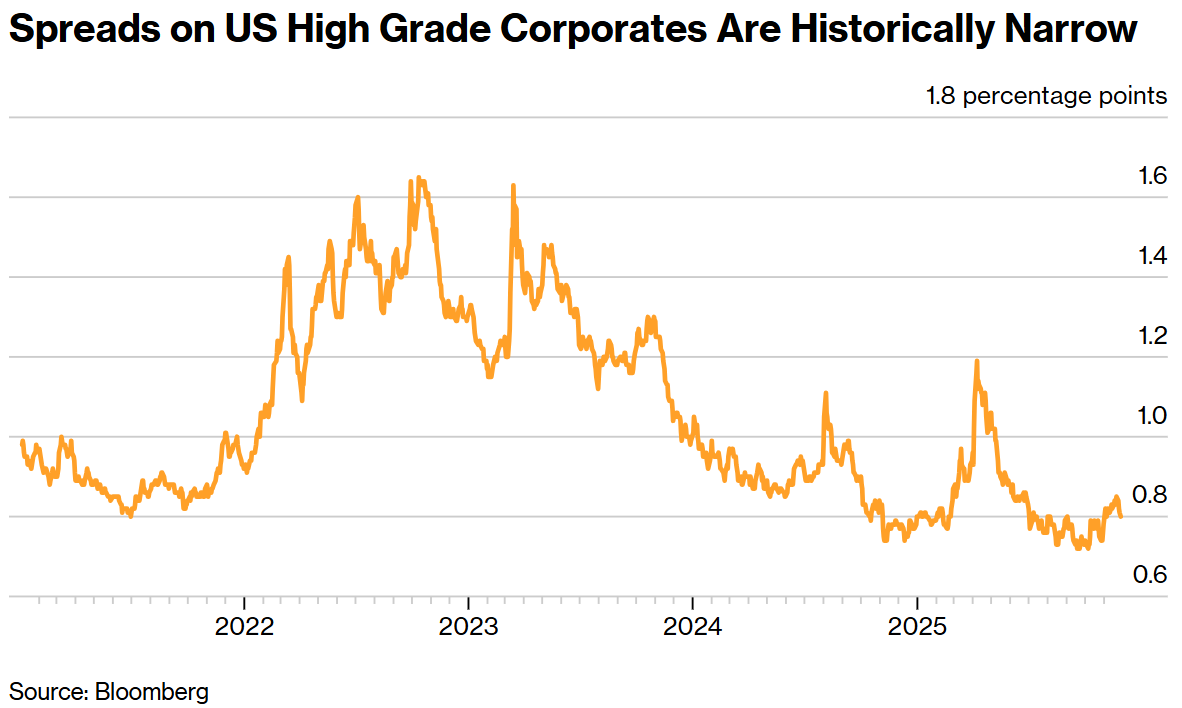
Core Viewpoint - Investment firms, including Columbia Threadneedle, are closely monitoring U.S. mortgage-backed securities (MBS) as a refuge from the high valuations of U.S. corporate bonds and a wave of tech bond issuances that may impact returns [1] Group 1: Corporate Bond Market - JPMorgan strategists predict that the total issuance of U.S. investment-grade bonds, excluding refinancing, could exceed $800 billion in 2026, representing a net increase of approximately 54% from this year [1] - The majority of this issuance is expected to come from tech companies investing in artificial intelligence infrastructure, such as data centers [1] - JPMorgan anticipates that the spread of U.S. high-grade corporate bonds will widen by about 0.15 percentage points in 2026 due to the large volume of issuances [1] Group 2: Mortgage-Backed Securities (MBS) - MBS are projected to deliver the strongest returns in two decades, with the Bloomberg U.S. MBS Index rising by 8.35% as of last Friday, the best performance since 2002 [1] - Morgan Stanley notes that while corporate bond supply is increasing, the net supply of MBS may only see a slight rise next year due to high home prices and mortgage rates suppressing home buying activity [5] - Demand for MBS is expected to be stronger, particularly from real estate investment trusts (REITs) that are purchasing more MBS due to high valuations of their stocks [5] Group 3: Investment Strategies - Columbia Threadneedle's investment manager, Alex Christensen, indicates a gradual shift towards MBS as long-term investment-grade bond spreads fail to provide sufficient buffer against various risks, including increased issuance and deteriorating fundamentals [6] - Some investors are reallocating funds from corporate bonds to other securitized debt products, seeking higher yields [6] - Loomis Sayles' portfolio manager, Brian Kennedy, is focusing on bonds that offer higher yields than MBS, such as mortgage obligations and bonds backed by franchise fees, while attempting to minimize interest rate risk [6]


管涛:拜登政府时期中美双向跨境证券投资状况
Di Yi Cai Jing· 2025-04-27 12:40
Core Viewpoint - The analysis of cross-border securities investment between China and the U.S. reveals a significant decline in Chinese investments in U.S. long-term securities, particularly U.S. Treasury bonds, while investments in U.S. company stocks have increased, indicating a shift in investment strategy [1][2][3][4][5][6]. Group 1: Chinese Investment in U.S. Long-term Securities - As of the end of 2024, Chinese investors held $1,309.3 billion in U.S. long-term securities, a decrease of $220.8 billion or 14.4% from the end of 2020, accounting for 4.1% of foreign holdings [2]. - The balance of Chinese holdings in long-term U.S. Treasury bonds was $698.6 billion, down $334 billion or 32.3%, contributing significantly to the overall decline in Chinese long-term securities investments [2][5]. - In contrast, Chinese holdings of U.S. company stocks increased to $375.1 billion, a rise of $113.9 billion or 43.6%, offsetting some of the declines in other areas [3]. Group 2: Changes in Specific Securities - Chinese holdings of U.S. government agency bonds remained relatively stable, with a slight increase of $4 billion or 1.9%, while holdings of U.S. corporate bonds decreased by $4.7 billion or 19.6% [4][6]. - The overall reduction in Chinese long-term securities was influenced by a net reduction of $1,722 billion in U.S. long-term securities, with non-transactional changes accounting for $692 billion [4][6]. Group 3: U.S. Investment in Chinese Securities - As of the end of 2024, U.S. investors held $246 billion in Chinese long-term securities, a decrease of $39.6 billion or 13.9% from the end of 2020, representing 1.6% of U.S. foreign long-term securities holdings [7]. - The primary reason for this decline was a reduction in U.S. holdings of Chinese company stocks, which fell by $21.3 billion or 8.5% [7][9]. - U.S. holdings of Chinese government bonds decreased significantly by $15.6 billion or 52.7%, contributing to the overall decline in U.S. investments in Chinese long-term securities [8][9]. Group 4: Comparative Analysis of Investment Trends - Despite the differences in scale, both Chinese and U.S. investments in their respective long-term securities show similar proportions, each around 2% of their total foreign securities investments [8]. - The data indicates that while U.S. investors have been reducing their exposure to Chinese securities, Chinese investors have been diversifying their investments, particularly increasing their stakes in U.S. equities [12][13].