美国短期国库券

Search documents
独家洞察 | 缓冲型ETF VS 美国国库券,谁才是投资者的安稳基石?
慧甚FactSet· 2026-01-08 08:14
Core Viewpoint - The article discusses the consideration of buffer ETFs as a suitable investment option when the investment horizon shortens, particularly in the context of funding home renovations and managing market risks [2]. Group 1: Investment Strategy - The author and their spouse traditionally maintained a 70% stock and 30% bond allocation but are now looking to de-risk their portfolio due to a shortened investment timeline [2]. - The need to reduce or eliminate stock market exposure and lower bond duration and credit risk is emphasized as a response to potential market downturns [2]. Group 2: Buffer ETFs Introduction - Innovator ETFs launched a series of "100% buffer" ETFs in summer 2023, designed to provide full downside protection while being linked to major indices like the S&P 500 [3]. - Other institutions such as First Trust, Calamos, Prudential, and BlackRock have also introduced similar products, positioning them as alternatives to traditional bank products like CDs [3]. Group 3: Investment Characteristics Comparison - Treasury bills (T-bills) offer fixed terms and yields with no downside risk unless a large-scale default occurs, but they have a capped upside [4]. - 100% buffer ETFs combine index exposure with protective put options, allowing for full downside protection while providing limited upside potential [4]. - The article notes that the clarity of the return structure for buffer ETFs is only present at the time of option establishment, with subsequent returns influenced by various market factors [4]. Group 4: Due Diligence Process - A two-step due diligence process is recommended: selecting the most suitable 100% buffer ETF and comparing it with T-bills of similar maturity [5]. - The selection process involves understanding product terminology and the practices of different issuers, as well as choosing a reference asset and expiration date [5]. Group 5: Product Evaluation - Five buffer ETF options were identified, including DMAX, PMJA, ZJAN, CPSY, and DECM, with varying expense ratios and potential returns [6]. - DMAX is highlighted as the most cost-effective option with a total cost of ownership (TCO) of 0.67% and an annual upside cap of 8.40% [9]. Group 6: Performance Analysis - The analysis of DMAX's performance relative to the S&P 500 indicates that it offers 100% downside protection while providing a potential upside if the index performs well [10]. - The comparison with T-bills shows that DMAX has a higher potential return, but the costs associated with its protective mechanisms must be considered [12]. Group 7: Tax Considerations - The article discusses the tax implications of investing in buffer ETFs versus T-bills, noting that capital gains from buffer ETFs may be taxed at a higher rate compared to the interest from T-bills [18]. - The potential for higher tax burdens on capital gains in high-tax states is also highlighted, affecting the attractiveness of buffer ETFs for certain investors [18]. Group 8: Conclusion - The decision to invest in buffer ETFs like DMAX versus T-bills should consider risk tolerance, potential returns, and tax implications based on individual circumstances [19]. - The article concludes that for some investors, the known costs of buffer ETFs may not justify the uncertain potential returns, especially in the context of their specific financial goals [20].



借短还长,英日央行领衔抛弃长债,转向高频滚动的“利率赌博”
Hua Er Jie Jian Wen· 2025-12-03 08:36
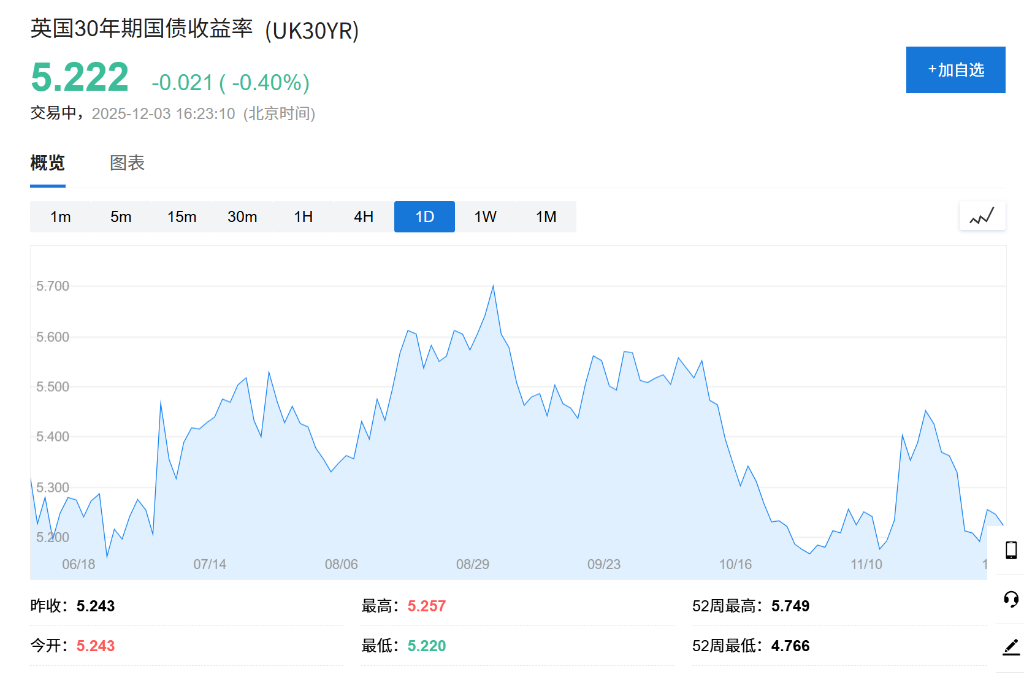
Core Insights - Major economies are shifting their debt strategies from traditional long-term bonds to shorter-term debt instruments, led by the UK and Japan [1][2] - This shift is driven by central banks reducing their bond-buying programs, leading to decreased demand for long-term bonds and rising government borrowing costs [1][2] - The trend is not isolated, as the US and Australia are also increasingly relying on short-term debt to finance deficits [1][2] Group 1: Debt Strategy Changes - The UK has reduced its long-term bond issuance to a historical low and is considering expanding its ultra-short-term bill market [1][5] - Japan plans to increase the issuance of short-term debt following a sell-off of long-term bonds [1][5] - The average duration of global government bonds has fallen to its lowest level since 2014, indicating a broader trend towards shorter maturities [1][2] Group 2: Demand Dynamics - Traditional buyers of long-term bonds, such as pension funds, are withdrawing from the market, creating a significant demand gap [2][5] - In the UK, the yield spread between long-term and short-term bonds has widened, making short-term borrowing more attractive [2][5] - In Japan, the demand for ultra-long bonds from banks and insurance companies has diminished, further contributing to the shift [2][5] Group 3: Financial Implications - The issuance of short-term bonds is becoming increasingly appealing due to the significant yield spread, with short-term bonds expected to make up 44% of new UK bond issuance this fiscal year [5] - In Japan, bonds with maturities of five years or less are projected to account for about 60% of new issuances, up from 56% in the previous fiscal year [5] - The strategy of shortening debt duration carries risks, as it bets on future declines in long-term bond yields, which could lead to increased costs if rates do not fall as anticipated [6][7]