英国国债

Search documents
英国10/30年期国债收益率本周跌约12个基点
Jin Rong Jie· 2026-02-27 18:18
Group 1 - The yield on UK 10-year government bonds decreased by 4.4 basis points, reaching a daily low of 4.231%, with a cumulative decline of 12.1 basis points for the week [1] - The 2-year UK bond yield fell by 2.5 basis points to 3.525%, accumulating a weekly drop of 5.5 basis points [1] - The 30-year UK bond yield decreased by 3.6 basis points to 5.040%, with a total weekly decline of 11.7 basis points [1] - The 50-year UK bond yield dropped by 2.9 basis points to 4.612%, resulting in a weekly decrease of 9.7 basis points [1] - The yield spread between 2-year and 10-year UK bonds fell by 1.774 basis points to +70.545 basis points, with a cumulative weekly decline of 6.788 basis points [1]
每日机构分析:2月27日
Xin Hua Cai Jing· 2026-02-27 16:54
Group 1: US Housing Market - The average interest rate for a 30-year fixed mortgage in the US fell to 5.98% as of February 26, down from 6.01% the previous week and significantly lower than 6.76% a year ago. This decline is primarily attributed to the drop in the 10-year Treasury yield. However, economists believe this decrease is insufficient to materially stimulate housing demand [1] - The current decline in mortgage rates is seen as a result of market volatility rather than strong economic fundamentals, raising questions about its sustainability. Analysts emphasize that the shortage of housing inventory remains a core constraint on market recovery, indicating that merely lowering rates will not drive demand unless supply improves [1] - Despite the lower rates, there has been a noticeable increase in mortgage refinancing activity [1] Group 2: UK Government Bonds - UK government bond prices have risen due to market expectations that the Office for Budget Responsibility will announce a reduction in bond issuance for the current fiscal year and further cuts in the 2027 fiscal year. Analysts suggest that strong tax revenues early in the year may lead to a downward revision of bond issuance expectations [2] Group 3: Japan Inflation - In February, Tokyo's core consumer prices, excluding fresh food, rose by 1.8% year-on-year, slightly above economists' median forecast of 1.7%. The inflation rate is cooling as the impact of government measures to lower utility bills becomes evident and food cost increases slow down [2] Group 4: South Korea Exports - South Korea's exports are expected to grow for the ninth consecutive month in February, driven by a surge in chip demand amid a global AI investment boom. Analysts predict a 24.0% year-on-year increase in exports, with semiconductor prices rising faster than expected and low inventory levels supporting strong export momentum [2] - There is a high likelihood that semiconductor export growth will exceed 100% in the first half of the year [2] Group 5: Singapore Trade Performance - Singapore's manufacturing and trade performance may be adversely affected by uncertainties in US trade policy by 2026. Potential trade tensions and geopolitical conflicts among major economies could raise production costs and exacerbate global economic policy uncertainty, ultimately dampening global investment flows and trade activities [2]
英国料将把国债发行规模削减20% 为债券投资者带来利好
Xin Lang Cai Jing· 2026-02-27 12:25
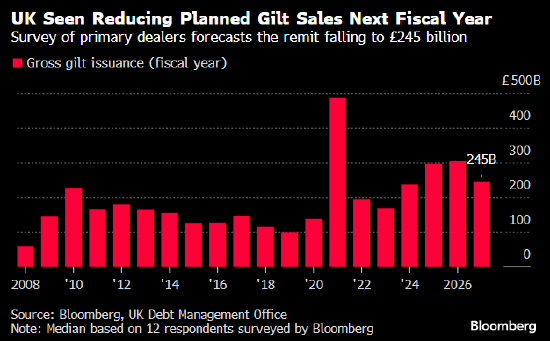
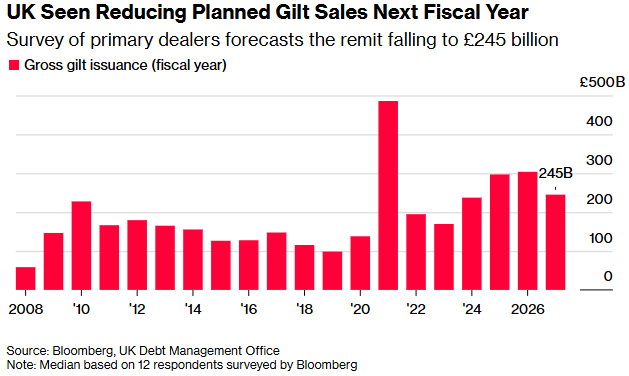
Core Viewpoint - The UK is expected to reduce its national debt issuance in the coming year, which is positive news for bond investors concerned about the country's fiscal tightness [1][3]. Group 1: Debt Issuance Plans - The Debt Management Office is projected to announce a total national debt issuance of £245 billion ($331 billion) for the fiscal year 2026/2027 [1][3]. - This issuance amount will be the lowest in three years, representing a decrease of £59 billion (approximately 20%) compared to the current fiscal year [1][3]. Group 2: Market Impact - The reduction in debt issuance is expected to alleviate short-term financing cost pressures for the UK government, which currently has the highest financing costs among the G7 countries [1][3]. - Dani Stoilova, an economist at BNP Paribas, believes this will help maintain market stability in the coming months, indicating a return to normalcy after the shocks from the pandemic and energy crisis [1][3].

三年最低水平!英国计划削减20%国债供应,债市投资者迎来罕见利好
智通财经网· 2026-02-27 08:05
Core Viewpoint - The UK is expected to significantly reduce its government bond issuance in the upcoming fiscal year, providing a rare positive signal for bond investors concerned about the country's fiscal health [1]. Group 1: Bond Issuance Forecast - The UK Debt Management Office (DMO) is projected to announce a total bond issuance of £245 billion (approximately $331 billion) for the fiscal year 2026/2027, marking the lowest level in three years and a reduction of £59 billion, or about 20%, from the current fiscal year [1][4]. - This anticipated decrease in bond issuance may alleviate some of the recent pressures on the UK government's borrowing costs, which are currently the highest among the G7 countries [1]. Group 2: Fiscal Improvement Indicators - The expected decline in bond issuance reflects an improvement in the UK's recent fiscal situation, with cash tax revenues exceeding budget forecasts and government spending on debt interest being significantly lower than anticipated [5]. - The proportion of unallocated bonds is expected to be 10.2%, up from 9.2% in March of the previous year, indicating a shift in the distribution of bond sales across different maturities [5]. Group 3: Market Reactions and Predictions - The DMO has been reducing the weighted average maturity of its debt in response to a waning appetite from traditional buyers like pension funds, which has helped lower the 30-year yield to its lowest level since April [9]. - Despite a positive month for UK bonds in February, characterized by slowing inflation and a stable labor market, market strategists remain cautious about the sustainability of this performance due to ongoing political risks [10]. - The £245 billion bond issuance will still be the fourth highest in history, amidst fierce competition for buyers due to substantial global government borrowing [10].
欧洲债市:英国国债引领欧债牛平 主要股指大跌刺激国债买盘
Xin Lang Cai Jing· 2026-02-26 18:06
Group 1 - The UK government bonds are leading the European bond market, with major stock indices declining significantly, which has increased demand for government bonds [1][7] - The performance of UK government bonds has driven the 30-year yield down to its lowest level since April, as traders increase bets on a potential interest rate cut by the Bank of England [1][7] - Traders currently expect a cumulative interest rate cut of approximately 51 basis points this year, up from an earlier expectation of about 48 basis points [8] Group 2 - The market is closely watching the upcoming UK government bond issuance plan [9] - The European Central Bank President, Christine Lagarde, stated that the ECB will closely monitor any signs of unemployment resulting from the application of artificial intelligence in the economy [9] - In Belgium, consumer prices rose by 1.45% year-on-year in February, compared to 1.1% in January [2][9] Group 3 - The German 10-year government bond yield decreased by 1 basis point to 2.70%, while German government bond futures rose by 13.00 points to 129.76 [3][10] - The Italian 10-year government bond yield remained stable at 3.31%, with the spread between Italian and German bonds widening by 1 basis point to 61 basis points [4][11] - The French 10-year government bond yield remained stable at 3.26% [5][12] - The 10-year UK government bond yield fell by 3 basis points to 4.28% [6][13]
债市日报:2月26日
Xin Hua Cai Jing· 2026-02-26 09:44
Market Overview - The bond market continues to face pressure, with yields on medium to long-term bonds rising by over 2 basis points, and the main contracts for government bond futures closing lower, with the 30-year contract down by 0.53% [1][2] - The overall liquidity in the market is expected to stabilize, with cash returning after the holiday and the central bank providing support [1] Bond Yield Movements - The 10-year government bond yield rose by 2.4 basis points to 1.9810%, while the 30-year government bond yield increased by 2.2 basis points to 2.2530% [2] - The China Convertible Bond Index fell by 1.03%, with significant declines in several convertible bonds, while others saw notable increases [2] International Bond Market Trends - In North America, U.S. Treasury yields rose across the board, with the 10-year yield increasing by 2.1 basis points to 4.052% [3] - In the Eurozone, the 10-year French bond yield decreased by 1.2 basis points, while the German bond yield rose slightly [3] Primary Market Activity - The China Development Bank issued financial bonds with yields of 1.6295% for 3-year bonds and 1.8327% for 7-year bonds, with bid-to-cover ratios of 3.3 and 2.2 respectively [4] Liquidity and Funding Conditions - The central bank conducted a reverse repurchase operation of 320.5 billion yuan at a rate of 1.40%, with a net withdrawal of 79.5 billion yuan for the day [5] - Short-term Shibor rates mostly declined, with the overnight rate down by 1.0 basis point to 1.368% [5] Institutional Insights - Long-term strategies involving leveraged investments in the bond market are being discussed, emphasizing the importance of market conditions [6] - There is a focus on convertible bonds, with a recommendation to pay attention to sectors like chemicals, construction materials, and power equipment due to potential recovery opportunities [6]
欧洲债市:德国国债基本持平 利差收窄
Xin Lang Cai Jing· 2026-02-25 18:51
Group 1 - German government bonds remained stable, underperforming Italian bonds amid a narrowing overall yield spread, while Germany issued 12-year and 15-year bonds [1][4] - The stock market rebound has weakened demand for core fixed-income assets, although European government bonds still slightly outperform U.S. and U.K. government bonds [1] - European Central Bank (ECB) Governing Council member Boris Vujcic stated that while officials have regained control over price levels, vigilance against risks is still necessary [1][5] Group 2 - A Bloomberg survey indicated that over half of the economists polled expect ECB President Christine Lagarde to leave before the end of her term [5] - U.K. government bonds experienced a steepening bear market amid a day of light data [6] - Bank of England Monetary Policy Committee member Megan Greene emphasized that the BoE does not need to "follow the Fed" and should focus on factors determining the U.K. inflation outlook [6] Group 3 - The yield on German government bonds changed little, standing at 2.71% [2][6] - Italian 10-year government bond yields decreased by 1 basis point to 3.31% [3][6] - The Italian-German bond yield spread narrowed by 1 basis point to 60 basis points [3][7] - French 10-year government bond yields fell by 1 basis point to 3.26% [3][8] - The yield on 10-year U.K. government bonds rose by 1 basis point to 4.32% [3][9]
英镑走高 利率分化和市场情绪成为焦点
Xin Lang Cai Jing· 2026-02-25 11:02
Core Viewpoint - The British pound is experiencing fluctuations against the US dollar and euro, influenced by interest rate differentiation and market sentiment, with uncertainties in UK politics and potential further rate cuts from the Bank of England impacting its near-term outlook [1][6]. Group 1: Currency Performance - The British pound has risen by 0.10% against the euro, currently at 87.17 pence, after hitting a low of 87.52 pence, the lowest since December 19 [3][8]. - The British pound has increased by 0.18% against the US dollar, now at 1.3511 dollars [4][9]. Group 2: Economic Indicators - The Bank of England's Governor Andrew Bailey indicated that a rate cut in March is possible, although recent data shows that service price inflation has not eased as hoped [2][7]. - The UK 10-year government bond yield fell to its lowest since December 2024 at 4.29% on Tuesday, before rising by two basis points on Wednesday [5][9]. - The UK Debt Management Office's upcoming bond issuance plan is under close scrutiny, which will follow the Chancellor's submission of the latest economic growth and borrowing forecasts to Parliament [4][9]. Group 3: Political Context - Political uncertainties are rising, particularly surrounding Prime Minister Keir Starmer, who faces calls for resignation due to the appointment of Peter Mandelson as the UK ambassador to the US, amid scrutiny related to Mandelson's past connections [5][9].
欧洲债市:避险情绪提振欧债 英国10年期收益率走低
Xin Lang Cai Jing· 2026-02-23 17:19
Group 1 - The core viewpoint is that German government bonds have risen alongside other European government bonds due to increased demand for safe-haven assets amid stock market declines, although the increase is less than that of U.S. and U.K. bonds [1][9] - The potential risks posed by artificial intelligence to various sectors of the global economy remain a focal point of concern [1] Group 2 - The Ifo Institute's survey on German business confidence reported an index of 90.5, slightly above the median estimate, but had a limited impact on the market [2][10] - German government bond yields fell by 2 basis points to 2.72% [3][11] - German bond futures increased by 22 points to 129.56 [4][12] Group 3 - The yield on Italian 10-year government bonds decreased by 2 basis points to 3.32% [5][13] - The spread between Italian and German government bonds remained relatively unchanged at 61 basis points [6][14] - The yield on French 10-year government bonds fell by 2 basis points to 3.28% [7][15] - The yield on 10-year U.K. government bonds dropped by 3 basis points to 4.32%, reaching the lowest level since December 2024 [8][16]
债券市场的“隐形稳定器”正在消退 美国国债面临最大风险
Xin Lang Cai Jing· 2026-02-20 15:03
Core Insights - Japan's role as an "invisible stabilizer" in the global bond market may be changing, with U.S. Treasuries likely to be the most affected [12][21] - Japanese investors and institutions are the largest overseas holders of sovereign debt, with Japan holding 12.4% of U.S. Treasuries, exceeding $1 trillion [14][15] - Rising domestic bond yields in Japan are prompting investors to consider reallocating significant funds back to domestic bonds to capitalize on these higher yields [5][13] Group 1 - Japanese bond yields have reached new highs since late last year, with the benchmark 10-year government bond yield recently reported at around 2.12% [16][19] - The yield spread between Japanese 10-year bonds and U.S. 10-year bonds has narrowed by approximately 115 basis points over the past year [16] - The deVere Group's CEO warns that investors may not fully account for the potential ripple effects of rising Japanese yields on the global bond market [4][16] Group 2 - The shift in Japanese investment behavior could lead to a tightening of the global financial environment, with long-term bond risk premiums expected to rise [6][16] - Japan has historically been a structural buyer of U.S. Treasuries and major developed market bonds; a reduction in this buying could lead to higher yields [6][21] - The Bank of Japan's monetary policy remains perceived as overly accommodative, with expectations for 2 to 3 rate hikes needed to restore investor confidence [19][20] Group 3 - The Government Pension Investment Fund (GPIF) currently allocates 50% of its assets to the bond market, with nearly half in overseas bonds, amounting to approximately ¥72.8 trillion (around $470.6 billion) [19] - Market observers note that while Japanese investors may consider reallocating funds domestically, significant changes are expected to be gradual rather than abrupt [19][20] - The volatility and liquidity of Japanese government bonds remain concerns that need to be addressed before a large-scale return of funds occurs [20]