老视成镜

Search documents
老人鞋等 16 类产品抽检不合格,这些品类你还在买吗?
Yang Shi Xin Wen Ke Hu Duan· 2026-02-10 06:41
Core Viewpoint - The recent national quality supervision sampling conducted by the State Administration for Market Regulation revealed a significant number of non-compliant products across various categories, indicating potential quality control issues in the market. Group 1: Product Sampling Overview - A total of 1,234 batches of 16 product types were sampled, including 399 batches from 14 online platforms and 225 batches from 205 sales units across 19 provinces [1] - 190 batches were found to be non-compliant, with 4 batches being illegal products and 186 batches failing inspection [1] Group 2: Specific Product Findings - In the category of elderly vision correction glasses, 49 out of 89 batches were found non-compliant, with issues including counterfeit products and various optical performance failures [2] - For elderly shoes, 9 out of 68 batches were non-compliant, with issues related to safety and performance standards [2] - The ceramic sealing water nozzle category had 36 out of 130 batches failing inspection, with multiple performance-related failures identified [3] Group 3: Regulatory Actions - Provincial market regulatory departments have taken measures such as product removal, sealing, and confiscation of non-compliant products [3] - Clear rectification requirements have been established for non-compliant production and sales units, with strict enforcement of corrective actions [3] - Continuous non-compliance will lead to severe legal consequences, including potential criminal referrals [3]
涉及老人鞋等16种产品190批次抽查不合格
Yang Shi Xin Wen Ke Hu Duan· 2026-02-10 06:40
Core Insights - The State Administration for Market Regulation has conducted a national quality supervision inspection of 16 types of products, including elderly shoes, with a total of 1,234 batches tested across various platforms and provinces [1] Group 1: Inspection Results - A total of 399 batches were inspected from 374 sales units on platforms such as 1688, JD.com, Douyin, Suning, Tmall, and Kuaishou [1] - 190 batches were found to be non-compliant, including 4 batches of illegal products (all power adapters) and 186 batches of products that failed inspections [1] - Specific non-compliant products included 49 batches of presbyopic glasses, 9 batches of elderly shoes, and various other items such as gas heating water heaters and industrial gas detectors [1] Group 2: Follow-up Actions - Among the previously inspected non-compliant production units, 24 out of 91 remained non-compliant in the latest inspection [2] - For presbyopic glasses, 49 batches were found non-compliant, with issues including counterfeit products and various optical performance failures [2] - For elderly shoes, 9 batches were non-compliant, with one counterfeit product and issues related to safety and durability [2] Group 3: Specific Product Issues - In the inspection of ceramic sealing water nozzles, 36 out of 130 batches were found non-compliant, with failures in corrosion resistance, load-bearing capacity, and assembly [3] - Regulatory actions have been taken against non-compliant products, including removal from shelves and strict enforcement of corrective measures for production units [3] - Continuous non-compliance will lead to severe legal consequences, including potential criminal referrals [3]
涉及老人鞋等16种产品 190批次抽查不合格
Xin Lang Cai Jing· 2026-02-10 06:39
Core Insights - The State Administration for Market Regulation has conducted a national quality supervision inspection of 16 types of products, revealing a total of 190 batches of non-compliant products from 1234 batches tested [1] Group 1: Inspection Overview - A total of 399 batches of products were inspected across 14 platforms and 374 sales units, with 225 batches from 205 sales units in 19 provinces, and 610 batches from 610 production units in 24 provinces [1] - The inspection identified 4 batches of illegal products, all of which were power adapters, and 186 batches of products failed quality tests [1] Group 2: Specific Product Findings - In the category of elderly shoes, 68 batches were inspected, with 9 batches found non-compliant, including 1 batch that was counterfeit [2] - For optical glasses, 49 batches were found non-compliant, with issues including 1 counterfeit product and multiple safety-related failures [2] - The ceramic sealing water nozzles had 130 batches inspected, with 36 batches failing quality tests due to various performance issues [3] Group 3: Regulatory Actions - Provincial market regulatory departments have taken measures such as removing non-compliant products from shelves, sealing, and confiscating them [3] - Clear rectification requirements have been established for non-compliant production and sales units, with strict enforcement of corrective actions [3] - Continuous non-compliance will lead to serious legal consequences, including criminal referrals for violations [3]
市场监管总局开展光伏并网逆变器等16种产品质量抽查,190批次产品不合格
Xin Lang Cai Jing· 2026-02-10 04:38
Core Viewpoint - The State Administration for Market Regulation has conducted a national quality supervision sampling inspection of 16 products, including photovoltaic grid-connected inverters, revealing a significant number of non-compliant products in the market [1] Group 1: Inspection Overview - A total of 1,234 batches of 16 products were sampled across 14 platforms, including major e-commerce sites like Alibaba, JD.com, and Douyin [1] - The inspection covered 205 sales units in 19 provinces, with 225 batches of products checked, and 610 production units in 24 provinces, with 610 batches inspected [1] Group 2: Non-compliance Findings - Out of the inspected products, 190 batches were found to be non-compliant, which includes 4 batches of illegal products, all of which were power adapters [1] - The inspection identified 186 batches of products that failed quality tests, including 3 batches of photovoltaic grid-connected inverters and various other products such as automotive coolant and gas heating water heaters [1] Group 3: Follow-up on Previous Inspections - Among the previously inspected non-compliant production units, 91 were tracked, with 24 of these units still producing non-compliant products [2]
事关养老!为群众安享幸福晚年提供标准助力 | 新版标准指南解读↓
Yang Shi Wang· 2025-11-27 08:29
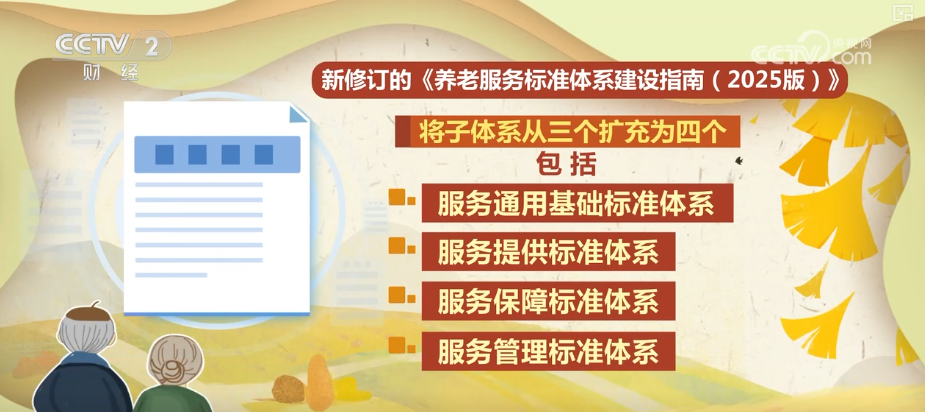
Core Viewpoint - The Ministry of Civil Affairs and the State Administration for Market Regulation have jointly released the "Guidelines for the Construction of the Elderly Care Service Standard System (2025 Edition)" to enhance the standardization and evaluation system for elderly care services, aiming for high-quality development in this sector [1] Group 1: Standard System Overview - The revised 2025 edition expands the sub-systems from three to four, including: General Basic Standards System, Service Provision Standards System, Service Guarantee Standards System, and Service Management Standards System [2] - The General Basic Standards System aims to unify fundamental and general concepts and scopes in the elderly care sector [4] - The Service Provision Standards System is designed to standardize the content and specific requirements of elderly care services [4] - The Service Guarantee Standards System focuses on regulating the operational support elements for various elderly care institutions, including personnel training, job settings, environmental construction, facilities, technology assistance, information technology, and elderly products [4] Group 2: Current Challenges and Future Directions - The Deputy Director of the Elderly Care Service Department highlighted that while significant progress has been made in standardization, there are still shortcomings in the system's framework, mechanism, and element guarantees, such as an imbalance in standard supply and a predominance of recommended standards over mandatory ones [6] - The upcoming focus will be on accelerating the development of key core standards, emphasizing speed, quality, and mandatory nature to increase the effective supply of standards [6] Group 3: Focus on Elderly Products - As of October 2025, the State Administration for Market Regulation has published a total of 262 national standards related to elderly-friendly and barrier-free designs, with 13 standards specifically for elderly products, including appliances, furniture, shoes, reading glasses, and adult diapers [9] - The Deputy Director of the Standards Technology Department stated that there will be a continued emphasis on coordinating standards for elderly products and services, particularly in key areas such as rehabilitation aids, textiles, home appliances, public facilities, smart products, and life services [11]

养老服务有了“新标尺” 乐享“夕阳红”美好愿景进一步照进现实
Yang Shi Wang· 2025-11-26 10:24
Core Viewpoint - The Ministry of Civil Affairs and the State Administration for Market Regulation have jointly released the "Guidelines for the Construction of the Elderly Care Service Standard System (2025 Edition)" to enhance the standardization and evaluation system for elderly care services, aiming for high-quality development in this sector [1][5]. Group 1: Standard System Expansion - The revised 2025 edition expands the sub-systems from three to four, including: 1. General Basic Standards System 2. Service Provision Standards System 3. Service Guarantee Standards System 4. Service Management Standards System [3][5]. - The General Basic Standards System aims to unify basic and general concepts in the elderly care sector, while the Service Provision Standards System specifies the content and requirements of elderly care services [3]. Group 2: Focus on Core Standards - The Ministry of Civil Affairs emphasizes the need to address shortcomings in the standardization framework, including an imbalance in standard supply, with more recommended standards than mandatory ones [5]. - The new guidelines will accelerate the development of key core standards, focusing on speed, quality, and mandatory nature to increase effective standard supply [5][6]. Group 3: Integration with Other Sectors - The elderly care standardization work will focus on creating a supply structure that combines home-based care, community support, and professional institutional care, integrating resources from various sectors such as housing, health, culture, and finance [6][8]. Group 4: New Indicators and Standards - The updated guidelines introduce new secondary and tertiary indicators, particularly in service provision, to address the characteristics of different service scenarios, including home, community, and institutional care [8]. - New indicators include "entrusted consulting services" and "traveling elderly care services," aligning with the trends in the silver economy [8]. Group 5: Progress in Standards Development - As of October this year, the State Administration for Market Regulation has released a total of 262 national standards related to aging and accessibility, with 13 standards specifically for elderly products [9][11]. - Future efforts will focus on accelerating the development of standards for rehabilitation aids and other key areas related to elderly care [11].
45批次产品抽查不合格
Liao Ning Ri Bao· 2025-11-12 00:59
Group 1 - The provincial market supervision bureau conducted quality supervision sampling on 24 types of products, including toys, adult diapers, prescription glasses, and reading glasses, with a total of 1204 batches [1] - Among the sampled products, 41 batches from 40 distribution units were found to be non-compliant, resulting in a non-compliance rate of 4.2%, while 4 batches from 4 manufacturing enterprises had a non-compliance rate of 1.7% [1] Group 2 - Specific non-compliance was noted in 3 batches of prescription glasses from companies such as Shenyang Dapeng Trading Co., Ltd., with a non-compliance rate of 10%, primarily due to issues with cylindrical axis deviation and spherical focal power deviation [1] - In the case of reading glasses, 5 batches from various retailers, including Benxi Chunfeng Trading Center and Panjin Zhongxing Glasses Co., Ltd., exhibited a non-compliance rate of 25%, with detected issues including spherical focal power deviation and optical center deviation [1]
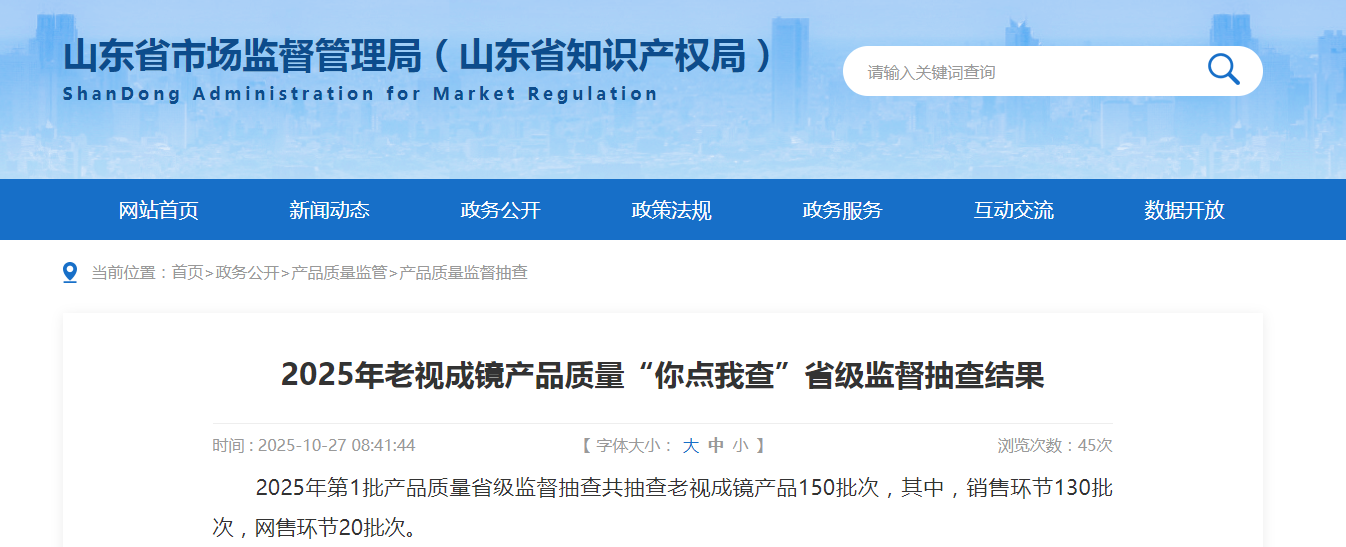
山东省市场监管局发布2025年老视成镜产品质量“你点我查”省级监督抽查结果
Zhong Guo Zhi Liang Xin Wen Wang· 2025-11-04 09:01
Core Insights - The Shandong Provincial Market Supervision Administration recently released the results of the 2025 provincial quality supervision sampling for presbyopic lenses, indicating a focus on product quality in the optical industry [4]. Group 1: Sampling Results - A total of 150 batches of presbyopic lenses were sampled, with 130 from retail and 20 from online sales [4]. - The inspection was based on national standards including GB13511.1-2011 and GB/T13511.3-2019, assessing various quality parameters such as assembly quality and optical center deviations [4]. Group 2: Non-compliance Findings - 21 batches from 21 sellers were found to be non-compliant with relevant standards, with issues including deviations in lens focal power and assembly quality [5]. - The Shandong Provincial Market Supervision Administration has mandated corrective actions for the sellers of the non-compliant products, in accordance with the Product Quality Law of the People's Republic of China [5]. Group 3: Consumer Guidance - Consumers are advised to check their vision with an eye doctor before purchasing presbyopic lenses to rule out age-related eye diseases [6]. - Important purchasing tips include verifying product labels for essential information, trying on the glasses before finalizing the purchase, and keeping receipts for potential disputes [7].