适老家电

Search documents
帮主郑重:三大消费赛道优质标的清单,中长线闭眼盯这几类!
Sou Hu Cai Jing· 2025-12-19 00:39
Group 1: Smart Connected Vehicles - Focus on three categories: 1) Companies producing core components for autonomous driving, such as lidar and in-vehicle cameras, with leading firms investing over 10% of revenue in R&D [3] [4] - 2) Intelligent cockpit service providers, with new vehicle penetration rates exceeding 60% and accelerating growth [4] - 3) Automotive-grade chip manufacturers, particularly those involved in domestic substitution, as domestic new energy vehicle installations account for over 50% of the global total, making chip localization a necessity [4] Group 2: AI Consumer Electronics - Emphasis on "AI+" upgrade targets: 1) New product categories empowered by AI, such as smart speakers with large models and AI translation devices, with sales growth rates exceeding 30% year-on-year [4] - 2) Leading companies in the consumer electronics supply chain, especially those producing AI modules and precision manufacturing for top brands, benefiting from industry upgrades and stable overseas orders [4] - 3) Companies related to AR/VR devices, supported by policies promoting digital consumption, with leading firms already in mass production [4] Group 3: Silver Economy - Focus on "essential needs + quality": 1) Companies in elderly health management, such as those producing smart blood glucose meters and blood pressure monitors, with over 280 million people aged 60 and above driving demand for health monitoring [4] - 2) Operators of elderly care services, particularly those with chain operations and integrated medical care, benefiting from policy incentives like venue and tax benefits, with leading institutions achieving over 85% bed utilization [4] - 3) Companies involved in elderly-friendly renovations, such as leading firms in elderly appliances and smart nursing equipment, with the market for elderly-friendly renovations growing over 25% annually [4] Group 4: Investment Strategy - Long-term investment targets should focus on R&D investment, market share, and policy alignment, as these companies are positioned at the forefront of national strategy and industrial upgrades [5]


预见未来家:2025年度家电行业十大趋势
Xin Lang Cai Jing· 2025-12-10 14:00
Group 1 - The core viewpoint of the articles highlights the transformative impact of AI and green technology on the home appliance industry, driven by policies such as the "old-for-new" initiative, which has invigorated the market and accelerated technological upgrades [1][25][48] - The integration of AI into home appliances has shifted from optional enhancements to fundamental redefinitions of product forms and user experiences, marking a new phase in the industry [3][27] - The sales growth of smart home products has been significant, with a reported increase of 940.7% in new smart home product barcodes, indicating a robust market trend [4][30] Group 2 - The trend towards personalized and flexible customization in home appliances is emerging, exemplified by the popularity of products like the "three-tub washing machine," which responds to consumer feedback [8][33] - The green upgrade of home appliances is gaining momentum, with a reported sales increase of over 10% for first-level energy-efficient products, reflecting a shift in consumer awareness towards sustainable living [11][36] - The aging population in China is driving the demand for elder-friendly appliances, with new standards and products being developed to cater to this demographic [13][38] Group 3 - The "Good House" initiative is fostering a deep integration of home appliances with home design, pushing for a seamless experience in kitchen and living spaces [14][39] - The trend of collaboration among major appliance brands, such as the strategic partnership between Hisense and Midea, signifies a shift from competition to "co-opetition" in the industry [19][44] - The globalization of the Chinese home appliance industry is accelerating, with companies expanding their presence through mergers and international marketing strategies, including partnerships with global sports events [21][46]







增强供需适配性 打开万亿级消费新蓝海
Yang Guang Wang· 2025-12-01 05:51
Core Insights - The Chinese government has introduced a significant policy to boost consumption, focusing on enhancing the adaptability of supply and demand through a comprehensive implementation plan with 19 key tasks aimed at promoting a two-way economic cycle [1][2] Group 1: Policy Overview - The implementation plan was jointly released by six government departments, including the Ministry of Industry and Information Technology and the National Development and Reform Commission [1] - The plan emphasizes the importance of matching consumer demand with production, highlighting the need for quality products that meet market needs [1] Group 2: Market Potential - China is the world's second-largest consumer market, with the largest middle-income group, indicating substantial growth potential in consumption [1] - The rise of new technologies such as artificial intelligence and virtual reality is accelerating the emergence of new consumption patterns, creating opportunities for market expansion [1] Group 3: Demographic Insights - By the end of 2024, the elderly population in China is projected to reach 310 million, accounting for 22% of the total population, indicating a growing market for elderly care products and services [2] - There is a significant unmet demand across various demographic groups, including children, students, and young adults, suggesting potential for multi-trillion market opportunities [2] Group 4: Supply-Side Structural Reform - The implementation plan aims to address structural mismatches in supply and demand, promoting the entry of high-quality consumer goods into everyday life [2] - The focus is on supply-side structural reform, encouraging brand leadership, standard upgrades, and the application of new technologies to enhance production quality [2]
事关养老!为群众安享幸福晚年提供标准助力 | 新版标准指南解读↓
Yang Shi Wang· 2025-11-27 08:29
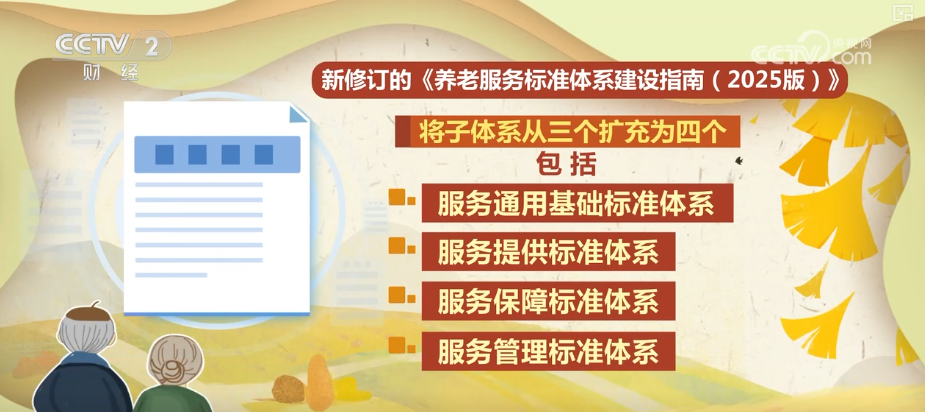
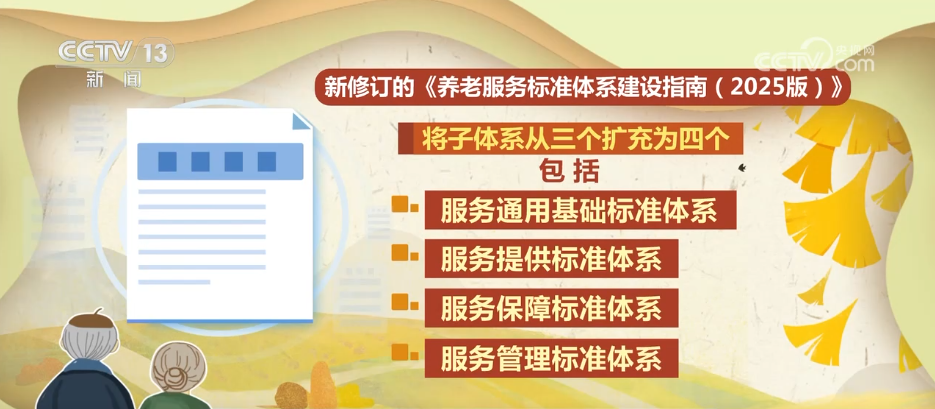
Core Viewpoint - The Ministry of Civil Affairs and the State Administration for Market Regulation have jointly released the "Guidelines for the Construction of the Elderly Care Service Standard System (2025 Edition)" to enhance the standardization and evaluation system for elderly care services, aiming for high-quality development in this sector [1] Group 1: Standard System Overview - The revised 2025 edition expands the sub-systems from three to four, including: General Basic Standards System, Service Provision Standards System, Service Guarantee Standards System, and Service Management Standards System [2] - The General Basic Standards System aims to unify fundamental and general concepts and scopes in the elderly care sector [4] - The Service Provision Standards System is designed to standardize the content and specific requirements of elderly care services [4] - The Service Guarantee Standards System focuses on regulating the operational support elements for various elderly care institutions, including personnel training, job settings, environmental construction, facilities, technology assistance, information technology, and elderly products [4] Group 2: Current Challenges and Future Directions - The Deputy Director of the Elderly Care Service Department highlighted that while significant progress has been made in standardization, there are still shortcomings in the system's framework, mechanism, and element guarantees, such as an imbalance in standard supply and a predominance of recommended standards over mandatory ones [6] - The upcoming focus will be on accelerating the development of key core standards, emphasizing speed, quality, and mandatory nature to increase the effective supply of standards [6] Group 3: Focus on Elderly Products - As of October 2025, the State Administration for Market Regulation has published a total of 262 national standards related to elderly-friendly and barrier-free designs, with 13 standards specifically for elderly products, including appliances, furniture, shoes, reading glasses, and adult diapers [9] - The Deputy Director of the Standards Technology Department stated that there will be a continued emphasis on coordinating standards for elderly products and services, particularly in key areas such as rehabilitation aids, textiles, home appliances, public facilities, smart products, and life services [11]
新版养老服务指南回应民生关切
Jing Ji Wang· 2025-11-27 02:07
Core Viewpoint - The Ministry of Civil Affairs and the State Administration for Market Regulation have jointly issued the revised "Guidelines for the Construction of the Elderly Care Service Standard System (2025 Edition)", aiming to enhance the quality of elderly care services and establish a standard system that aligns with China's national conditions [1][2]. Group 1: Standardization and Quality Improvement - The revised guidelines optimize the standard system framework, clarifying standard targets and improving structural organization to adapt to new developments in elderly care services [2][3]. - New secondary and tertiary indicators have been added, particularly in service provision, to address the characteristics of different service scenarios such as home, community, and institutional care [2][3]. - The guidelines include indicators for "age-friendly transformation services," "safety management," and "technology assistance for the elderly," reinforcing health management policies like health assessments and monitoring [2][3]. Group 2: Addressing Current Challenges - Despite a large number of elderly care institutions and diverse service models, there are still deficiencies in service quality and risk management, necessitating the clarification of service content and quality requirements [3]. - The revision aims to tackle issues such as unbalanced standard supply, weak guidance, and ineffective implementation of key standards, ensuring that standardization keeps pace with the evolving needs of elderly care services [3]. Group 3: Supporting Elderly Needs - The increasing diversity in the needs of the elderly population in areas like care, health management, and social security highlights the importance of a robust standard system for ensuring high-quality elderly living [4]. - As of October this year, 262 national standards related to age-friendliness and accessibility have been published, supporting the establishment of a senior-friendly society [4]. Group 4: Future Directions - The State Administration for Market Regulation plans to enhance collaboration with relevant departments to accelerate the development of essential and urgently needed elderly care standards, particularly in home and community care, quality safety, and smart elderly care [5]. - The implementation of the guidelines is seen as an opportunity to promote the effective application of important standards, supporting the establishment of a unified national elderly care service standard and evaluation system [5].
新版养老服务指南回应民生关切 新增适老化改造服务、科技助老等指标
Jing Ji Ri Bao· 2025-11-27 01:12
Core Viewpoint - The Ministry of Civil Affairs and the State Administration for Market Regulation have jointly issued the revised "Guidelines for the Construction of the Elderly Care Service Standard System (2025 Edition)", aiming to enhance the quality of elderly care services and establish a standard system that aligns with China's national conditions [1] Group 1: Standardization and Quality Improvement - The revised guidelines are designed to adapt to the rapid development of new business models, technologies, and practices in elderly care, addressing issues such as the lack of standards and unbalanced supply structures [1][3] - The new version optimizes the standard system framework, adding multiple secondary and tertiary indicators, particularly in service provision, to ensure comprehensive coverage of various service scenarios [2][3] Group 2: Health and Safety Focus - New indicators have been introduced, including "elderly-friendly renovation services," "safety management," and "technology assistance for the elderly," to enhance health management and care services [2][4] - The guidelines emphasize the need for standardized practices to improve service quality and ensure the safety of elderly individuals, addressing existing deficiencies in service content and quality requirements [3] Group 3: Support for Elderly-Friendly Society - As of October this year, China has released 262 national standards related to elderly care and accessibility, contributing to a robust standard system that supports the construction of an elderly-friendly society [4] - The standardization of elderly products is also progressing, with 13 national standards published to enhance the quality of products tailored for the elderly, ensuring they meet specific needs [4] Group 4: Future Directions - The State Administration for Market Regulation plans to strengthen collaboration with relevant departments to accelerate the development of essential standards for elderly care, particularly in home and community settings [5] - The implementation of the guidelines is seen as a catalyst for establishing a unified national standard and evaluation system for elderly care services, promoting the coordinated development of the elderly care sector and industry [5]
为安享幸福晚年提供标准助力 两部门详解新版养老服务标准体系建设指南
Xin Hua She· 2025-11-26 11:33
Core Viewpoint - The article discusses the recent release of the "Guidelines for the Construction of the Elderly Care Service Standard System (2025 Edition)" by the State Administration for Market Regulation and the Ministry of Civil Affairs, aiming to enhance the quality and standardization of elderly care services in response to the growing demand for such services in society [1][2]. Group 1: Standardization and Development - The new guidelines aim to lead the systematic and standardized development of elderly care services, addressing the rapid evolution of new business models, technologies, and service scenarios such as home care, community services, and institutional care [1][2]. - Compared to the 2017 version, the revised guidelines have made adjustments and expansions in the framework structure, classification methods, coverage of standard objects, and system coding [1]. Group 2: Policy Implementation and Focus Areas - The revision emphasizes the coordination of standards with policy implementation, focusing on accelerating the construction of elderly-friendly housing and improving safety and quality standards for elderly-friendly products [2]. - New indicators have been added, including "elderly-friendly renovation services," "safety management," and "technology assistance for the elderly," highlighting the importance of health care and rehabilitation services [2]. Group 3: Future Directions - The State Administration for Market Regulation plans to accelerate the development of standards in key areas such as rehabilitation aids, textiles, home appliances, public facilities, smart products, and life services to support the elderly in enjoying a happy and secure later life [3].
我国发布262项适老化国家标准,银发经济迎来标准化支撑
Xin Jing Bao· 2025-11-26 10:28
Core Insights - China has entered a moderately aging society, leading to significant policy support for the silver economy, with a total of 262 national standards related to aging and accessibility expected to be published by October 2025 [1][2] Group 1: Policy and Standards Development - The 20th National Congress of the Communist Party has emphasized the development of the silver economy, aiming to address the challenges of population aging, cultivate new economic growth drivers, and improve the quality of life for citizens [1] - The State Administration for Market Regulation is collaborating with the Ministry of Civil Affairs and other departments to enhance the standardization of aging-related products and services, focusing on both aging-friendly renovations and elderly products [1] Group 2: Standardization of Elderly Products - The State Administration for Market Regulation has released 13 national standards for elderly products, including standards for aging-friendly home appliances, furniture, shoes, and adult diapers, effectively addressing the specific needs of the elderly [2] - Related departments are conducting standard promotion activities to guide companies in improving the usability, compatibility, and safety of existing products based on the established standards [2]
养老服务有了“新标尺” 乐享“夕阳红”美好愿景进一步照进现实
Yang Shi Wang· 2025-11-26 10:24
Core Viewpoint - The Ministry of Civil Affairs and the State Administration for Market Regulation have jointly released the "Guidelines for the Construction of the Elderly Care Service Standard System (2025 Edition)" to enhance the standardization and evaluation system for elderly care services, aiming for high-quality development in this sector [1][5]. Group 1: Standard System Expansion - The revised 2025 edition expands the sub-systems from three to four, including: 1. General Basic Standards System 2. Service Provision Standards System 3. Service Guarantee Standards System 4. Service Management Standards System [3][5]. - The General Basic Standards System aims to unify basic and general concepts in the elderly care sector, while the Service Provision Standards System specifies the content and requirements of elderly care services [3]. Group 2: Focus on Core Standards - The Ministry of Civil Affairs emphasizes the need to address shortcomings in the standardization framework, including an imbalance in standard supply, with more recommended standards than mandatory ones [5]. - The new guidelines will accelerate the development of key core standards, focusing on speed, quality, and mandatory nature to increase effective standard supply [5][6]. Group 3: Integration with Other Sectors - The elderly care standardization work will focus on creating a supply structure that combines home-based care, community support, and professional institutional care, integrating resources from various sectors such as housing, health, culture, and finance [6][8]. Group 4: New Indicators and Standards - The updated guidelines introduce new secondary and tertiary indicators, particularly in service provision, to address the characteristics of different service scenarios, including home, community, and institutional care [8]. - New indicators include "entrusted consulting services" and "traveling elderly care services," aligning with the trends in the silver economy [8]. Group 5: Progress in Standards Development - As of October this year, the State Administration for Market Regulation has released a total of 262 national standards related to aging and accessibility, with 13 standards specifically for elderly products [9][11]. - Future efforts will focus on accelerating the development of standards for rehabilitation aids and other key areas related to elderly care [11].
618家电渠道加速分层:线上巨头落地 家居卖场升维
2 1 Shi Ji Jing Ji Bao Dao· 2025-06-15 13:58
Core Viewpoint - The home appliance industry is entering a highly competitive phase as it shifts towards a saturated market, with companies like Red Star Macalline and JD.com expanding their physical presence to capture market share in the home appliance and home improvement sectors [1][2][3]. Group 1: Market Trends - The home appliance market in China is projected to reach a cumulative scale of 730.4 billion yuan in 2024, reflecting a year-on-year growth of 4.2% [2]. - As of May 19, 2023, the "trade-in for new" program has generated cumulative sales of 5.12 billion yuan, with government subsidies amounting to 829 million yuan, accounting for 16.2% of total sales [1]. - The offline channel is experiencing a strong recovery with a projected annual growth rate of 22.3% in 2024, particularly in large chain stores [4]. Group 2: Company Strategies - Red Star Macalline plans to establish over 150 smart appliance lifestyle stores across 115 core cities by the end of 2024, with a total operating area exceeding 1.5 million square meters, representing 10% of its total operating area [1]. - The company aims to transform its product offerings by reducing the area dedicated to traditional categories from nearly 100% to 60%, with a target of 15% for high-end appliances [5]. - JD.com has opened the largest JD MALL in Beijing, indicating a strategic shift towards integrating home appliances and home improvement services in physical retail spaces [1][4]. Group 3: Consumer Behavior - Consumers are increasingly seeking comprehensive solutions rather than individual products, leading to a demand for integrated service platforms that combine home appliances, home decor, and renovation services [3][7]. - The shift in consumer preferences is evident as the renovation market transitions from new home projects to existing home upgrades and partial renovations in major cities [6]. - The overall consumer logic is evolving, with a preference for one-stop service platforms that cater to diverse needs in home improvement and appliance purchasing [4][7].