陶瓷砖

Search documents
市场监管总局开展光伏并网逆变器等16种产品质量抽查,190批次产品不合格
Xin Lang Cai Jing· 2026-02-10 04:38
Core Viewpoint - The State Administration for Market Regulation has conducted a national quality supervision sampling inspection of 16 products, including photovoltaic grid-connected inverters, revealing a significant number of non-compliant products in the market [1] Group 1: Inspection Overview - A total of 1,234 batches of 16 products were sampled across 14 platforms, including major e-commerce sites like Alibaba, JD.com, and Douyin [1] - The inspection covered 205 sales units in 19 provinces, with 225 batches of products checked, and 610 production units in 24 provinces, with 610 batches inspected [1] Group 2: Non-compliance Findings - Out of the inspected products, 190 batches were found to be non-compliant, which includes 4 batches of illegal products, all of which were power adapters [1] - The inspection identified 186 batches of products that failed quality tests, including 3 batches of photovoltaic grid-connected inverters and various other products such as automotive coolant and gas heating water heaters [1] Group 3: Follow-up on Previous Inspections - Among the previously inspected non-compliant production units, 91 were tracked, with 24 of these units still producing non-compliant products [2]
陶瓷巨头蒙娜丽莎,2025年净利润预计将“腰斩”!部分高管拟降薪不低于20%
Mei Ri Jing Ji Xin Wen· 2026-01-20 04:57
Core Viewpoint - Mona Lisa expects a significant decline in net profit for 2025, projecting a year-on-year decrease of 47.18% to between 45 million and 66 million yuan, following a previous profit drop in 2024 [1][3][4]. Group 1: Financial Performance - The anticipated net profit for 2025 is between 45 million and 66 million yuan, a sharp decline from 125 million yuan in the previous year [3][4]. - The expected non-recurring net profit is projected to be between 30 million and 44.5 million yuan, reflecting a year-on-year decrease of 56.74% to 70.84% [3][4]. - Basic earnings per share are expected to drop to 0.11 yuan from 0.31 yuan in the previous year [4]. Group 2: Reasons for Performance Decline - The company cites intense competition in the ceramic tile market and a decline in average selling prices as key factors leading to lower overall sales revenue [5][6]. - The real estate sector, which is closely linked to the company's strategic engineering business, is entering a phase of inventory management, resulting in reduced order volumes [5][6]. - The company has also made provisions for asset impairment in accordance with accounting standards, contributing to the anticipated decline in performance [5]. Group 3: Management Response - In response to the challenging business environment, the company plans to reduce the salaries of some directors and senior management by no less than 20%, aligning with the decline in operating revenue [1][5]. - The company is focusing on strengthening its distribution business, expanding market reach, and implementing lean management practices to control production costs and improve operational efficiency [1][5]. Group 4: Industry Context - The building materials and home improvement industry is undergoing a transformation, moving from a growth phase to a period of inventory competition, with expectations for a more favorable supply-demand balance by 2026 [6][7]. - Despite current challenges, there is optimism regarding future demand driven by urbanization, renovation of existing homes, and public building decoration [6][7]. - The company believes that there are still significant opportunities in the ceramic tile market, despite recent downturns, and is exploring financial investments within a controlled risk framework [7].

山东省济宁市市场监管局公布2025年第2批市级产品质量监督抽查结果
Zhong Guo Zhi Liang Xin Wen Wang· 2026-01-08 08:50
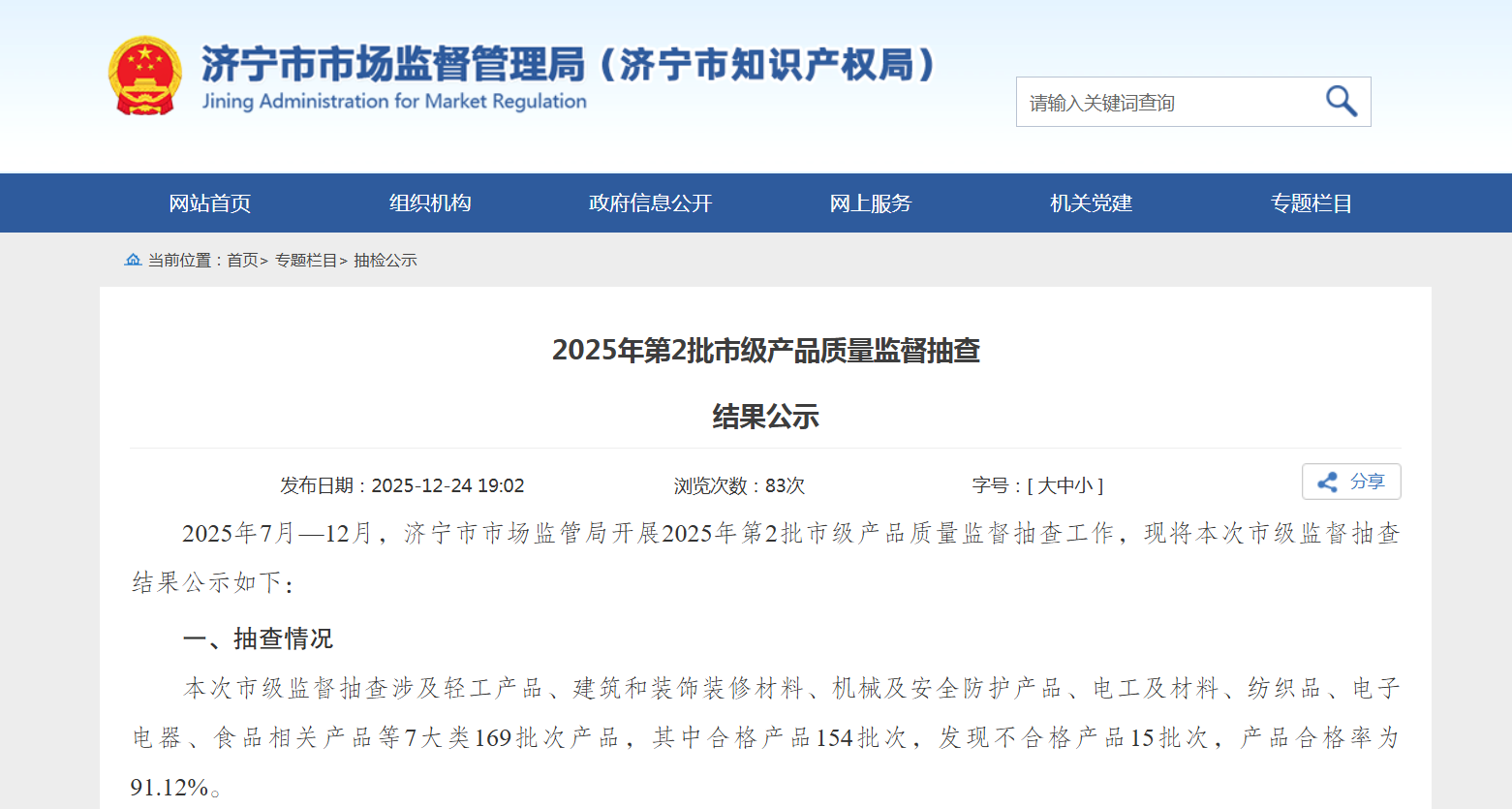
Summary of Key Points Core Viewpoint The Jining Market Supervision Administration in Shandong Province has released the results of the second batch of product quality supervision and spot checks for 2025, indicating a product pass rate of 91.12% across various categories. Group 1: Overall Inspection Results - A total of 169 batches of products were inspected, with 154 batches passing and 15 batches failing, resulting in a compliance rate of 91.12% [2]. Group 2: Specific Product Categories - **Plastic Shopping Bags**: Out of 3 batches inspected, 1 batch was found non-compliant, leading to a non-compliance rate of 33.33% [3]. - **Chlor-alkali Products**: All 6 batches of high-purity hydrochloric acid and by-product hydrochloric acid were compliant [4]. - **Industrial Formaldehyde**: All 2 batches inspected were compliant [5]. - **Industrial Methanol**: All 3 batches inspected were compliant [6]. - **Sodium Hypochlorite**: All 2 batches inspected were compliant [7]. - **Benzene Products**: Both batches of crude benzene and coke benzene products were compliant [8][9]. - **Industrial Hydrogen Peroxide**: The single batch inspected was compliant [10]. - **Lead-acid Batteries**: All 11 batches inspected were compliant [11]. - **Household and Similar Use Plugs and Sockets**: All 5 batches inspected were compliant [12]. - **Food Contact Paper Packaging and Containers**: All 4 batches inspected were compliant [13]. - **Food Contact Plastic Packaging Containers and Tools**: All 4 batches inspected were compliant [14]. - **Composite Film Bags**: All 7 batches inspected were compliant [15]. - **Non-composite Film Bags**: All 3 batches inspected were compliant [16]. - **Melamine Plastic Tableware**: All 2 batches inspected were compliant [17]. - **Construction Steel**: All 30 batches inspected were compliant [18]. - **Waterproof Membranes**: All 5 batches inspected were compliant [19]. - **Ceramic Tiles**: All 6 batches inspected were compliant [20]. - **Automotive Lubricants**: All 11 batches inspected were compliant [21]. - **Coal Products**: All 10 batches inspected were compliant [22]. - **Textiles**: Out of 50 batches inspected, 14 batches were found non-compliant, resulting in a non-compliance rate of 28% [23].
蒙娜丽莎(002918) - 2026年1月7日投资者关系活动记录表
2026-01-07 09:46
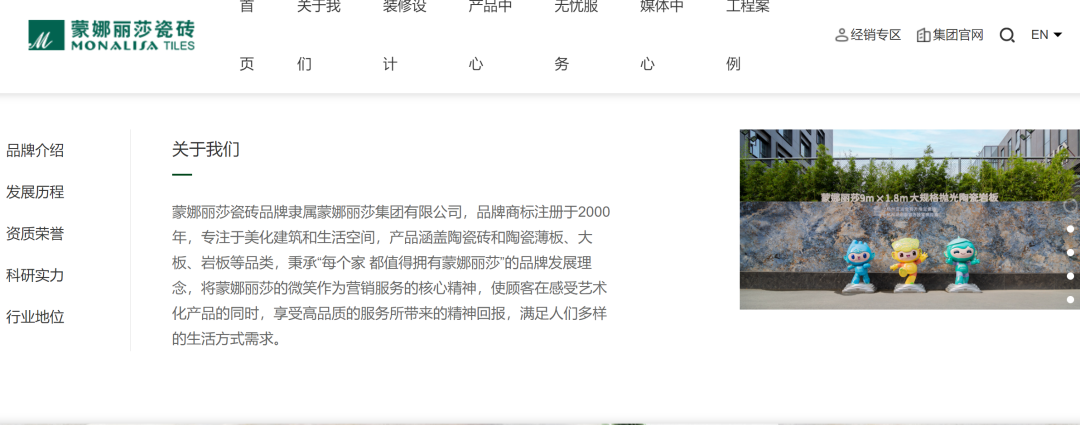
Group 1: Industry Overview - The ceramic industry in 2025 continues the development trend of 2024, with no significant stabilization observed, and market share of leading companies remains low [2] - In 2026, national policies will focus on boosting domestic demand, which is expected to benefit the ceramic industry under pressure [2] - Urbanization, renovation, and public building decoration will maintain significant market demand, leading to structural adjustments in the ceramic industry [2] Group 2: Company Brand Positioning - The company specializes in high-quality building ceramic products, with brands including "Mona Lisa," "QD," and "Meierqi," and is a leader in large ceramic slabs and rock slabs [2] - The brand philosophy emphasizes that "every home deserves a Mona Lisa," integrating brand culture into product quality and customer service [2] - Continuous focus on product innovation, quality enhancement, and service optimization is essential for increasing brand attractiveness and consumer choice [2] Group 3: Financial Performance and Strategy - The company has seen a gradual improvement in gross margin, with ongoing cost reduction and efficiency enhancement measures [3] - Future cost reduction will become more challenging, leading to a greater focus on quality improvement and efficiency [3] - The management prioritizes cash flow and profitability, implementing lean management and enhancing brand value transmission [3] Group 4: Investment and Growth Strategy - The company aims to strengthen its core ceramic business while pursuing a "big tile, big building materials, big home" strategy [3] - Current investments are limited in impact on overall performance, with a focus on maintaining risk control [3] - Any significant future investments will be disclosed in accordance with legal regulations [3]
【图解】推动新兴产业、未来产业发展 12月起一批国家标准将实施
Zhong Guo Jing Ji Wang· 2025-12-02 08:06
Group 1 - A series of important national standards will be implemented starting in December, aimed at promoting the healthy development of emerging and future industries, creating a favorable consumer environment, and ensuring the safety of people's lives and property [3][4][5][6][7][8][9][10][11][12][13][14][15][16][17][18][19][20]. Group 2 - The standard for sensitive personal information processing (GB/T 45574-2025) establishes general and specific security requirements, further regulating the handling of sensitive personal information and protecting the rights of individuals [5]. - The e-commerce platform service quality evaluation standard (GB/T 31526-2025) introduces an evaluation index system to enhance service quality and optimize user experience on e-commerce platforms [6]. - The green packaging technical specifications for toys and children's products (GB/T 44869-2024) set basic requirements for packaging, aiming to reduce plastic waste and promote green development in the sector [7][8]. - The industrial instrument intelligence level requirements (GB/T 45727-2025) will drive technological innovation and industry upgrades in instrument manufacturing [9]. - The national standards for urban furniture (GB/T 45793-2025 and GB/T 45794-2025) will improve the performance and quality of public facilities, enhancing urban living environments [10][12]. - The ceramic tile quality grading standard (GB/T 45817-2025) aims to elevate product quality and promote the transformation of the ceramic tile industry towards mid-to-high-end development [13]. - The furniture recycling transaction technical specifications (GB/T 45697-2025) will standardize recycling practices, improving efficiency and transparency in the furniture industry [14]. - The guidelines for classifying and grading agricultural product wholesale markets (GB/T 46118-2025) will enhance management practices and support high-quality development in the sector [15]. - Standards related to business entity credit will improve credit levels and provide technical support for the construction of a social credit system [16][17]. - The technical guidelines for in-depth investigation of traffic accidents (GB/T 45645.1-2025) will support scientific determination of accident causes and enhance traffic safety management [18]. - The dynamic monitoring and early warning requirements for the safety performance of new energy vehicles (GB/T 45688-2025) will help standardize safety monitoring platforms [19]. - The technical specifications for remote service and management systems for electric vehicles (GB/T 32960.1-2025 and GB/T 32960.4-2025) will ensure safe and reliable operation of electric vehicles, promoting healthy development in the new energy vehicle industry [20].

陶瓷砖新国标实施 上市公司着力推动产品创新升级
Zheng Quan Ri Bao Zhi Sheng· 2025-12-01 16:37
Core Viewpoint - The implementation of the national standard "Quality Grading of Consumer Ceramic Tiles" marks a significant step in the transformation of China's ceramic tile industry, guiding competition back to product value enhancement and curbing low-price and disorderly competition [1][2]. Industry Overview - The new standard provides clear and quantifiable criteria for high-quality ceramic tiles, establishing a benchmark for companies and accelerating the elimination of inefficient production capacity and industry consolidation [1]. - The highest quality grade is designated as "5A" (AAAAA), with only an estimated 5% of products expected to meet this standard across the industry [1]. Company Actions - Leading companies such as Dongpeng Holdings, Marco Polo, and Mona Lisa are actively promoting product innovation and upgrading in response to the new standard [1][2]. - Dongpeng Holdings emphasizes its long-standing high-standard manufacturing and quality control capabilities, which are expected to provide a competitive advantage under the new standard [2]. - Mona Lisa has launched its first batch of 5A ceramic products, implementing a closed-loop quality control model that integrates over 1,100 internal standards that exceed national benchmarks [2]. Market Dynamics - The market share of leading ceramic tile companies remains relatively low, and the new standard is anticipated to drive industry consolidation [2]. - Companies are encouraged to seize development opportunities through product innovation and upgrades to enhance competitiveness and capture a larger market share [2].
涉及敏感个人信息处理、电商服务等 12月1日起一批国家标准实施
Zhong Guo Xin Wen Wang· 2025-12-01 08:01
Core Points - A series of important national standards will be implemented starting December 1, aimed at promoting the healthy development of emerging industries and ensuring consumer safety [1] Sensitive Personal Information Processing - The national standard for sensitive personal information processing (GB/T 45574—2025) establishes general and specific security requirements, enhancing the protection of personal information rights [2] E-commerce Platform Services - The national standard for e-commerce platform service quality evaluation (GB/T 31526—2025) introduces a comprehensive evaluation index system to improve service quality and user experience on e-commerce platforms [3] Green Packaging for Toys and Children's Products - The national standard for green packaging of toys and children's products (GB/T 44869—2024) sets basic requirements for materials, excessive packaging limitations, recycling, and environmental impact analysis [4] Industrial Instrument Intelligence - The national standard for industrial instrument intelligence levels (GB/T 45727—2025) outlines requirements and evaluation methods, promoting technological innovation and industry upgrades [5] Urban Furniture - Two national standards for urban furniture provide guidelines for system planning, design, maintenance, and management, enhancing the quality and comfort of urban public facilities [6] Ceramic Tile Quality Classification - The national standard for ceramic tile quality classification (GB/T 45817—2025) defines classification principles and testing methods, aiming to elevate product quality and drive industry transformation [7] Furniture Recycling Transactions - The national standard for furniture recycling transactions (GB/T 45697—2025) specifies operational requirements to enhance efficiency and transparency in the recycling process [8] Agricultural Product Wholesale Market - The national standard for agricultural product wholesale market classification (GB/T 46118—2025) establishes classification principles and indicators to improve market management and promote high-quality development [10] Business Entity Credit Standards - A set of national standards related to business entity credit aims to enhance credit levels and provide a technical basis for the construction of a social credit system [11] Traffic Accident Investigation - The national standard for traffic accident investigation (GB/T 45645.1—2025) defines terms and principles for conducting thorough investigations, contributing to improved traffic safety management [12] New Energy Vehicle Safety Monitoring - The national standard for dynamic monitoring and early warning of new energy vehicle safety performance (GB/T 45688—2025) aims to standardize data monitoring and enhance safety management [13] Electric Vehicle Remote Service and Management - The national standards for electric vehicle remote service and management systems outline system architecture and testing requirements, ensuring safe and reliable operation of electric vehicles [14]
涉及敏感个人信息、电商服务、新能源汽车安全等 12月1日起一批国家标准实施
Jing Ji Guan Cha Wang· 2025-12-01 06:15
Group 1 - A series of important national standards will be implemented starting December 1, which include sensitive personal information processing, e-commerce platform services, and green packaging for toys and children's products [1] - These standards aim to promote the healthy development of emerging and future industries, create a favorable consumption environment, and ensure the safety of people's lives and property [1] - Specific areas covered by the new standards include industrial instrument intelligence levels, urban furniture, ceramic tile quality grading, furniture recycling transactions, agricultural product wholesale market classification and grading, business entity credit, in-depth investigation of road traffic accidents, dynamic monitoring and early warning of new energy vehicle operational safety performance, and remote service and management systems for electric vehicles [1]
行业聚焦:全球建筑陶瓷行业头部企业市场份额及排名情况(附厂商名单)
QYResearch· 2025-11-25 02:49
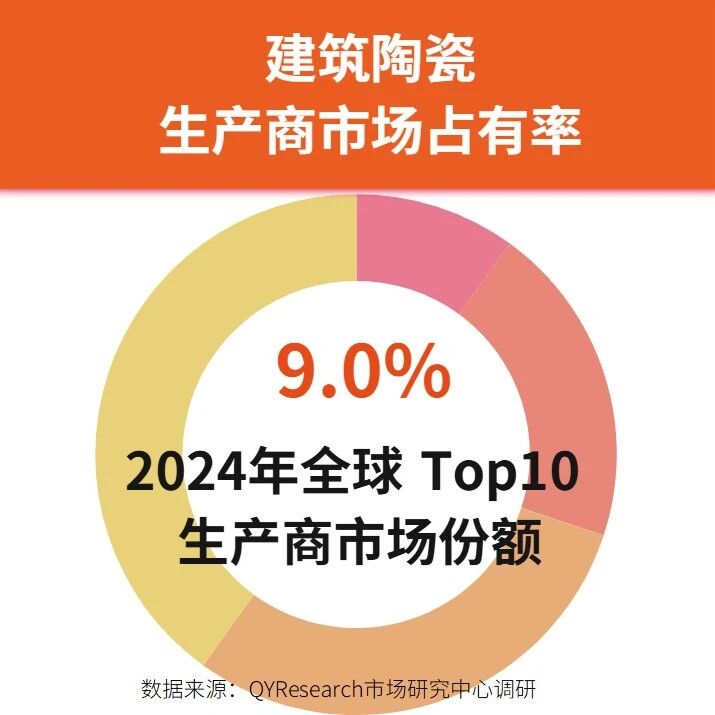
Core Viewpoint - The global building ceramics market is projected to reach a size of $137.44 billion by 2031, with a compound annual growth rate (CAGR) of 2.4% in the coming years [4]. Market Overview - Building ceramics include various ceramic products used in construction, such as wall tiles, floor tiles, and glazed tiles, characterized by high strength, fire resistance, moisture resistance, frost resistance, acid and alkali resistance, and color retention [2]. - The global market for building ceramics is currently undergoing a strategic transformation, shifting from scale expansion to value-driven and sustainable development [13]. Market Size and Trends - The global production of tiles is expected to decline to 14.95 billion square meters in 2024, a decrease of 6.2% from 2023 [11]. - Asia is the largest production region for building ceramics, accounting for 72.8% of global production, while Europe contributes 10.9% [11]. Key Market Players - Major global manufacturers include Mohawk Industries, LAMOSA, Grupo Pamesa, Marco Polo, Dongpeng Holdings, and Mona Lisa, with the top ten companies holding approximately 9.0% of the market share in 2024 [7]. Product Segmentation - Ceramic tiles are the primary product segment, holding about 71.2% of the market share [9]. Market Drivers - The demand for aesthetically pleasing and durable building materials is increasing, particularly for natural stone tiles, which offer rich design options and exceptional durability [18]. - The ongoing expansion of the construction and real estate sectors, especially in emerging economies, is a significant driver for the building ceramics market [19]. - Advances in manufacturing technology, such as digital printing and automation, are enhancing product quality and design possibilities while optimizing production costs [20]. Challenges Facing the Industry - The building ceramics industry faces environmental pressures and rising production costs due to the need for compliance with carbon neutrality and stricter environmental policies [22]. - The application of new technologies, such as foamed ceramics, is hindered by technical and standardization barriers, limiting their market adoption [23]. - Intense competition and market fragmentation, particularly in developing countries, lead to price competition and compressed profit margins [24].
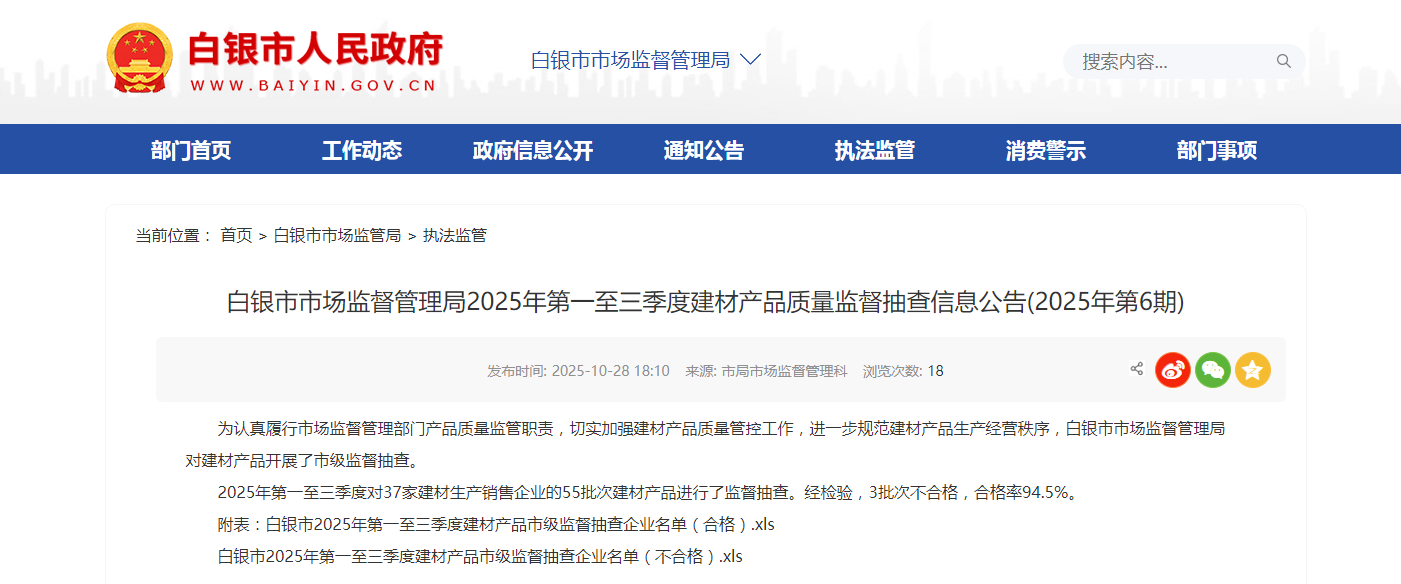
甘肃省白银市市场监督管理局发布2025年第一至三季度建材产品质量监督抽查信息公告(2025年第6期)
Zhong Guo Zhi Liang Xin Wen Wang· 2025-11-12 04:42
Core Insights - The Baiyin City Market Supervision Administration conducted a quality supervision inspection of building materials from January to September 2025, involving 55 batches from 37 production and sales enterprises, with a compliance rate of 94.5% [2][3]. Group 1: Quality Inspection Results - A total of 55 batches of building materials were inspected, with 3 batches found to be non-compliant, resulting in a compliance rate of 94.5% [2][3]. - The inspection aimed to strengthen quality control and standardize the production and operation order of building materials in Baiyin City [2]. Group 2: Compliance and Non-compliance - The inspection identified specific enterprises with non-compliant products, which included issues related to size deviation, appearance quality, and other quality parameters [2][3]. - A list of compliant and non-compliant enterprises was published, providing transparency and accountability in the building materials market [2].