
养老服务标准化

Search documents
为安享幸福晚年提供标准助力
Xin Lang Cai Jing· 2026-01-17 18:43
Core Insights - The Ministry of Civil Affairs and the State Administration for Market Regulation have jointly released the "Guidelines for the Construction of Elderly Care Service Standards System (2025 Edition)" to promote high-quality development in elderly care services [2][3] - The revised guidelines aim to adapt to new business models, technologies, and service scenarios in elderly care, enhancing the standardization and regulation of services related to elderly living, mental comfort, and more [3][4] Group 1: Standardization and Development - The new guidelines include adjustments in the framework structure, classification methods, coverage of standard objects, and coding of the standards compared to the 2017 version [2] - The revision emphasizes the need for standardization in various service scenarios, including home care, community services, and institutional care, laying a solid foundation for systematic and standardized development in elderly care [3] Group 2: Policy Implementation and Focus Areas - The guidelines strengthen the collaboration between standards and policy implementation, focusing on accelerating the construction of elderly-friendly housing and improving safety and quality standards for elderly products [3] - The initiative includes the development of standards for elderly care services, safety management, and technology assistance for the elderly, highlighting the importance of health care and rehabilitation services [3][4] Group 3: Market Regulation and Product Development - The State Administration for Market Regulation has coordinated with various departments to expedite the development of national standards for elderly-friendly public infrastructure, home environments, and products, addressing the digital divide faced by the elderly [4] - A total of 262 national standards related to elderly care and accessibility have been published, guiding companies to enhance the usability and safety of products designed for the elderly [4]

人民财评:以品牌化、标准化推动养老服务跃升
Ren Min Wang· 2026-01-14 08:29
Core Viewpoint - The Ministry of Civil Affairs and seven other departments have jointly issued measures to promote the branding of elderly care services, aiming to elevate the sector from fragmentation and low standards to branding and standardization, thereby enhancing the silver economy [1][2]. Group 1: Market Potential and Demographics - The silver economy in China has significant growth potential, with the elderly population aged 60 and above expected to reach 310 million by the end of 2024 and over 400 million by 2035, leading to a market scale projected to exceed 30 trillion yuan [1]. - The branding of elderly care services is essential for the development of the silver economy, ensuring that the elderly can enjoy better care and services [1]. Group 2: Branding and Standardization - The current elderly care market suffers from fragmentation, with a lack of standardized services and low consumer trust, which the new measures aim to address by supporting chain-operated care services and encouraging trademark registration [1]. - The measures propose the establishment of distinctive signage for care service providers and the inclusion of brands in the "China Consumer Famous Products" list, transforming service providers from "general stores" to "flagship stores" [1]. Group 3: Technological Integration - The future of elderly care will require technological empowerment, with a projected increase in the care-dependent population to over 40 million in the next five years, creating a demand for over 5 million additional caregivers [2]. - The measures advocate for the integration of big data, cloud computing, artificial intelligence, and Beidou technology in health monitoring, safety alerts, and personalized services for the elderly, enhancing service quality [2]. Group 4: Sustainable Development and Market Dynamics - The branding initiative is expected to foster a fair competitive environment, driving market development and creating a sustainable cycle of improved services, increased consumption, and a more vibrant industry [2]. - The policy aims to transition elderly care services from quantity expansion to quality improvement, laying the groundwork for high-quality, large-scale, and professional development in the silver economy [2].
新版养老服务标准体系建设指南发布
Ren Min Ri Bao Hai Wai Ban· 2025-11-28 21:27
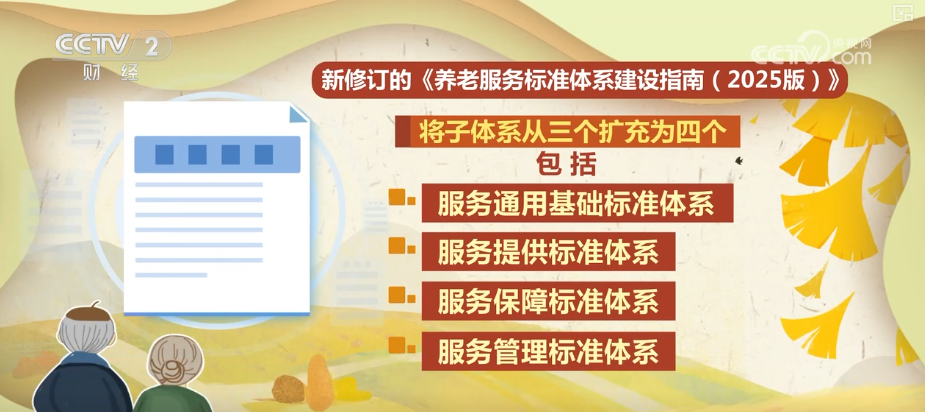
Core Viewpoint - The Ministry of Civil Affairs and the State Administration for Market Regulation have jointly issued the revised "Guidelines for the Construction of the Elderly Care Service Standard System (2025 Edition)" to enhance the standardization of elderly care services and address existing issues in the sector [1] Summary by Sections - The revised guidelines aim to resolve problems such as the lack of standards, outdated standards, unbalanced and insufficient standard supply structure, and inadequate working mechanisms in elderly care services [1] - The new version builds upon the 2017 edition, adjusting and expanding the main standard system framework, clarifying standard objects, and creating a more complete and scientifically categorized structure [1] - The main content of the new guidelines is divided into six parts, with the construction content section consisting of four parts: general basic service standards, service provision standards, service guarantee standards, and service management standards [1] - These standards are intended to unify the concepts and scope of elderly care services, standardize service content and specific requirements, and regulate the operation and management of various elderly care institutions [1]
事关养老!为群众安享幸福晚年提供标准助力 | 新版标准指南解读↓
Yang Shi Wang· 2025-11-27 08:29
Core Viewpoint - The Ministry of Civil Affairs and the State Administration for Market Regulation have jointly released the "Guidelines for the Construction of the Elderly Care Service Standard System (2025 Edition)" to enhance the standardization and evaluation system for elderly care services, aiming for high-quality development in this sector [1] Group 1: Standard System Overview - The revised 2025 edition expands the sub-systems from three to four, including: General Basic Standards System, Service Provision Standards System, Service Guarantee Standards System, and Service Management Standards System [2] - The General Basic Standards System aims to unify fundamental and general concepts and scopes in the elderly care sector [4] - The Service Provision Standards System is designed to standardize the content and specific requirements of elderly care services [4] - The Service Guarantee Standards System focuses on regulating the operational support elements for various elderly care institutions, including personnel training, job settings, environmental construction, facilities, technology assistance, information technology, and elderly products [4] Group 2: Current Challenges and Future Directions - The Deputy Director of the Elderly Care Service Department highlighted that while significant progress has been made in standardization, there are still shortcomings in the system's framework, mechanism, and element guarantees, such as an imbalance in standard supply and a predominance of recommended standards over mandatory ones [6] - The upcoming focus will be on accelerating the development of key core standards, emphasizing speed, quality, and mandatory nature to increase the effective supply of standards [6] Group 3: Focus on Elderly Products - As of October 2025, the State Administration for Market Regulation has published a total of 262 national standards related to elderly-friendly and barrier-free designs, with 13 standards specifically for elderly products, including appliances, furniture, shoes, reading glasses, and adult diapers [9] - The Deputy Director of the Standards Technology Department stated that there will be a continued emphasis on coordinating standards for elderly products and services, particularly in key areas such as rehabilitation aids, textiles, home appliances, public facilities, smart products, and life services [11]
新版养老服务指南回应民生关切
Jing Ji Wang· 2025-11-27 02:07
Core Viewpoint - The Ministry of Civil Affairs and the State Administration for Market Regulation have jointly issued the revised "Guidelines for the Construction of the Elderly Care Service Standard System (2025 Edition)", aiming to enhance the quality of elderly care services and establish a standard system that aligns with China's national conditions [1][2]. Group 1: Standardization and Quality Improvement - The revised guidelines optimize the standard system framework, clarifying standard targets and improving structural organization to adapt to new developments in elderly care services [2][3]. - New secondary and tertiary indicators have been added, particularly in service provision, to address the characteristics of different service scenarios such as home, community, and institutional care [2][3]. - The guidelines include indicators for "age-friendly transformation services," "safety management," and "technology assistance for the elderly," reinforcing health management policies like health assessments and monitoring [2][3]. Group 2: Addressing Current Challenges - Despite a large number of elderly care institutions and diverse service models, there are still deficiencies in service quality and risk management, necessitating the clarification of service content and quality requirements [3]. - The revision aims to tackle issues such as unbalanced standard supply, weak guidance, and ineffective implementation of key standards, ensuring that standardization keeps pace with the evolving needs of elderly care services [3]. Group 3: Supporting Elderly Needs - The increasing diversity in the needs of the elderly population in areas like care, health management, and social security highlights the importance of a robust standard system for ensuring high-quality elderly living [4]. - As of October this year, 262 national standards related to age-friendliness and accessibility have been published, supporting the establishment of a senior-friendly society [4]. Group 4: Future Directions - The State Administration for Market Regulation plans to enhance collaboration with relevant departments to accelerate the development of essential and urgently needed elderly care standards, particularly in home and community care, quality safety, and smart elderly care [5]. - The implementation of the guidelines is seen as an opportunity to promote the effective application of important standards, supporting the establishment of a unified national elderly care service standard and evaluation system [5].
新版养老服务指南回应民生关切 新增适老化改造服务、科技助老等指标
Jing Ji Ri Bao· 2025-11-27 01:12
Core Viewpoint - The Ministry of Civil Affairs and the State Administration for Market Regulation have jointly issued the revised "Guidelines for the Construction of the Elderly Care Service Standard System (2025 Edition)", aiming to enhance the quality of elderly care services and establish a standard system that aligns with China's national conditions [1] Group 1: Standardization and Quality Improvement - The revised guidelines are designed to adapt to the rapid development of new business models, technologies, and practices in elderly care, addressing issues such as the lack of standards and unbalanced supply structures [1][3] - The new version optimizes the standard system framework, adding multiple secondary and tertiary indicators, particularly in service provision, to ensure comprehensive coverage of various service scenarios [2][3] Group 2: Health and Safety Focus - New indicators have been introduced, including "elderly-friendly renovation services," "safety management," and "technology assistance for the elderly," to enhance health management and care services [2][4] - The guidelines emphasize the need for standardized practices to improve service quality and ensure the safety of elderly individuals, addressing existing deficiencies in service content and quality requirements [3] Group 3: Support for Elderly-Friendly Society - As of October this year, China has released 262 national standards related to elderly care and accessibility, contributing to a robust standard system that supports the construction of an elderly-friendly society [4] - The standardization of elderly products is also progressing, with 13 national standards published to enhance the quality of products tailored for the elderly, ensuring they meet specific needs [4] Group 4: Future Directions - The State Administration for Market Regulation plans to strengthen collaboration with relevant departments to accelerate the development of essential standards for elderly care, particularly in home and community settings [5] - The implementation of the guidelines is seen as a catalyst for establishing a unified national standard and evaluation system for elderly care services, promoting the coordinated development of the elderly care sector and industry [5]
新增适老化改造服务、科技助老等指标——新版养老服务指南回应民生关切
Jing Ji Ri Bao· 2025-11-26 22:39
Core Viewpoint - The Ministry of Civil Affairs and the State Administration for Market Regulation have jointly issued the revised "Guidelines for the Construction of the Elderly Care Service Standard System (2025 Edition)", aiming to enhance the quality of elderly care services and establish a standard system that aligns with China's national conditions [1][2]. Group 1: Standardization and Quality Improvement - The revised guidelines optimize the standard system framework, clarifying standard targets and improving structural organization to adapt to new developments in elderly care services [2][3]. - New secondary and tertiary indicators have been added, particularly in service provision, to address various service scenarios such as home, community, and institutional care, thereby laying a foundation for systematic and standardized development of elderly care services [2][3]. Group 2: Addressing Current Challenges - Despite the large number of elderly care institutions and facilities, there are still deficiencies in service quality and risk management, necessitating the clarification of service content and quality requirements through standardization [3]. - The revision aims to tackle issues such as unbalanced standard supply structure, weak guidance of standards, and inadequate implementation of key standards, ensuring that standardization keeps pace with the evolving needs of elderly care services [3]. Group 3: Supporting Elderly Needs - The guidelines emphasize the importance of a comprehensive standard system to meet the diverse needs of the elderly in areas such as life care, health management, social security, and cultural enrichment [4]. - As of October this year, China has issued 262 national standards related to elderly care and accessibility, establishing a standard system that supports the construction of an elderly-friendly society [4]. Group 4: Future Directions - The State Administration for Market Regulation plans to enhance collaboration with relevant departments to accelerate the development of essential elderly care service standards, particularly in home and community care, quality safety, and smart elderly care [5]. - The implementation of the guidelines is seen as an opportunity to promote the effective application of important standards, supporting the establishment of a unified national elderly care service standard and evaluation system [5].
为安享幸福晚年提供标准助力 两部门详解新版养老服务标准体系建设指南
Xin Hua She· 2025-11-26 11:33
Core Viewpoint - The article discusses the recent release of the "Guidelines for the Construction of the Elderly Care Service Standard System (2025 Edition)" by the State Administration for Market Regulation and the Ministry of Civil Affairs, aiming to enhance the quality and standardization of elderly care services in response to the growing demand for such services in society [1][2]. Group 1: Standardization and Development - The new guidelines aim to lead the systematic and standardized development of elderly care services, addressing the rapid evolution of new business models, technologies, and service scenarios such as home care, community services, and institutional care [1][2]. - Compared to the 2017 version, the revised guidelines have made adjustments and expansions in the framework structure, classification methods, coverage of standard objects, and system coding [1]. Group 2: Policy Implementation and Focus Areas - The revision emphasizes the coordination of standards with policy implementation, focusing on accelerating the construction of elderly-friendly housing and improving safety and quality standards for elderly-friendly products [2]. - New indicators have been added, including "elderly-friendly renovation services," "safety management," and "technology assistance for the elderly," highlighting the importance of health care and rehabilitation services [2]. Group 3: Future Directions - The State Administration for Market Regulation plans to accelerate the development of standards in key areas such as rehabilitation aids, textiles, home appliances, public facilities, smart products, and life services to support the elderly in enjoying a happy and secure later life [3].
中国加快推动解决养老服务标准缺失滞后问题
Zhong Guo Xin Wen Wang· 2025-11-26 11:01
Core Points - China is accelerating efforts to address the lack of standards in elderly care services due to the increasing aging population, which has become a significant public concern [1] - The National Market Supervision Administration and the Ministry of Civil Affairs jointly released the "Guidelines for the Construction of Elderly Care Service Standards System (2025 Edition)" to tackle issues related to outdated and insufficient standards [1] Summary by Sections Standard System Revision - The revised guidelines have shifted from three sub-systems in the 2017 version to four, adding a new service management standard system to regulate various aspects of elderly care institutions [2] - The new service management standards will cover admission and discharge processes, standard system construction, dispute resolution, service quality monitoring, institution evaluation, credit management, risk prevention, and protection of elderly rights [2] Future Directions - The National Market Supervision Administration plans to continue strengthening the coordination of standards for elderly products and services, focusing on key areas such as rehabilitation aids, textiles, home appliances, public facilities, smart products, and life services [2] - The aim is to accelerate the development of age-appropriate standards to enhance the quality of life for the elderly population [2]
养老服务标准大升级,2025版指南呈现四大变化
Xin Jing Bao· 2025-11-26 10:52
Core Points - The new guideline for the construction of the elderly care service standard system (2025 version) has been comprehensively upgraded compared to the 2017 version, aiming to enhance the foundational and leading role of standardization in the high-quality development of elderly care services [1][2] Group 1: Structural Improvements - The framework structure of the standard system has been optimized, adding a "service management" subsystem to the existing three subsystems, making the framework more reasonable and complete [1] - New secondary and tertiary indicators have been added to adapt to the new requirements of elderly care services, considering different service scenarios such as home, community, and institutional care [1] Group 2: New Indicators and Services - The guideline introduces new indicators such as "entrusted consulting services" and "travel elderly care services" to align with the trends in the silver economy [1] - The guideline emphasizes the importance of life care and mental comfort services, laying a solid foundation for the systematic and standardized development of elderly care services [1] Group 3: Standard Coding and Policy Coordination - The standard coding system has been further improved, enhancing the guidance function for the revision of standards and clarifying the direction for key areas and emerging industries [2] - The guideline strengthens the coordination between standards and policy implementation, adding indicators related to "elderly-friendly home renovations," "safety management," and "technology assistance for the elderly" [2]