联想企业级AI系统

Search documents
杨元庆重磅对谈黄仁勋,透露新合作、AI新风口
2 1 Shi Ji Jing Ji Bao Dao· 2026-01-04 00:24
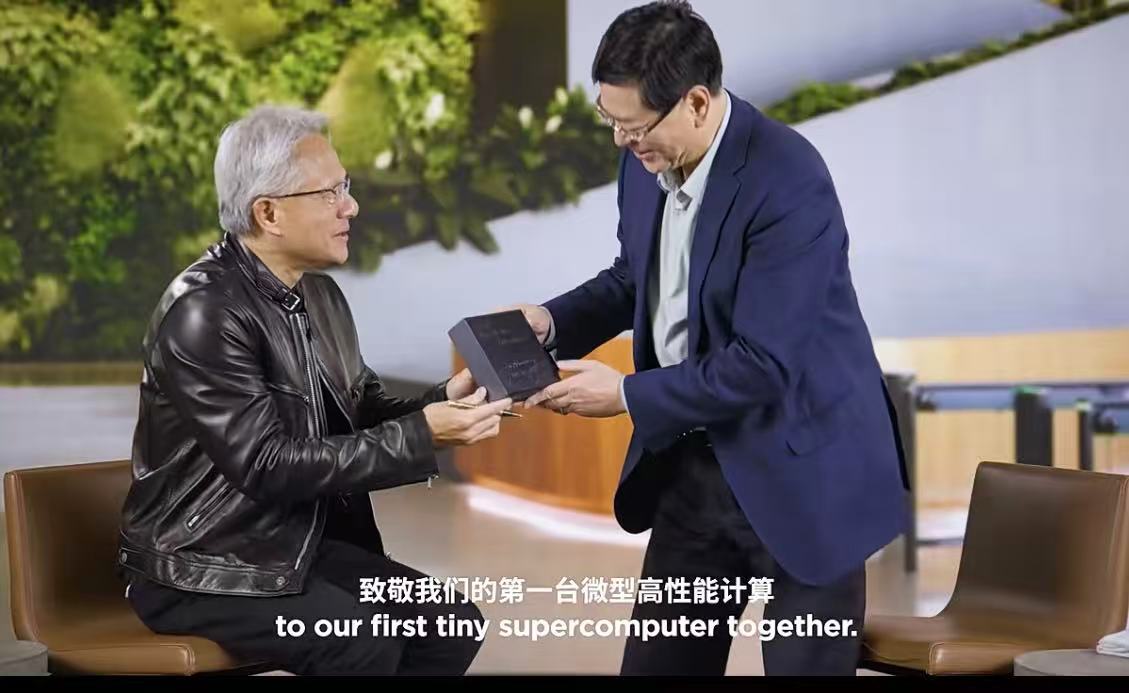
Core Viewpoint - The upcoming CES 2026 will feature Lenovo's largest annual technology innovation conference, "Lenovo Tech World," alongside key figures from the global tech industry, including NVIDIA's CEO Jensen Huang and Lenovo's CEO Yang Yuanqing, who discussed the next wave of artificial intelligence (AI) focusing on "hybrid AI" [1][2]. Group 1: Trends in AI Development - Huang and Yang identified two major trends in the next phase of AI development: enterprise-level AI will become the core battlefield, with hybrid AI as a key breakthrough; AI will permeate various sectors of the real economy, creating significant market opportunities [2][9]. - Huang noted that AI is evolving from "generative AI" to "agent-based AI," achieving breakthroughs in reasoning and problem-solving capabilities, which will enhance AI's practical applications [2][9]. - The focus will shift to the enterprise market, characterized by a deep integration of public cloud models and customized open-source models [2][9]. Group 2: Collaboration Between NVIDIA and Lenovo - NVIDIA is collaborating with Lenovo to develop an enterprise-level AI system based on RTX Pro, with NVIDIA providing its most advanced chips for this project [3][10]. - Huang described the upcoming server as revolutionary and expressed eagerness to launch it for large-scale enterprise market promotion [3][10]. - The partnership between NVIDIA and Lenovo has lasted nearly 30 years, with their collaboration in AI having grown fivefold in recent years, and Huang anticipates the potential for this to increase fivefold again in the next two years [4][11]. Group 3: Future Prospects and Market Opportunities - Huang emphasized that every company is utilizing AI, every industry will be built on AI, and every country is developing AI infrastructure, providing vast opportunities for collaboration [4][11]. - The integration of Lenovo's liquid cooling technology and high-performance hardware with NVIDIA's architectural innovations is expected to drive advancements in server development and factory construction, promoting AI automation in industries such as manufacturing and logistics [4][11]. - Yang presented Huang with Lenovo's latest ThinkStation PGX workstation, which Huang praised as a "personal AI cloud" for developers, symbolizing their ongoing commitment to innovation in high-performance computing [4][12].




杨元庆与黄仁勋“炉边谈话”透露新合作
Mei Ri Jing Ji Xin Wen· 2026-01-03 15:17
Group 1 - The core viewpoint is that artificial intelligence (AI) is evolving from "generative AI" to "agent-based AI," which has stronger problem-solving capabilities and reasoning based on facts [1] - Huang Renxun and Yang Yuanqing agree that the key opportunity for future AI development lies in "hybrid AI" [1] Group 2 - Huang Renxun identifies two major trends in future AI development: the first is the application of agent-based AI systems that will not rely solely on a single cloud model but will deeply integrate cutting-edge large models with customized models from enterprises and individuals [2] - The second trend is the integration of hybrid enterprise intelligence into various global industries, including high-performance computing, AI cloud, AI factories, enterprise intelligence, industrial intelligence, and even robotic intelligence [2] Group 3 - Lenovo Group and NVIDIA have had a nearly 30-year partnership, with their collaboration in the AI field growing fivefold in recent years [2] - Huang Renxun stated that they have the capability to increase this collaboration fivefold again in the next two years [2] Group 4 - NVIDIA is collaborating with Lenovo to create an enterprise-level AI system based on the RTX Pro series of professional-grade graphics cards, with NVIDIA providing its most advanced chips for this project [2] - Lenovo will hold an innovation technology conference on January 6, 2026, during the CES 2026 in Las Vegas, where they will jointly launch an enterprise-level AI product with NVIDIA [2][3]

黄仁勋对谈杨元庆:30年老友立下新目标
Di Yi Cai Jing Zi Xun· 2026-01-03 15:05
Core Insights - The dialogue between NVIDIA CEO Jensen Huang and Lenovo CEO Yang Yuanqing highlights the long-standing partnership and future directions in AI and computing technologies [2][3] - Both companies anticipate significant growth opportunities in the AI sector, particularly through the development of hybrid AI systems [3][4] Group 1: Partnership and Growth - The collaboration between NVIDIA and Lenovo has evolved over 28 years, with business scale increasing fivefold in the last two years [2] - Lenovo's AI business growth is attributed to its global business layout and technological advantages in high-performance computing and water cooling technology [2] - Huang expressed confidence that the partnership could expand fivefold again in the next two years, driven by the widespread adoption of AI across industries [4] Group 2: Future Trends in AI - The next phase of AI development will feature two main trends: the integration of public cloud models with private customized models, and the application of hybrid enterprise intelligence across various industries [3] - Lenovo and NVIDIA are collaborating to create an enterprise-level AI system based on RTX Pro, which Huang described as a revolutionary server [3] - The anticipated launch of this product is expected to significantly impact sectors such as industrial, logistics, warehousing, and robotics [4]
黄仁勋:预计未来两年与联想集团合作规模将翻5倍
Xin Lang Cai Jing· 2026-01-03 13:50
Core Insights - The collaboration between Lenovo and NVIDIA in the AI sector has increased fivefold over the past few years, with NVIDIA's CEO Jensen Huang predicting the potential for another fivefold growth in the next two years [1][2] - The next phase of AI development is expected to focus on two main trends: enterprise-level AI becoming the core battlefield and hybrid AI as a key breakthrough [1][2] Group 1: AI Development Trends - Enterprise-level AI is anticipated to be the primary focus, with hybrid AI being a critical breakthrough point [1][3] - AI is evolving from "generative AI" to "agent-based AI," achieving breakthroughs in reasoning and problem-solving capabilities, which opens up more possibilities for AI applications [3] Group 2: Strategic Alignment and Product Development - Lenovo's hybrid AI strategy aligns with NVIDIA's vision, emphasizing that hybrid AI requires robust enterprise-level servers, which is a strength of Lenovo [3] - NVIDIA and Lenovo are jointly developing an enterprise-level AI system based on RTX Pro, with NVIDIA providing advanced chips for this revolutionary server [2][3] - Lenovo is expected to unveil technical details of this project at the upcoming Lenovo Global Innovation Technology Conference on January 6 in Las Vegas [4]
黄仁勋对谈杨元庆:30年老友立下新目标,锚定混合AI
Di Yi Cai Jing· 2026-01-03 13:18
Core Insights - NVIDIA and Lenovo are collaborating to develop an enterprise-level AI system based on RTX Pro, aiming to enhance AI capabilities in various industries [4] - The partnership has seen a fivefold increase in business scale over the past two years, indicating strong growth potential [3] - Both companies foresee a shift from generative AI to agent-based AI, which will integrate public cloud models with customized private models [3][5] Group 1 - The collaboration between NVIDIA and Lenovo has reached a significant milestone after 28 years, with expectations to expand fivefold in the next two years [3][5] - The focus is on hybrid AI, which combines public and private models, requiring robust infrastructure that the joint enterprise-level AI system will provide [3] - The anticipated trends include the integration of hybrid enterprise intelligence across various sectors, such as high-performance computing and industrial intelligence [3] Group 2 - NVIDIA's CEO expressed excitement about launching a revolutionary server aimed at the enterprise market, with technical details to be revealed at an upcoming global innovation conference [4] - The upgrade of system architecture to rack-level computing has improved token efficiency by 10 to 15 times, showcasing significant technological advancement [5] - The collaboration is expected to unlock substantial application potential in industries like logistics, warehousing, and robotics [5]