聚合支付服务

Search documents
武城农商银行:优化服务举措 增添春节年味
Qi Lu Wan Bao· 2026-01-25 06:44
Core Viewpoint - The article highlights the bustling activity in the Wucheng County agricultural products wholesale market, emphasizing the financial pressures faced by small merchants during the pre-Spring Festival period and the supportive measures taken by Wucheng Rural Commercial Bank to facilitate their operations [1][2]. Group 1: Market Activity - The Wucheng County agricultural products wholesale market is vibrant with various fresh vegetables, seasonal fruits, and fresh meat, indicating a busy preparation for the Spring Festival [1]. - Wang, a seasoned fruit wholesaler, notes that nearly 40% of his annual sales occur in the month before and after the Spring Festival, leading to increased financial pressure due to prepayment requirements from suppliers [1]. Group 2: Financial Support - Wucheng Rural Commercial Bank responded to Wang's financial needs by providing a "stock preparation loan" of 150,000 yuan, streamlining the process with on-site material collection and online approval [1]. - The bank, in collaboration with local regulatory and business departments, launched the "Party Building Co-construction, Financial Benefits to the People" initiative, which included on-site financial education and distribution of over 1,200 promotional materials [1]. Group 3: Service Optimization - The bank has optimized its service processes to cater to the short, frequent, and fast borrowing needs of small merchants, reducing loan approval times to within three days [2]. - The bank has also enhanced its payment services by introducing promotional activities like "payment discounts" to attract consumers, effectively increasing foot traffic and sales for merchants [2]. - To date, the bank has issued over 20 million yuan in "stock preparation loans" to more than 80 local merchants, contributing to a lively market atmosphere during the festive season [2].
近12亿元!上市公司收购这家收单外包服务商
Xin Lang Cai Jing· 2025-12-16 04:45
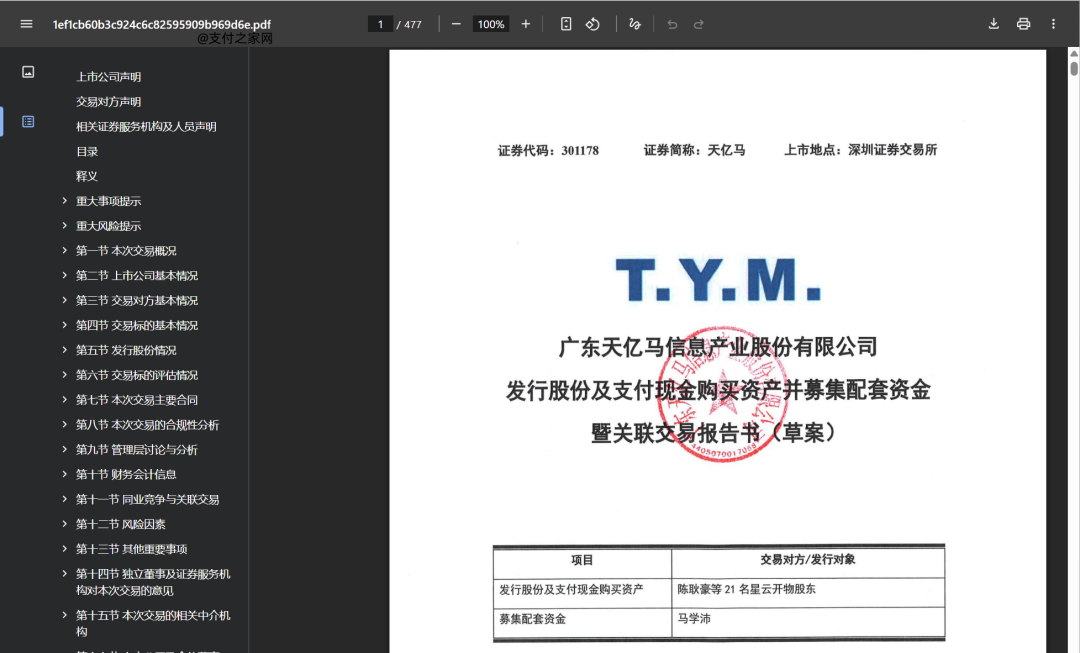
Group 1 - The core point of the article is that Guangdong Tianyima Information Industry Co., Ltd. plans to acquire 98.5632% of Xingyun Kaiwu's equity through a combination of issuing shares and cash payment, with the total transaction value estimated at approximately 1.189 billion yuan [1][9] - The acquisition will result in Xingyun Kaiwu becoming a subsidiary of Tianyima, enhancing its position in the payment industry [1][9] - Xingyun Kaiwu is not a licensed payment institution but operates in the acquiring outsourcing service segment of the payment industry [10][11] Group 2 - Xingyun Kaiwu has completed the necessary registrations with the China Payment and Clearing Association, indicating its compliance as an acquiring outsourcing service provider [11][12] - The company has a significant operational scale, connecting over 3.8 million active devices across more than 600 cities in China, focusing on self-service equipment and intelligent platform construction [11][12] - The business model of Xingyun Kaiwu integrates self-service devices, SaaS systems, and acquiring outsourcing services, catering to various offline consumption scenarios [11][12] Group 3 - The article highlights that the acquisition of non-licensed payment entities by listed companies is not unprecedented, with varying outcomes in past cases [13][14] - Historical examples include Huafeng Superfiber's acquisition of Weifutong Technology for approximately 1.8 billion yuan, which was one of the early cases of capital market integration of payment peripheral service providers [13][14] - The ongoing regulatory emphasis on clarifying the boundaries between payment institutions and outsourcing service providers may influence the future of such acquisitions in the payment industry [14]

金融活水润市井 邮储银行青岛分行赋能个体工商户发展
Zhong Guo Jin Rong Xin Xi Wang· 2025-11-21 06:33
Core Viewpoint - The Postal Savings Bank of China Qingdao Branch is actively addressing the financial needs of small and micro businesses in Qingdao by embedding financial services throughout their operational processes, thereby supporting their entrepreneurial aspirations [1][2][3] Group 1: Service Approach - The bank employs a "delicate approach" to build a comprehensive visiting network, ensuring that services are tailored to meet the specific needs of merchants rather than merely promoting products [1] - Each customer manager is designated as a "chief service manager," focusing on problem-solving rather than just loan sales, thus enhancing the overall service experience for merchants [1] Group 2: Targeted Solutions - The bank utilizes a "targeted approach" to address the diverse needs of individual businesses, moving away from a one-size-fits-all service model [2] - By implementing a "government-bank linkage," the bank gathers valuable insights into industry policies and compiles a list of quality merchants, allowing for more effective marketing strategies [2] - Specific financial products, such as pure credit "industry loans" with a maximum credit limit of 1 million yuan, are tailored for businesses with high cash flow needs and seasonal fluctuations [2] Group 3: Promotion and Awareness - The bank adopts a "penetrative approach" to enhance awareness of financial policies among merchants, utilizing offline scenarios for effective communication [3] - Collaborations with government resources and industry associations help translate complex financial policies into understandable information for merchants [3] - The bank's innovative "service as promotion" model encourages merchants to actively engage with financial services, significantly improving their awareness and acceptance of available policies [3]

聚合支付服务商未备案:经营风险与上架壁垒
Sou Hu Cai Jing· 2025-10-11 01:27
Core Insights - The increasing penetration of digital payments has made aggregation payment a fundamental infrastructure for commercial transactions, but some service providers are neglecting the importance of regulatory compliance, leading to significant operational risks and barriers to market access [1][2] Regulatory Compliance - Aggregation payment service providers must complete registration to operate legally, as per the "Administrative Measures for Payment Business of Non-Bank Payment Institutions" and local financial regulations [1] - Non-compliant entities face three major risks: administrative penalties ranging from 100,000 to 1 million yuan, business disruptions due to inability to partner with licensed payment institutions, and credit sanctions affecting future financing and qualifications [1] Market Operations - Non-compliance can trigger a chain reaction of operational crises, including loss of partnerships with major clients like state-owned enterprises, potential delays in fund settlement, and damage to brand reputation due to negative publicity [1][2] - Major app stores have made compliance a prerequisite for app listing, leading to three restrictions for non-compliant applications: rejection of new app submissions, mandatory removal of existing non-compliant apps, and functional limitations affecting user experience [2] Support Services - Companies like Shandong Hanglvtong Electronic Technology Group provide comprehensive management services to help payment service providers navigate the complex registration process, ensuring compliance and facilitating efficient market access [2][3] - The importance of compliance is emphasized as a survival baseline for the aggregation payment industry, with a call for service providers to leverage professional support to achieve rapid compliance transformation [3]