胶原贴敷料

Search documents
大股东股权被冻结!又一美妆企业IPO失败
Sou Hu Cai Jing· 2026-01-19 02:40
Core Viewpoint - The cosmetic industry faces its first IPO termination case in 2026, as Chuang'er Bio announces the cessation of its listing guidance due to unresolved shareholder equity freeze issues, marking its second failed IPO attempt [1][3][11]. Group 1: IPO Termination Reasons - The termination of the IPO guidance is attributed to the long-term unresolved issue of shareholder equity freeze, particularly involving the second-largest shareholder Ding Yumei, whose shares are frozen due to legal actions related to Evergrande's debt crisis [3][5][8]. - The company had previously attempted to go public, facing setbacks including two failed applications to the Sci-Tech Innovation Board and a subsequent shift to the Beijing Stock Exchange, which also did not yield results [10][11]. Group 2: Financial Performance and Challenges - Chuang'er Bio has struggled with fluctuating financial performance, with revenue consistently hovering between 240 million and 400 million RMB over the past six years, indicating a clear growth ceiling [12][14]. - The company's revenue for 2025 was reported at 214 million RMB for the first half, reflecting a year-on-year increase of 16.98%, but net profit plummeted by 55.99% to 13.21 million RMB, highlighting a trend of "increased revenue without increased profit" [13][14]. Group 3: Industry Context and Competitive Landscape - The collagen market is projected to surpass hyaluronic acid, becoming the leading ingredient in skincare by 2025, with a forecasted market size of 108.3 billion RMB by 2027, growing at a compound annual growth rate of 42.4% [16]. - Competitors like Juzhi Bio and Jinbo Bio have significantly outpaced Chuang'er Bio in both revenue and profitability, with Juzhi Bio's revenue soaring from 2.36 billion RMB in 2022 to 5.54 billion RMB in 2024, while Chuang'er Bio's growth remains stagnant [17][20]. Group 4: Regulatory and Technological Challenges - Regulatory tightening and the decline of the "medical device" business model have adversely affected Chuang'er Bio, which previously relied on its medical dressing products for competitive advantage [18]. - The shift in technology from animal-derived collagen to recombinant collagen has created a gap, with competitors advancing in this area while Chuang'er Bio remains focused on traditional collagen products [19][20]. Group 5: Future Outlook - The termination of the IPO is seen as a culmination of long-standing issues in industry competition, technological positioning, and capital utilization, suggesting that Chuang'er Bio must find a sustainable growth engine and differentiate itself in a competitive landscape to consider future IPO attempts [21].

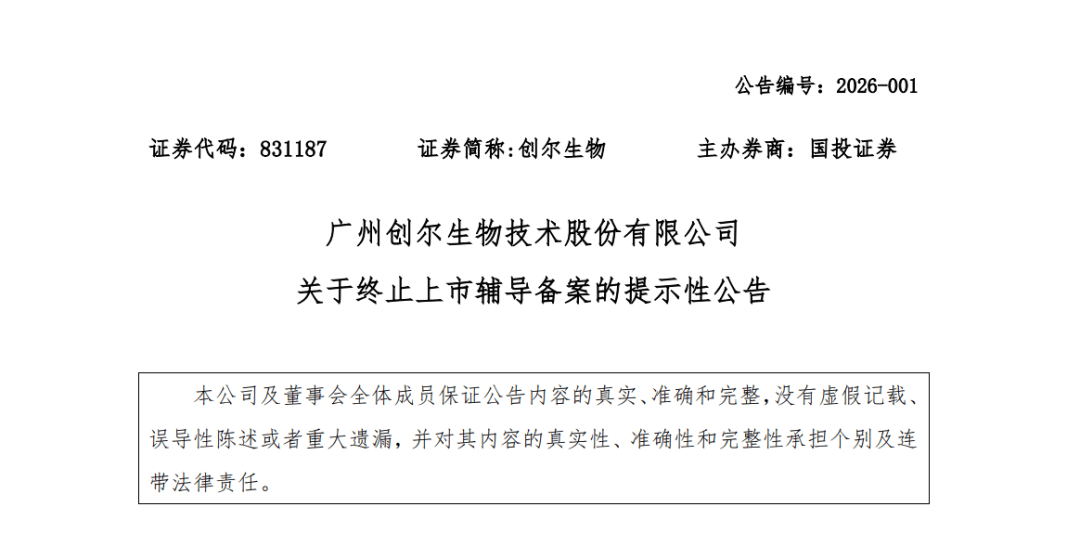
“胶原贴敷料第一股”终止上市!
Sou Hu Cai Jing· 2026-01-16 07:44
Core Viewpoint - Chuang'er Bio has terminated its IPO counseling due to unresolved shareholder equity freeze issues, marking a significant setback in its long and tumultuous journey towards public listing [1][5][10]. Company Overview - Founded in 2002, Chuang'er Bio specializes in the research, development, and production of active collagen biomedical materials, and is recognized as a high-tech enterprise in China [4]. - The company launched its core brand "Chuangfukang," which held an 8% market share in the Chinese patch-type medical skin repair dressing market in 2019, ranking second in the industry [1][16]. Financial Performance - In the first half of 2025, Chuang'er Bio reported a revenue of 214 million yuan, a year-on-year increase of 16.98%, but its net profit attributable to shareholders dropped significantly by 55.99% to 13.21 million yuan [4][12]. - The company's revenue structure shows that collagen products accounted for 87.83% of total revenue, indicating its reliance on this segment [4][13]. IPO Journey - Chuang'er Bio's IPO attempts have been fraught with challenges, including two failed attempts to list on the Sci-Tech Innovation Board and the Beijing Stock Exchange due to financial performance issues and shareholder equity freezes [10][14]. - The company’s second-largest shareholder, Ding Yumei, has had her shares frozen, which has been a critical factor in the termination of the IPO process [5][8]. Industry Context - The tightening of regulatory policies in the "medical device" sector has significantly impacted the growth of companies like Chuang'er Bio, which was once a leader in the collagen dressing market [16][17]. - Competitors such as Jinjian Bio and Fuhua have successfully entered the capital market and expanded their technological and market advantages, leaving Chuang'er Bio at a disadvantage [17][19]. Market Dynamics - The collagen product market is becoming increasingly competitive, with new entrants intensifying the pressure on established players like Chuang'er Bio [18]. - The shift towards restructured collagen products is becoming a market and technological trend, benefiting companies that adapt to these changes [19].

618前,最会提问的主持人张泉灵拷问中国胶原蛋白
FBeauty未来迹· 2025-05-09 09:20
Core Viewpoint - The article discusses the competitive landscape of the collagen market in China, highlighting the success of domestic brand Chuangfukang, which has maintained stable prices for 23 years despite technological advancements and market pressures [2][5][14]. Market Background - The collagen market is on the brink of a "second explosion," with projections indicating that by 2027, the overall market size in China will reach 173.8 billion yuan [3]. - The rise of recombinant collagen has significantly contributed to market growth, with domestic companies breaking international barriers in collagen technology [3][5]. - The article emphasizes the importance of scientific communication in addressing consumer skepticism regarding price increases in collagen products [5][24]. Technological Breakthroughs - Chuangfukang, under Chuang'er Biotechnology, has made significant advancements in collagen extraction technology, reducing costs from 2,000 to 7,000 yuan per gram for imported collagen to a fraction of that for domestic products [3][12][19]. - The company has achieved FDA certification for its raw materials and has expanded its market reach to Europe, the U.S., and South Korea [3][5]. Challenges in Communication - The article identifies three main issues in the scientific communication of collagen products: homogenized messaging, lack of cost transparency, and a disconnect in consumer understanding of the medical benefits of collagen [5][24]. - Chuangfukang's low profile in the market has hindered broader consumer awareness of its technological breakthroughs [5][24]. Marketing and Consumer Engagement - The collaboration with the advertising agency Shizhi Xiang aims to address consumer concerns about pricing and technology through direct dialogue and transparency [6][8][24]. - The marketing strategy focuses on establishing trust through third-party validation and addressing sensitive pricing issues directly [24][26]. Brand Positioning - Chuangfukang's commitment to not raising prices for over two decades reflects its philosophy of making technological innovations accessible to a broader audience [14][19]. - The brand has achieved a high customer loyalty rate, with a 50% repurchase rate, attributed to its competitive pricing and product quality [20][22]. Conclusion - The article concludes that Chuangfukang's journey exemplifies the potential of domestic brands to innovate and maintain ethical pricing in a competitive market, emphasizing the need for effective communication strategies to enhance consumer trust and brand image [24][28].