脑机接口医疗器械

Search documents
脑机接口迎重大利好
21世纪经济报道· 2026-01-29 14:39
Core Viewpoint - The recent approval of two medical device industry standards by the National Medical Products Administration (NMPA) marks a significant step towards the high-quality development of brain-computer interface (BCI) technologies in the medical field, providing essential support for standardization and regulation [1][2]. Group 1: Standardization and Development - The two newly established standards focus on the design and application of BCIs for medical devices, specifically addressing issues related to motor function rehabilitation and the reliability of invasive devices [7]. - The BCI market in China is projected to reach 3.2 billion yuan in 2024, with an 18.8% year-on-year growth, and is expected to grow to 5.58 billion yuan by 2027, reflecting a 20% growth rate [6]. - The establishment of these standards is a response to the challenges faced by the BCI industry, including terminology confusion, fragmented technology layout, and lack of unified regulations, which have hindered rapid development [6][7]. Group 2: Policy and Industry Resonance - Recent policies have positioned BCIs as a key future industry, with the 14th Five-Year Plan highlighting their potential as a new engine for economic growth [9]. - The NMPA has prioritized the approval of implantable BCI medical devices, expediting the market entry of innovative products [9]. - The commercial process for BCIs is expected to accelerate, with significant policy support and technological advancements driving rapid industry growth [10]. Group 3: Future Development and Market Dynamics - The future vision for the BCI industry includes cultivating globally influential leading enterprises and a number of specialized small and medium-sized enterprises by 2030 [11]. - Potential applications in the medical field are expected to expand beyond mere functional restoration to include "functional enhancement" applications, utilizing a combination of multiple devices and technologies [11].


脑机接口标准化迎新突破!两项医疗器械标准立项赋能产业升级
2 1 Shi Ji Jing Ji Bao Dao· 2026-01-29 07:36
Core Viewpoint - The recent approval of two medical device industry standards by the National Medical Products Administration (NMPA) marks a significant step towards the high-quality development of brain-computer interface (BCI) technology in China, providing essential support for the industry [1][4]. Industry Development - The BCI market in China is projected to reach 3.2 billion yuan in 2024, with a year-on-year growth of 18.8%, and is expected to grow to 5.58 billion yuan by 2027, reflecting a growth rate of 20% [3]. - As of early 2026, there are 2,041 BCI-related patents in China, with over 90% being invention patents, indicating a strong focus on innovation within the industry [3]. Standardization Efforts - The establishment of a standard system is crucial for addressing issues such as terminology confusion, fragmented technology layout, and lack of unified regulations, which currently hinder the rapid development of the BCI industry [3][4]. - The two newly approved standards specifically target medical devices for stroke and spinal cord injury rehabilitation, addressing urgent needs for regulation in the BCI medical device sector [4]. Policy Support - The "14th Five-Year Plan" identifies BCI as one of six future industries, highlighting its potential as a new engine for economic growth in China [5]. - The NMPA has prioritized the approval of implantable BCI medical devices, expediting the market entry of innovative products [6]. Market Dynamics - The BCI industry is entering a critical commercialization phase, driven by policy support, technological advancements, and clinical breakthroughs [6][7]. - The capital market shows strong interest in BCI, with significant increases in stock prices and investment events, indicating a robust growth outlook for the sector [7]. Future Directions - The future applications of BCI in the medical field are expected to expand into active scenarios for neuro-regulation, multi-modal integration, and potentially enhancing functions beyond mere rehabilitation [8].

脑机接口技术未来如何普惠大众
Xin Lang Cai Jing· 2026-01-27 22:08
Core Insights - Brain-computer interface (BCI) technology in China has made significant advancements, allowing paralyzed patients to control devices using their thoughts, marking a new phase in clinical applications [1][2] Group 1: Clinical Advancements - In December 2025, a clinical trial demonstrated that a paralyzed patient could control an electric wheelchair and a robotic dog using only their thoughts [1] - The first prospective clinical trial in June 2025 showed a patient with amputated limbs controlling a computer cursor through BCI [1] - A recent trial involved 32 patients with cervical spinal cord injuries, successfully enabling them to control pneumatic gloves for fine motor tasks [2] Group 2: Product Development Challenges - Invasive BCIs are classified as Class III medical devices in China, requiring clinical trials to prove safety and efficacy before market approval [3] - Current BCI systems are transitioning from laboratory exploration to clinical application, but no products have yet been approved for sale [3] - Key factors for developing scalable BCI products include minimizing surgical trauma and ensuring effective data collection and transmission [3][4] Group 3: Future Prospects - The industry anticipates that BCI technology could evolve into a new economic growth point, potentially benefiting the general public [6] - Establishing industry standards is crucial for the development of the BCI sector, with recent standards being published since 2025 [6] - The Ministry of Industry and Information Technology and other governmental bodies have issued guidelines to accelerate the innovation and development of the BCI industry [7]
新华视点|植入人脑之后,脑机接口技术将如何改变我们的生活?
Xin Hua She· 2026-01-27 12:45
Core Insights - Brain-computer interface (BCI) technology in China has made significant advancements, particularly in clinical applications for patients with severe disabilities, allowing them to control devices using their thoughts [1][2][3] Group 1: Technological Advancements - A recent clinical trial demonstrated that a patient with quadriplegia could control an electric wheelchair and a robotic dog using only their thoughts, marking a significant milestone in BCI technology [1] - The first prospective clinical trial in June 2025 showed a patient with limb amputations controlling a computer cursor through BCI, indicating the technology's potential for various applications [2] - The development of semi-invasive BCI systems has progressed rapidly, with a recent trial involving 32 patients successfully controlling pneumatic gloves for fine motor tasks [2] Group 2: Product Development and Market Readiness - The invasive BCI systems are classified as Class III medical devices in China, requiring clinical trials to prove safety and efficacy before market approval [3] - Current BCI systems are transitioning from laboratory exploration to clinical application, but no products have yet received approval for commercial use [3] - To achieve scalable applications, BCI technology must focus on minimizing surgical trauma and ensuring effective data collection and transmission [4] Group 3: Future Prospects and Industry Growth - The BCI field is expected to become a significant growth area within brain science, with foundational research enhancing application effectiveness [5] - Establishing industry standards is crucial for the development of BCI technology, as the current regulatory framework is still in its infancy [5] - The Chinese government is actively promoting the BCI industry through collaborative initiatives aimed at fostering innovation and creating a supportive ecosystem for technology transfer [5] Group 4: Application and Accessibility - The future of BCI technology includes the need for diverse software and application scenarios, similar to the smartphone ecosystem, to enhance its accessibility to the general public [6] - The goal is to develop "killer applications" that can provide significant cognitive enhancements with minimal invasive procedures, paving the way for widespread adoption of BCI technology [6]
医疗创新ETF(516820)连续3天净流入,医疗器械板块持续活跃
Xin Lang Cai Jing· 2026-01-21 05:24
Group 1 - The core viewpoint of the articles highlights the positive momentum in the medical and healthcare innovation sector, driven by policy support and technological advancements, particularly in the brain-computer interface market [2][3] - The China Securities Medical and Medical Device Innovation Index (931484) has shown a slight increase of 0.03%, with notable gains from specific stocks such as Teva Bio, which rose by 3.38%, and Ganli Pharmaceutical, which increased by 2.24% [1] - The Medical Innovation ETF (516820) has experienced continuous net inflows over the past three days, totaling 11.24 million yuan, with a peak single-day inflow of 6.0262 million yuan [1] Group 2 - The National Healthcare Security Administration has released a guideline establishing 37 pricing projects for surgical and treatment auxiliary services, which includes advanced technologies such as 3D printing and robotic surgery [1] - The brain-computer interface sector is expected to commercialize rapidly due to a combination of supportive policies and technological breakthroughs, with non-invasive technologies gaining traction for their safety and cost-effectiveness [2] - The top ten weighted stocks in the China Securities Medical and Medical Device Innovation Index account for 63.75% of the index, indicating a concentrated investment in leading companies within the sector [3]
武汉协和医院智能脑机接口研究院将落户车谷院区
Xin Lang Cai Jing· 2026-01-18 23:36
Core Viewpoint - The establishment of the Intelligent Brain-Computer Interface Research Institute at Wuhan Union Hospital aims to advance key technologies in both invasive and non-invasive brain-computer interfaces, marking a significant development in the field [1] Group 1 - The research institute will focus on critical core technology research related to brain-computer interfaces [1] - It will create the first specialized intelligent matrix for brain-computer interfaces in China [1] - The institute plans to build a multimodal brain disease database with a scale of one million entries [1] Group 2 - The initiative includes conducting multiple clinical trials for brain-computer interface medical devices [1] - The goal is to incubate and cultivate a number of technology companies that possess core technologies and have market competitiveness in the brain-computer interface sector [1]
每日市场观-20251222
Caida Securities· 2025-12-22 06:00
Market Overview - On December 22, 2025, the market closed higher with a trading volume of 1.75 trillion, an increase of approximately 70 billion from the previous trading day[1] - The majority of industries saw gains, particularly commerce, light industry, environmental protection, and social services, while a few sectors like banking, coal, and electronics experienced slight declines[1] - The Shanghai Composite Index showed a three-day upward trend, indicating some technical recovery, although the Sci-Tech Innovation Board remains in a weaker technical state[1] Industry Trends - Recently active sectors such as cyclical and consumer industries have shown increased activity, contrasting with the historically dominant technology sector[1] - The commercial aerospace sector remains strong but has shown signs of slowing momentum, with notable stock differentiation within the sector[1] - Valuations in the non-ferrous metals and insurance sectors are worth further attention, while the autonomous driving sector has seen a recent accumulation of events[1] Fund Flow - On December 19, the net inflow for the Shanghai Stock Exchange was 24.489 billion, while the Shenzhen Stock Exchange saw a net outflow of 8.336 billion[4] - The top three sectors for net inflow were automotive parts, general equipment, and general retail, while the semiconductor and electronic components sectors faced the largest outflows[4] Economic Indicators - From January to November 2025, the national online retail sales increased by 9.1%, with smart wearables and smart robots growing by 22.1% and 19.4%, respectively[11] - The national railway transported 3.727 billion tons of goods from January to November, reflecting a year-on-year growth of 2.7%[12] Investment Activity - In December, the stock private equity positions reached a new high for the year, with the stock private equity position index rising to 83.59%, marking a 0.61 percentage point increase from the previous week[13] - Public fund institutions participated in 85 individual stock placements this year, with a total allocation exceeding 34.088 billion, a 14.24% increase from the same period last year[15]
江西:支持脑机接口医疗器械纳入创新产品推荐目录
Zheng Quan Shi Bao Wang· 2025-12-02 08:13
Core Insights - The Jiangxi Provincial Government has issued measures to accelerate the development of brain-computer interface (BCI) technology and industry, emphasizing the promotion of innovative products [1] Group 1: Innovation and Product Development - The measures support the inclusion of BCI medical devices in the recommended directory for innovative products [1] - There is a focus on accelerating the iteration and large-scale promotion of BCI complete products [1] - The government plans to select innovative application projects in BCI and regularly publish typical cases and innovative achievements [1] Group 2: Integration with Artificial Intelligence - The initiative promotes the "Artificial Intelligence +" action to expedite the research and development of BCI technologies [1] Group 3: Technology Transfer and Standards - The Jiangxi Provincial Government will organize activities to facilitate the transfer and transformation of BCI technological achievements [1] - Support is provided for individuals or organizations leading the revision of relevant standards to apply for the Jiangxi Provincial Governor's Quality Award and Patent Award [1]
中国光谷出台措施加快发展脑机接口产业
Zhong Guo Xin Wen Wang· 2025-10-09 02:58
Core Viewpoint - Wuhan East Lake High-tech Zone is accelerating the development of the brain-computer interface (BCI) industry through a series of supportive measures aimed at fostering innovation and application in this field [1][2] Group 1: Policy Measures - The document titled "Several Measures to Support the Innovation and Development of the Brain-Computer Interface Industry" outlines policies to strengthen technological product development, promote the application of technological achievements, and build an innovative ecosystem [1] - Support is provided for enterprises in the BCI field to collaborate with universities, research institutions, and medical organizations to develop major BCI products in areas such as motion control, speech synthesis, treatment of neurological diseases, and visual reconstruction [1] - The measures include the establishment of experimental service platforms and shared equipment platforms for BCI products, as well as support for the first trials and applications of BCI products [1] Group 2: Industry Development Initiatives - The "Five Ones" implementation path for advancing the BCI industry includes forming an industry alliance, building a specialized park, issuing a special policy, releasing application scenarios, and establishing an industry fund [2] - The Hubei BCI Industry Innovation Development Alliance has been established in East Lake High-tech Zone, and efforts are underway to create a BCI industry cluster area [2] - The International Brain-Computer Interface Innovation Center, a key innovation driver, is being constructed in collaboration with Tongji Hospital and Union Hospital, aiming to provide a comprehensive service system from concept validation to clinical trials and industrial transformation [2]
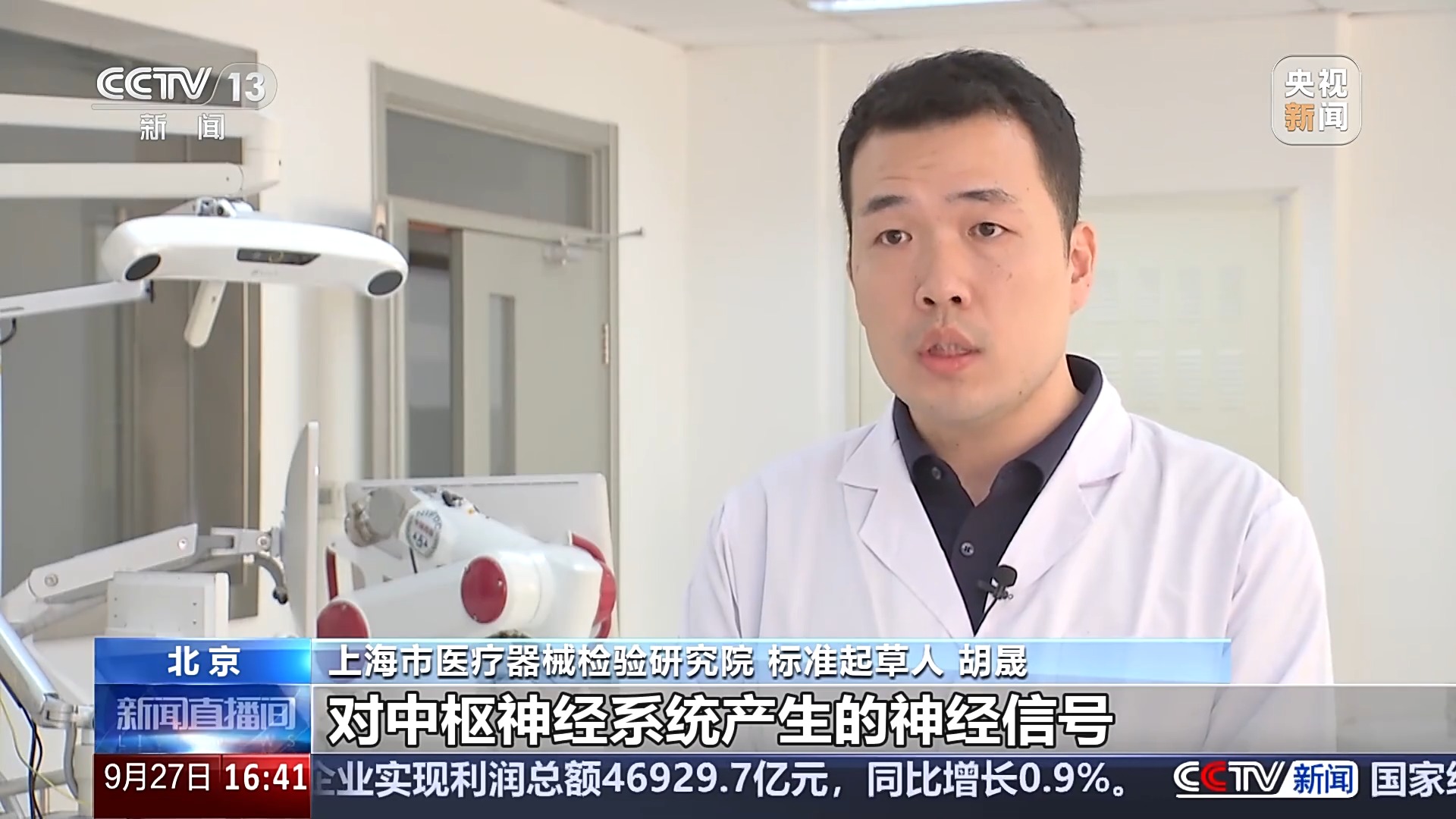
提供统一权威“通用语言” 我国首部脑机接口医疗器械标准发布
Yang Shi Xin Wen· 2025-09-27 09:30
Core Viewpoint - The National Medical Products Administration (NMPA) has approved the implementation of the first industry standard for brain-computer interface (BCI) medical devices in China, set to take effect on January 1, 2024, positioning China as a leader in this field internationally [1][6]. Summary by Relevant Categories Definition and Scope of BCI - The new standard defines "brain-computer interface" as a medical device capable of real-time decoding neural signals from the central nervous system, facilitating bidirectional information exchange between patients and external devices to improve or replace certain physiological functions [1][3][5]. Standardization and Regulatory Support - The standard provides a unified language for product development, production inspection, registration review, and regulation, covering core terms related to BCI medical devices, including paradigm types, signal forms, and signal processing [3]. - NMPA is expediting the establishment of multiple related standards and supportive policies to foster rapid development in the BCI medical device industry, with three additional standards already in the pipeline [9][11]. Market Growth and Future Projections - The BCI market in China is projected to exceed 6 billion yuan by 2028, with an estimated compound annual growth rate (CAGR) of 17.7% from 2024 to 2028. The global market for BCI applications in healthcare is expected to reach $40 billion by 2030 and $145 billion by 2040 [12].