自由牛仔

Search documents
疯狂过山车,消费龙头真反转了?
Ge Long Hui· 2025-11-23 08:22
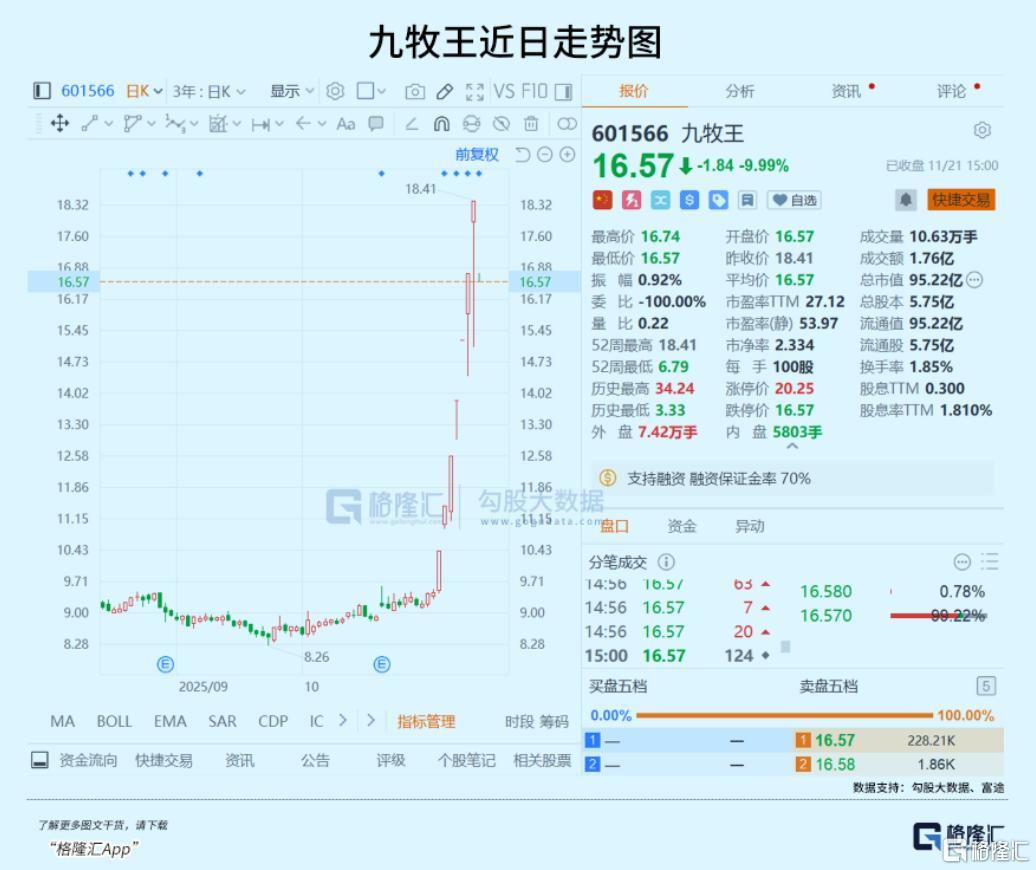
Core Viewpoint - The recent surge in the stock price of Jiumuwang is primarily driven by speculative trading related to the "Fujian" concept, despite underlying business fundamentals showing signs of weakness [1][3][29] Group 1: Stock Performance and Market Reaction - Jiumuwang's stock experienced a dramatic rise, achieving seven consecutive trading limits, with a doubling of its price within days, followed by a sudden drop on November 21 [1][2] - The stock price increase was catalyzed by the announcement of a strategic partnership with the Chinese Olympic Committee on November 11, which upgraded the company's role to an official sponsor [2][3] - Despite the partnership, the company's previous announcements regarding similar collaborations had little market impact, indicating that the recent price surge was more about market speculation than fundamental improvement [2][3] Group 2: Financial Performance - For the first three quarters of the year, Jiumuwang reported revenue of 2.13 billion yuan, a year-on-year decline of 6.02%, while net profit surged by 129.63% to 310 million yuan [6][10] - The significant increase in net profit was largely attributed to non-recurring gains, which accounted for over 60% of the net profit, raising concerns about the sustainability of this performance [11][12] - The company's core business showed a decline, with revenue from its main brand and sub-brands experiencing various degrees of decrease [10][11] Group 3: Industry Context and Challenges - The men's clothing industry is facing a transformation, with Jiumuwang, a leader in men's pants, struggling to adapt to changing consumer preferences towards younger, more fashionable styles [17][25] - The company has initiated a transformation strategy, investing over 1 billion yuan since 2020 to modernize its product offerings and brand image [17][20] - Despite these efforts, Jiumuwang's sales have not improved significantly, with inventory levels reaching a record high and turnover days exceeding 300, indicating inefficiencies in capital utilization [21][24] Group 4: Competitive Landscape - The men's apparel market is experiencing polarization, with low-cost brands gaining market share while established brands like Jiumuwang face pressure from both high-end and budget competitors [25][27] - Jiumuwang's market position is weakening, with its revenue ranking dropping to 14th among 38 companies in the industry, while competitors like Hailan Home and Semir are significantly outperforming [27][28] - The company's static price-to-earnings ratio has exceeded 50, far above the industry median of 20, raising concerns about the sustainability of its valuation amidst declining fundamentals [28][29]


疯狂过山车!消费龙头真反转了?
格隆汇APP· 2025-11-23 07:17
Core Viewpoint - The article discusses the recent stock price fluctuations of Jiumuwang, highlighting the impact of strategic partnerships and market trends, while also emphasizing the underlying challenges in the company's financial performance and the broader men's apparel industry [2][8][51]. Group 1: Stock Performance and Market Reaction - Jiumuwang experienced a significant stock price surge, achieving seven consecutive trading limits and doubling its price within a few days, driven by the announcement of a strategic partnership with the Chinese Olympic Committee [3][8]. - However, the stock faced a sharp decline on November 21, indicating volatility and potential overvaluation [4]. - The stock price increase was largely attributed to the recent "Fujian" concept hype in the market, rather than solely the partnership announcement [10]. Group 2: Financial Performance - Jiumuwang reported a net profit increase of 129.63% in its Q3 earnings report, despite a revenue decline of 6.02% year-on-year, raising concerns about the sustainability of this growth [6][13]. - The company's financial performance was significantly bolstered by non-recurring gains, which accounted for over 60% of its net profit, indicating reliance on investment income rather than core business operations [18][20]. - The company has faced declining revenues across its main and subsidiary brands, with notable drops in sales for its FUN and ZIOZIA brands [17]. Group 3: Industry Context and Challenges - The men's apparel industry is experiencing a shift, with traditional brands like Jiumuwang struggling to adapt to changing consumer preferences, particularly among younger demographics [31][50]. - Jiumuwang's market share in men's pants remains strong, but the company is perceived as outdated, necessitating a strategic transformation to appeal to modern consumers [28][30]. - The overall men's apparel market is facing a bifurcation, with low-cost brands gaining market share while established brands struggle to compete in the mid-range segment [49]. Group 4: Strategic Initiatives and Future Outlook - Jiumuwang has initiated a transformation strategy, investing over 1 billion RMB to revamp its product offerings and marketing approach, including the introduction of a new product line aimed at diverse male consumer needs [32][39]. - The company is also shifting its retail strategy by converting franchise stores to direct-operated ones, which has led to improved gross margins [38]. - Despite these efforts, Jiumuwang's inventory levels have reached record highs, indicating potential inefficiencies in sales and inventory management [41][44]. Group 5: Valuation and Market Position - Jiumuwang's static price-to-earnings ratio has exceeded 50 times, significantly higher than the industry median of 20 times, raising concerns about the sustainability of its valuation amidst declining core business performance [52][53]. - The company must focus on optimizing resource allocation and enhancing operational efficiency to navigate the current market challenges and achieve sustainable growth [54].
品牌年轻化初见成效,直营收入增长,36岁的九牧王再出发
市值风云· 2025-08-28 10:40
Core Viewpoint - Jiumuwang (九牧王) has experienced significant growth in net profit and is undergoing a strategic transformation to appeal to younger consumers, focusing on product innovation and brand image enhancement [3][4][16]. Financial Performance - In the first half of the year, Jiumuwang reported a net profit of 170 million yuan, a year-on-year increase of 248.5% [3]. - The substantial profit growth is attributed to increased gains from the fair value changes of financial assets [4]. Strategic Transformation - Jiumuwang is positioning itself as a "men's pants expert" and has introduced a "Five Pants" product series to cater to various male dressing scenarios, including sports, outdoor, casual, denim, and formal wear [5][8][16]. - The company has segmented its stores into four areas: business, casual, outdoor, and daily commuting, providing a one-stop shopping experience [9]. Product Innovation - The "Air Conditioning Pants," which utilize advanced cooling technology, have become a best-selling item, achieving over 30 million yuan in sales since their launch in April [11][12]. - The company is leveraging material technology to enhance product features, targeting the urban outdoor market [11][12]. Targeting Younger Consumers - Jiumuwang has seen a significant increase in its customer base under 40 years old, which now accounts for 46% of its clientele [17][21]. - The brand has signed five new ambassadors aged between 24 and 40 to resonate with younger consumers [17]. Marketing and Sales Strategy - The company is actively engaging in topic marketing and matrix communication through platforms like Xiaohongshu, Douyin, and Weibo to reach mainstream young consumers [19]. - Direct-to-consumer (DTC) strategies are being emphasized, with a 16.7% increase in revenue from direct sales channels [22][23]. Store Operations - Jiumuwang has transitioned 28 franchise stores to direct management, increasing the proportion of direct stores to 39.2% [24]. - The company is implementing a phased ordering policy to alleviate financial and inventory pressures on franchisees [24]. Online Sales Growth - Online sales accounted for 10.4% of total revenue in the first half of the year, reflecting a year-on-year increase of 0.65 percentage points [29].