至强(Xeon)处理器

Search documents
英特尔业绩电话会议实录:CEO陈立武坦言很失望!AI需求爆棚但英特尔产能告急!
Xin Lang Cai Jing· 2026-01-23 04:57
Core Insights - Intel's Q4 performance exceeded expectations, but weak Q1 guidance led to a significant stock drop, with CEO expressing disappointment over unmet market demand [1][6][8] - Despite strong AI demand, Intel faces severe supply bottlenecks, with depleted buffer inventory and manufacturing yields not meeting internal standards [1][3][8] Financial Performance - Q4 revenue reached $13.7 billion, with a non-GAAP gross margin of 37.9% and non-GAAP EPS of $0.15; Q1 revenue guidance is set at $11.7 to $12.7 billion, with a midpoint of $12.2 billion [16][34][41] - DCAI (Data Center and AI) revenue grew 15% quarter-over-quarter, but supply constraints prevented capturing higher potential revenue [4][12][38] Supply Chain and Inventory Issues - The company acknowledged that buffer inventory has been exhausted, leading to a "hand to mouth" operational state, particularly in Q1 [8][9][12] - Manufacturing yield improvements of 7%-8% per month are ongoing, but still below industry-leading levels, with a focus on optimizing yields by 2026 [3][9][19] Strategic Focus and Business Development - Intel is prioritizing high-margin data center business over client computing, with DCAI revenue showing the fastest growth in a decade [12][38] - The company is committed to enhancing its foundry business, with expectations for customer orders for the 14A process to materialize in late 2026 or early 2027 [14][15][40] AI and CPU Role - Management emphasized the underestimated role of CPUs in the AI era, highlighting their critical function in workload orchestration and control [11][12][29] - The shift towards "mixed AI" architectures necessitates robust CPU capabilities, driving demand for traditional server upgrades [11][12][29] Capital Expenditure and Future Outlook - Capital expenditures for 2026 are expected to remain flat or slightly decrease, with a shift towards spending on manufacturing tools rather than facility construction [15][44] - The company anticipates gradual supply improvements starting in Q2 2026, with a focus on meeting the strong demand in the data center and AI sectors [22][42]


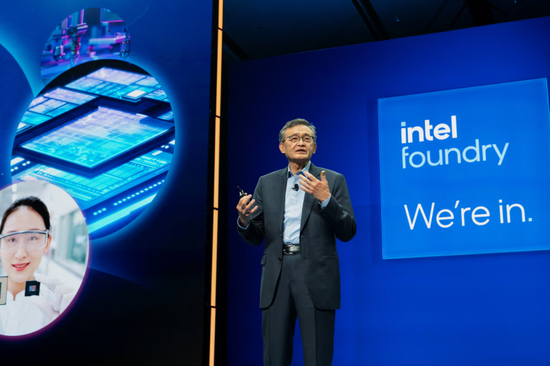
【招商电子】英特尔25Q3跟踪报告:Q3 EPS超指引预期,指引Q4 DC AI收入环比强劲增长
招商电子· 2025-10-26 12:48
Core Viewpoint - Intel's Q3 2025 revenue reached $13.7 billion, exceeding guidance, driven by strong demand in client and data center segments, with a gross margin of 40%, reflecting significant year-over-year and quarter-over-quarter improvements [3][4][14]. Financial Performance - Q3 2025 revenue was $13.7 billion, up 2.8% year-over-year and 6.2% quarter-over-quarter, surpassing the guidance range of $12.6 to $13.6 billion [3][4]. - Gross margin improved to 40%, a 22 percentage point increase year-over-year and a 10.3 percentage point increase quarter-over-quarter, attributed to revenue growth, product mix optimization, and reduced inventory reserves [3][15]. - Earnings per share (EPS) was $0.23, exceeding expectations due to revenue growth, margin improvement, and ongoing cost control [3][15]. Business Segments - **Client Computing Group (CCG)**: Revenue was $12.6 billion, up 7.6% quarter-over-quarter, driven by collaboration with Microsoft and the launch of Core Ultra 3 [4][17]. - **Data Center AI**: Revenue was $4.1 billion, up 5.1% quarter-over-quarter, driven by product mix optimization and strong demand for AI server CPUs [4][18]. - **Intel Foundry**: Revenue was $4.2 billion, down 4.5% quarter-over-quarter, with significant progress in 10nm and 7nm capacity [4][18]. - **Other Businesses**: Revenue was $993 million, down 5.7% quarter-over-quarter, with Mobileye, Altera, and IMS contributing a combined operating profit of $100 million [4][19]. Future Guidance - Q4 2025 revenue guidance is set at $12.8 to $13.8 billion, reflecting a year-over-year decline of 7% and a quarter-over-quarter decline of 3% [5][20]. - The company anticipates a slight quarter-over-quarter increase in Intel Products revenue, with a strong expected growth in DC AI revenue [5][20]. - For 2026, the company expects improved margins driven by increased production at advanced nodes and the large-scale production of Panther Lake [5][20]. Strategic Developments - The company plans to launch the first Panther Lake SKU by the end of 2025 and more SKUs in the first half of 2026, enhancing its product portfolio in the PC market [10][11]. - Intel aims to solidify its position in the AI market, focusing on becoming the preferred computing platform for AI inference workloads [11][12]. - The company is making significant progress in its foundry strategy, with the Intel 18A process achieving key milestones and expected to drive wafer output growth over the next decade [12][13]. Market Environment - The third quarter saw strong performance supported by core market growth, despite macroeconomic uncertainties [14]. - The demand for AI applications is driving growth in traditional computing businesses, with a notable increase in enterprise customer migration to Windows 11 [14][18]. - The company remains optimistic about the total addressable market for CPUs in 2026, despite the need for competitive improvements [14].