
舒敏保湿特护霜

Search documents
内外双卷不确定下找到百亿品牌的持续结构增长逻辑?
Jing Ji Guan Cha Bao· 2025-11-14 02:23
Core Insights - The article discusses the challenges and strategies for companies transitioning from a billion-level revenue to a hundred-billion-level brand, emphasizing the need for a deep understanding of core advantages and strategic optimization in a competitive market [1][38]. Group 1: Current Challenges in Revenue Growth - Companies face significant challenges in revenue growth due to market saturation and intensified competition, with traditional linear growth models becoming ineffective [3]. - The loss of clear causal relationships complicates growth strategies, making it difficult for companies to predict and drive growth as they scale [3]. - Increased market uncertainty from macroeconomic changes, technological advancements, and competitor strategies further complicates long-term planning [3]. Group 2: Differences in Growth Logic - Companies at the billion-level focus on product line breakthroughs, optimizing existing products and expanding variations to meet diverse consumer needs [5][6]. - In contrast, hundred-billion-level brands shift focus to brand expansion, enhancing brand influence and market positioning through diversified product portfolios [6][7]. - Successful large enterprises recognize the limitations of relying on a single product line and adopt multi-faceted strategies for sustained revenue growth [6][7]. Group 3: Strategic Approaches for Growth - The transition from billion to hundred-billion revenue requires a shift from a map strategy, which relies on clear market positioning and plans, to a puzzle strategy that emphasizes flexibility and adaptability in a dynamic market [8][9]. - Companies must integrate various business units and market opportunities to create a complex growth network, allowing for rapid adaptation to market changes [9]. Group 4: Building a Hundred-Billion Brand - Companies should focus on core advantage development and reasonable structural extensions to diversify and expand their market presence [11]. - The growth process should transition from category expansion to business expansion, ultimately enhancing brand value and market leadership [13][14]. - Successful examples include Huawei, which leveraged its core technology in telecommunications to expand into smartphones and smart home products [12]. Group 5: Multi-Category and Multi-Business Strategies - Companies should start with a strong single product and then expand into related categories based on market validation [15][16]. - The example of Bosideng illustrates how a focus on a core product can lead to successful category expansion, achieving significant revenue growth [17]. Group 6: Multi-Brand Strategy - Companies can consider a multi-brand strategy when market maturity limits growth potential, leveraging established brand reputation to enter new markets [22]. - Anta's multi-brand strategy demonstrates how a company can cover various market segments, enhancing competitiveness and brand influence [24]. Group 7: Internal and Structural Growth - Companies must recognize external challenges and effectively integrate internal resources to achieve structural growth [36][37]. - The experiences of Haier, Midea, and Gree highlight the importance of understanding core brand genes—service, channel, and product—as pathways to growth [34][35]. Group 8: Future Growth Pathways - The article outlines a framework for companies to transition from billion to hundred-billion brands, emphasizing the importance of strategic planning and resource optimization [39][42]. - The future growth stages include transitioning to a thousand-billion platform and a ten-thousand-billion ecosystem, requiring a comprehensive understanding of market dynamics and consumer needs [41][44].
化妆品企业为何再攻植物成分
经济观察报· 2025-10-11 08:21
Core Viewpoint - The domestic cosmetics industry is experiencing a significant transformation, focusing on the innovation of plant-based ingredients and the development of proprietary technologies for extracting and utilizing these ingredients effectively [1][4][14]. Group 1: Technological Advancements - Since 2022, the domestic cosmetics industry has gradually mastered the full-process technology of "active substance labeling, impurity separation, and purity control" [10]. - Companies like Yunnan's Betaini have successfully extracted beneficial components from plants, such as the Qingci fruit, which has shown efficacy in skin barrier repair and anti-aging [2][11]. - The use of AI technology has accelerated the identification and extraction of effective plant components, allowing for higher purity and better efficacy in products [12]. Group 2: Market Trends - There is a growing trend among domestic cosmetics companies to utilize plant-based ingredients as a key differentiator in product offerings, with many brands showcasing their latest research and development at industry conferences [3][6]. - The number of new plant-based raw materials registered has increased significantly, from 3 in 2022 to 42 in 2024, indicating a shift towards plant-based ingredients dominating the market [7]. - The market for domestic cosmetics is expanding, with local brands capturing over 55.2% of the market share, surpassing foreign brands [15]. Group 3: Investment and Capital Market - Several companies focusing on plant-based ingredients have initiated IPO processes, reflecting increased investor interest in the sector [14]. - Notable investments have been made in companies with capabilities in plant raw material research, indicating a strong market confidence in the potential of domestic plant-based cosmetics [14]. Group 4: Future Outlook - The domestic cosmetics industry is expected to continue its shift towards using local plant resources, with predictions that domestic raw materials will account for over 80% of the market share in the future [15]. - As the industry matures, the purity, stability, and efficacy of domestic raw materials are approaching or even surpassing international standards, enhancing brand confidence in local sourcing [15].



化妆品企业为何再攻植物成分|科技赋能新消费
Jing Ji Guan Cha Wang· 2025-10-11 07:07
Core Insights - The Chinese cosmetics industry is experiencing a significant shift towards the use of domestic plant ingredients, driven by innovation and the demand for unique, region-specific components [4][6][12] Group 1: Industry Trends - The trend of utilizing plant-based ingredients has become a common strategy among domestic cosmetics companies, with many brands showcasing their research and development achievements at industry events [3][5] - The number of new plant-based raw materials registered has surged, with 42 new plant materials recorded in 2024, surpassing chemical raw materials for the first time [6][12] - The market for domestic brands is growing, with over 55.2% market share in 2024, indicating a shift away from reliance on foreign brands [13] Group 2: Technological Advancements - Advances in technology have enabled the precise extraction and identification of active ingredients from plants, enhancing the efficacy of cosmetic products [8][9] - Companies are increasingly using AI technology to streamline the selection of effective cosmetic ingredients, significantly improving the efficiency of product development [10] Group 3: Market Dynamics - The capital market is showing increased interest in companies that focus on plant-based ingredients, with several firms initiating IPO processes and attracting significant investments [11][12] - The push for domestic raw material usage is expected to reshape the market landscape, with predictions that local ingredients will dominate the market share in the future [12][13]
2025年中国功能性护肤品行业产品布局分析 “妆字号”产品矩阵不断拓展【组图】
Qian Zhan Wang· 2025-09-15 04:11
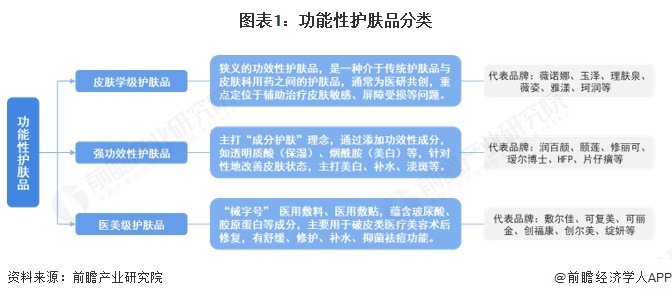
Core Viewpoint - The functional skincare industry in China is experiencing a rise of domestic brands, with products categorized into three main segments: dermatological skincare, high-efficacy skincare, and medical aesthetic skincare [1][2]. Group 1: Industry Overview - Functional skincare products are designed to alleviate or assist in treating specific skin issues, classified as either cosmetic (妆字号) or medical devices (械字号) [1]. - The industry is characterized by a growing presence of domestic brands, indicating a shift in market dynamics [1]. Group 2: Market Segmentation - The functional skincare market is divided into three segments: - Dermatological skincare, typically developed by cosmetic companies in collaboration with dermatologists, includes brands like Winona and La Roche-Posay [2]. - High-efficacy skincare, which emphasizes chemical ingredients, features brands such as WIS and HFP [2]. - Medical aesthetic skincare, developed by companies with a background in biomedicine or medical devices, includes brands like Fulejia and Kefu Mei [2]. Group 3: Product Composition - Dermatological skincare products focus on simplified and targeted ingredients, with examples like Winona's "Soothing Moisturizing Cream" containing ingredients such as sea buckthorn and hyaluronic acid [4]. - High-efficacy skincare products highlight active ingredients like niacinamide and salicylic acid [4]. - Medical aesthetic skincare products, such as those from Chuangfukang, contain fewer ingredients, focusing on essential components like collagen [4]. Group 4: Company Product Strategies - Companies in the functional skincare sector are diversifying their product lines, with many offering both cosmetic and medical device products [6]. - For instance, Betaini focuses on dermatological skincare while also extending into medical device products [6]. Group 5: Company Registration Data - Various companies have registered a significant number of products under both cosmetic and medical device categories, indicating a robust presence in the market: - Huaxi Biological has 1,766 cosmetic registrations and 27 medical device registrations [7]. - Fulejia has 3 cosmetic registrations and 110 medical device registrations [7].
贝泰妮(300957):战略调整持续 护肤彩妆双轮助力复苏
Xin Lang Cai Jing· 2025-05-05 10:43
Core Viewpoint - The company reported its 2024 annual report and Q1 2025 results, showing performance slightly below market expectations, with revenue growth but significant declines in net profit and cash flow metrics [1][4]. Financial Performance - 2024 revenue reached 5.736 billion yuan, a year-on-year increase of 3.87%, while net profit attributable to shareholders was 503 million yuan, down 33.53% year-on-year [1]. - Q1 2025 revenue was 949 million yuan, a year-on-year decline of 13.51%, with net profit attributable to shareholders at 28 million yuan, down 83.97% year-on-year [1]. - The company declared a cash dividend of 6.00 yuan per 10 shares (including tax) [1]. Profitability and Cost Structure - The gross margin for 2024 was 73.74%, a decrease of 0.16 percentage points year-on-year, while the net profit margin was 8.63%, down 5.12 percentage points year-on-year [1]. - The sales expense ratio increased to 49.97%, up 2.71 percentage points year-on-year, primarily due to increased brand promotion and online channel costs [1]. - The management expense ratio rose to 8.94%, up 1.46 percentage points year-on-year, attributed to depreciation and personnel costs [1]. Segment Performance - In 2024, skincare revenue was 4.801 billion yuan, down 1.42% year-on-year, while color cosmetics revenue surged to 551 million yuan, a growth of 226.51% year-on-year [2]. - Online channel revenue reached 3.912 billion yuan, up 10.13% year-on-year, with Douyin platform revenue growing by 30.96% to 827 million yuan [2]. Strategic Focus - The company is deepening its "sensitive skin PLUS" strategy, focusing on core products that enhance brand value and sales [3]. - The 2025 strategy will emphasize brand building, membership operations, and collaborative growth, with a focus on scientific communication and emotional content [3]. - The brand matrix includes various sub-brands targeting specific demographics, enhancing market penetration [3][4]. Future Outlook - The company has adjusted its profit forecasts for 2025-2026 and introduced a new forecast for 2027, expecting net profits of 667 million, 769 million, and 899 million yuan respectively [4]. - The price-to-earnings ratio is projected to be 26, 23, and 20 times for 2025, 2026, and 2027 respectively [4].
贝泰妮(300957):战略调整持续,护肤彩妆双轮助力复苏
Shenwan Hongyuan Securities· 2025-05-05 10:11
Investment Rating - The report maintains a "Buy" rating for the company [1] Core Views - The company has released its 2024 annual report and Q1 2025 quarterly report, with performance slightly below market expectations. 2024 revenue was 5.736 billion yuan, a year-on-year increase of 3.87%, while net profit attributable to shareholders was 503 million yuan, a year-on-year decline of 33.53% [4][6] - In Q1 2025, revenue was 949 million yuan, a year-on-year decline of 13.51%, and net profit attributable to shareholders was 28 million yuan, a year-on-year decline of 83.97% [4][6] - The company plans to focus on brand building, member operations, and overall collaborative growth in 2025, with a strategic emphasis on sensitive skin products [6] Financial Data and Profit Forecast - The company’s total revenue for 2024 is projected at 5.736 billion yuan, with a forecasted revenue of 6.281 billion yuan for 2025, representing a year-on-year growth rate of 9.5% [5] - The net profit attributable to shareholders is expected to be 667 million yuan in 2025, with a projected growth rate of 32.6% [5] - The gross profit margin for 2024 was 73.7%, with an expected margin of 74.9% in 2025 [5] Operational Insights - The company’s skincare segment showed resilience despite pressure, with skincare revenue at 4.801 billion yuan in 2024, a year-on-year decline of 1.42% [6] - The makeup segment experienced significant growth, with revenue increasing by 226.51% to 551 million yuan, accounting for 9.60% of total revenue [6] - Online sales channels drove overall resilience, with revenue from online channels reaching 3.912 billion yuan, a year-on-year increase of 10.13% [6] Strategic Focus - The company is deepening its "Sensitive Skin PLUS" strategy, focusing on core products that enhance brand value and sales [6] - The brand matrix includes various sub-brands targeting specific demographics, such as infants and anti-aging products, to achieve precise market coverage [6] - The organizational restructuring is expected to bring positive changes, with a focus on high-end and mass-market segments [6]
贝泰妮:公司稳步推进变革优化,期待多品牌贡献增量-20250427
GOLDEN SUN SECURITIES· 2025-04-27 00:23
Investment Rating - The report maintains a "Buy" rating for the company [7] Core Views - The company is steadily advancing transformation and optimization, with expectations for multi-brand contributions to incremental growth [1] - The main brand continues to deepen its focus on sensitive skin, while the multi-brand layout is expected to contribute additional growth [2] - Online channel optimization is improving operational efficiency, and offline channels are steadily expanding to reach more customers [3] - The brand matrix is essentially complete, and the main brand is continuously optimizing its product structure, with self-research and investment in multi-brands poised to contribute to a second growth peak [4] Financial Performance Summary - In 2024, the company is projected to achieve revenue of 5.736 billion yuan, a year-on-year increase of 3.87%, and a net profit attributable to shareholders of 503 million yuan, a decrease of 33.53% [1] - The gross profit margin is expected to remain stable at approximately 73.74% [1] - For Q1 2025, the company is expected to report revenue of 949 million yuan, a year-on-year decrease of 13.51%, with a net profit of 28 million yuan, a decrease of 83.97% [1] - The company anticipates revenue growth of 6.368 billion yuan in 2025, with net profits of 751 million yuan, reflecting a significant recovery in profitability [4] Brand and Product Performance Summary - The skincare category accounts for 84.13% of the company's self-owned brand sales, with the main brand Winona performing well in the sensitive skin segment [2] - Winona Baby brand achieved revenue of 200 million yuan, a year-on-year increase of 34.03%, while the Aikeman brand saw revenue growth of 65.59% [2] - The company is focusing on private domain member operations, achieving high repurchase rates, particularly among the 18-30 age group targeted by the Beifuting brand [2] Channel Strategy Summary - The company’s online, OMO, and offline channels account for 68.55%, 9.13%, and 22.32% of its main business, respectively [3] - Online sales from major platforms such as Alibaba and Douyin have shown varied performance, with Douyin sales increasing by 31% [3] - The company has expanded its offline distribution, covering over 129,000 pharmacy stores nationwide and opening 179 new brand stores [3] Future Earnings Forecast - Revenue projections for 2025-2027 are set at 6.368 billion yuan, 7.198 billion yuan, and 8.200 billion yuan, respectively, with net profits expected to recover to 751 million yuan, 924 million yuan, and 1.031 billion yuan [4][6]