英伟达H200AI芯片

Search documents
关税大棒再次落下,美国再加25%关税,特朗普提前开香槟,中国正抛售5000亿美债
Sou Hu Cai Jing· 2026-01-16 06:16
Group 1 - The Trump administration has imposed a 25% tariff on certain advanced computing chips, including Nvidia's H200 AI chip and AMD's MI325X semiconductor, reflecting a protectionist and unilateral approach to trade [1] - The policy aims to encourage domestic semiconductor manufacturing in the U.S. and reduce reliance on external supply chains, particularly from Taiwan and other regions, as the U.S. currently only achieves 10% self-sufficiency in chip production [1] - The tariff strategy may lead to increased production costs for companies like Apple, which could see manufacturing costs in the U.S. rise by 35% compared to China and India, potentially resulting in higher consumer prices [3] Group 2 - China's response to U.S. tariffs includes reducing its holdings of U.S. Treasury bonds, with approximately $70 billion cut since Trump took office, viewed as a defensive measure to mitigate risks associated with U.S. debt [3] - The tariff war is intertwined with international geopolitical dynamics, as the U.S. aims to reshape the global semiconductor supply chain and diminish the influence of Taiwanese firms like TSMC, which derives 76% of its revenue from U.S. chip sales [5] - TSMC faces uncertain prospects due to the geopolitical environment and potential threats from U.S.-Japan cooperation, which may impact its technological advancements and operational stability [5] Group 3 - The long-term effectiveness of the Trump administration's tariff policies remains uncertain, as they may lead to economic slowdown and increased consumer burdens in the U.S. [7] - The economic competition between the U.S. and China extends beyond tariffs, involving considerations of supply chain restructuring and national security [7] - The evolving relationship between the two nations will depend on market responses and political factors, with potential repercussions for both Chinese and American consumers if tariffs continue to escalate [7]


美国对H200加征25%关税!
国芯网· 2026-01-15 04:36
Core Viewpoint - The article discusses the recent decision by the U.S. government to impose a 25% tariff on certain advanced computing chips, including NVIDIA's H200 AI chip and AMD's MI325X chip, citing national security concerns and the need to reduce reliance on foreign semiconductor supply chains [1][3][4]. Group 1: Tariff Imposition - The U.S. White House announced a 25% tariff on specific advanced computing chips as part of a strategy to address national security threats [1][3]. - This tariff is based on the Trade Expansion Act of 1962, specifically Section 232, and aims to reshape the global semiconductor industry and supply chains [3][4]. - The U.S. consumes about 25% of the world's semiconductor products but only produces about 10% of the chips it requires, highlighting a significant dependency on foreign supply chains [3][4]. Group 2: Impact on Semiconductor Market - The tariff will not affect semiconductor products used in data centers, research, maintenance, and public sectors, which indicates a targeted approach to the imposition [3]. - Analysts suggest that the new measures will significantly increase production costs for domestic semiconductor manufacturing in the U.S. [3]. - The article notes that the H200 chip is designed specifically for the Chinese market, and there are uncertainties regarding China's willingness to purchase these chips following the tariff announcement [4]. Group 3: China's Response and Domestic Development - Chinese companies are actively working on developing domestic AI chips to replace NVIDIA's market share, indicating a push towards semiconductor independence [4]. - The article mentions that there is skepticism about whether China will continue to buy the H200 chip, as they aim to achieve self-sufficiency in semiconductor production [4].



A股五张图:极致的抱团、极致的反包、极致的爆发
Xuan Gu Bao· 2025-12-24 10:34
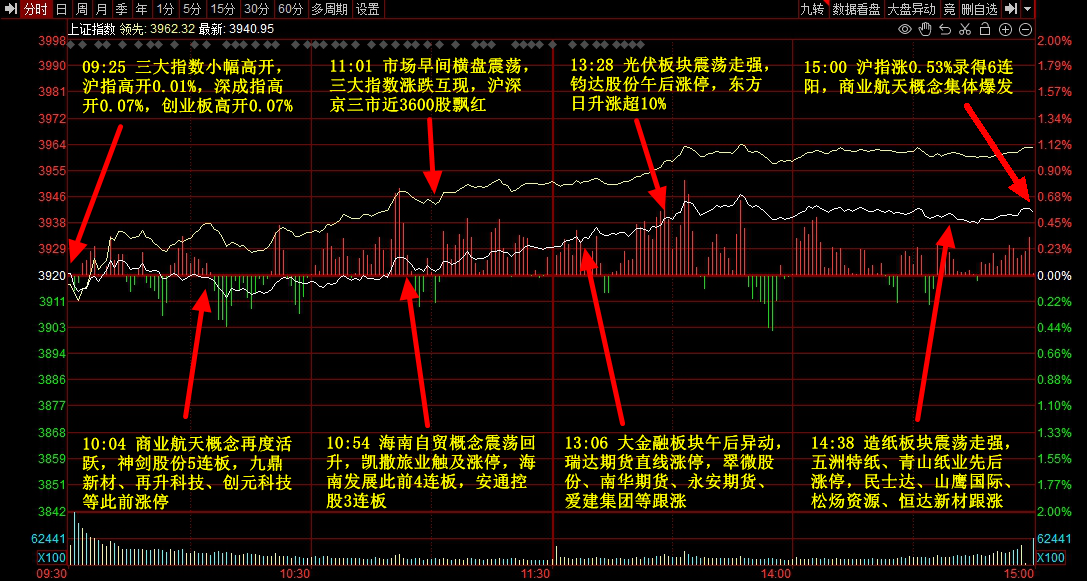
Market Overview - The market saw a strong performance today, with the Shanghai Composite Index, Shenzhen Component Index, and ChiNext Index rising by 0.53%, 0.88%, and 0.77% respectively, while over 4,100 stocks increased and more than 1,100 stocks declined [4]. Aerospace Sector - The aerospace sector rebounded significantly after a previous decline, with multiple stocks hitting the daily limit, including Shenjian Co. (5 consecutive limit-ups), Naisheng Technology, and others. The SpaceX concept stocks surged by 10.64%, while commercial aerospace and space computing rose by 4.49% and 4.38% respectively [6][5]. - The rebound was attributed to a media push regarding the State-owned Assets Supervision and Administration Commission's focus on key sectors, including aerospace, which may have influenced market sentiment [6]. AI Hardware Sector - The AI hardware industry showed strong performance, with stocks related to Nvidia, CPO, PCB, and fiberglass experiencing significant gains. Notably, Yingweike and Maigemite both reached their daily limits, with Maigemite ending a four-month consolidation period and hitting a new historical high [7]. - The catalyst for this surge was Nvidia's announcement to begin delivering H200 AI chips to Chinese customers before the Spring Festival, along with plans to increase production capacity [7]. Financial Sector - The financial sector experienced localized movements, with stocks like Ruida Futures and Meihu Co. showing notable gains. Financial technology and brokerage stocks rose by 1.52% and 0.98% respectively [19]. - A rumor regarding a potential 0.5% targeted reserve requirement ratio cut by the central bank appeared to drive some of the activity, despite being unverified [19]. Company-Specific Developments - Delis Co. announced a change in its targeted placement of shares, raising up to 885 million yuan, which will result in a change of its controlling shareholder to Yiyuan Aviation Technology Co. This news initially led to a nearly 7% increase in pre-market trading, but the stock ultimately fell by 6% during the day [11][12][13]. - The stock's volatility is attributed to speculative trading behavior, as it has a history of erratic price movements [13][14].