苹果Mac电脑

Search documents
美联储月末降息没戏?苹果加速CEO接班人计划
Shang Hai Zheng Quan Bao· 2026-01-10 01:11
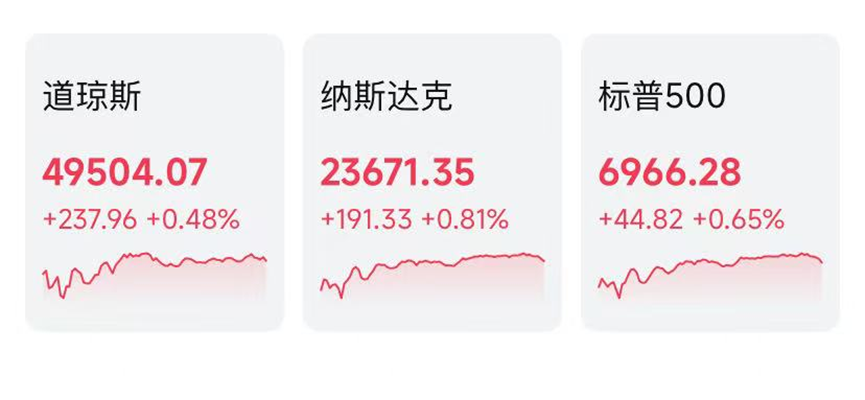
Group 1: Market Performance - The three major U.S. stock indices closed higher, with the Nasdaq rising nearly 1%, and both the Dow Jones and S&P 500 reaching all-time closing highs [1][2] - The Dow Jones increased by 0.48% to 49,504.07 points, while the S&P 500 rose by 0.65% to 6,966.28 points, and the Nasdaq gained 0.81% to 23,671.35 points [3] - For the week, the Dow Jones rose 2.32%, the S&P 500 increased by 1.57%, and the Nasdaq gained 1.88% [3] Group 2: Employment Data - The U.S. non-farm payrolls increased by 50,000 in December 2025, below the market expectation of 60,000, while the unemployment rate fell to 4.4%, better than the forecast of 4.5% [7][6] - Revisions showed that the non-farm payrolls for October were adjusted from -105,000 to -173,000, and for November from 64,000 to 56,000, indicating a total downward revision of 76,000 jobs for those two months [7] - The report alleviated severe concerns about labor market deterioration, which had prompted the Federal Reserve to lower interest rates in previous meetings [7] Group 3: Federal Reserve Outlook - The market currently estimates only a 5% probability of the Federal Reserve lowering interest rates at the next meeting [8] - The consensus is that the first rate cut by the Federal Reserve is expected in June 2026, with an anticipated total reduction of about 50 basis points throughout the year [8] Group 4: Apple Inc. Leadership Transition - Apple is accelerating the selection process for a successor to CEO Tim Cook, with John Ternus, the current Senior Vice President of Hardware Engineering, being the leading candidate [10][12] - Ternus, who joined Apple in 2001, has been instrumental in the development of several groundbreaking products and is recognized for his collaborative management style [12] - Other candidates being considered include Craig Federighi, Eddy Cue, and Greg Joswiak, with a potential announcement expected after the January earnings report [12]


内存短缺,服务器价格上涨
半导体行业观察· 2025-12-07 02:33
Core Insights - The article discusses the significant impact of memory shortages on server and PC prices, with manufacturers facing rising component costs due to a shift in production focus towards AI servers [3][4]. Group 1: Price Increases - DRAM prices are projected to rise by 8% to 13%, with some forecasts suggesting even higher increases [3]. - Major OEMs, including Dell, Lenovo, HP, and HPE, plan to raise server prices by approximately 15%, while PC prices are expected to increase by about 5% [4][5]. - Samsung has reportedly raised memory prices by up to 60% as wafer production capacity shifts towards AI workloads [4]. Group 2: Industry Response - Manufacturers are reevaluating their product lines, with some brands halting consumer-oriented memory production to meet enterprise demands [4]. - The COO of Dell described the current memory shortage as "unprecedented," indicating that supply is struggling to keep pace with growing demand [4]. - Lenovo's COO highlighted the immense cost pressure from memory and solid-state drives, complicating mitigation efforts [5]. Group 3: Market Dynamics - The shift towards AI-centric production is affecting the supply and cost of general hardware components [4][6]. - IDC analysts noted that the current market volatility is unusually high compared to past fluctuations, driven by increasing demand for servers, CPUs, and GPUs [5].