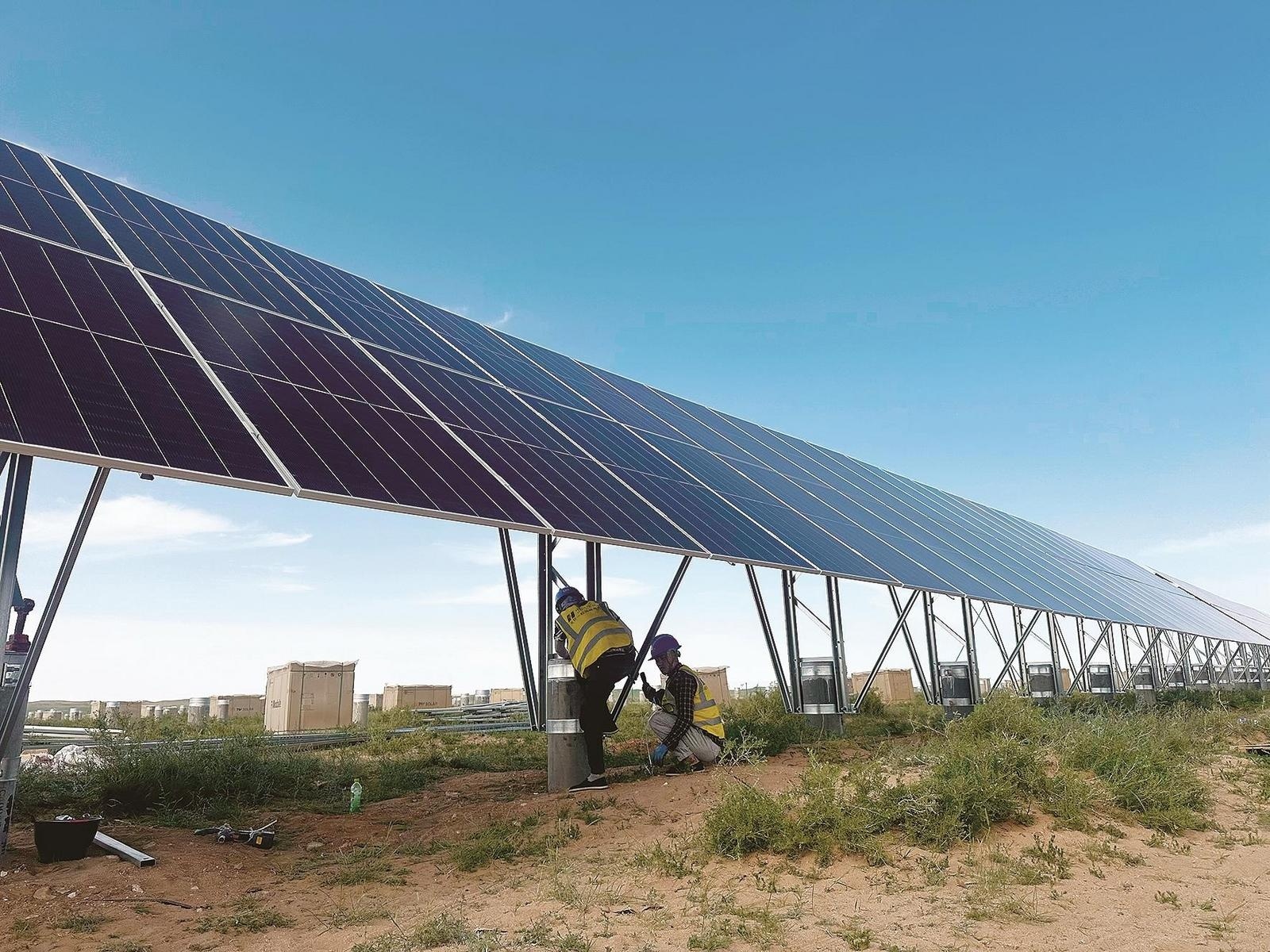
草光互补项目

Search documents
“碳”新路 逐“绿”行
Jin Rong Shi Bao· 2025-12-16 05:08
Group 1: Green Development Initiatives - The first "grass-light complementary" pilot project in China's desert grassland is taking shape in Inner Mongolia, focusing on ecological priority and green development [1] - Agricultural Development Bank of China approved a credit limit of 800 million yuan for the project, with 88 million yuan already disbursed, expecting an annual power generation of 85 million kWh, saving approximately 30,000 tons of standard coal and reducing CO2 emissions by about 90,000 tons [1] - By the end of Q3 this year, the balance of green loans in Baotou reached 42.901 billion yuan, a year-on-year increase of 15.71% [1] Group 2: Steel Industry Transformation - The steel industry is a pillar of Baotou's economy, and promoting its green transformation is crucial for high-quality economic development [2] - The People's Bank of China in Baotou is guiding financial resources to support the construction of a 2 million-ton CCUS carbon-neutral circular economy demonstration project, providing long-term and stable funding [2] - The project has received an initial credit of 180 million yuan, which was later increased to 394 million yuan, with 348 million yuan already utilized [2] Group 3: Innovative Financial Solutions - Due to year-end electricity payment pressures, the People's Bank of China in Baotou is promoting a "carbon evaluation + finance" business model to alleviate financial pressure on manufacturing enterprises [3] - This model allows financial institutions to assess electricity usage and operational data, integrating carbon capability evaluation into credit standards, facilitating a new financing channel [3] - A loan of 10 million yuan was issued to a manufacturing enterprise within two working days, with a 25 basis point reduction in interest rates, providing effective support for year-end electricity payments [3] Group 4: Silicon Photovoltaic Industry Support - The silicon photovoltaic industry is facing cyclical adjustments, and the People's Bank of China in Baotou is encouraging financial innovation to support low-carbon transitions [4] - A local silicon enterprise obtained the first domestic carbon verification certificate linked to green electricity, effectively offsetting 320,000 tons of carbon emissions and reducing carbon tariffs by nearly 10 million yuan [4] - A carbon footprint-linked loan of 260 million yuan was successfully issued, incentivizing the enterprise to enhance its green transformation efforts [4] Group 5: Grassland Ecological Financing - Baotou's Damao Banner has been approved as the first national pilot for the "grass ticket" system, aimed at establishing an ecological product value realization mechanism [5] - The People's Bank of China in Baotou, in collaboration with the local forestry and grassland bureau, issued a plan to support the "grass ticket" pilot, facilitating financial resources for ecological construction [5] - The Industrial and Commercial Bank of China issued 1.2 million yuan in production loans using "grass tickets" as collateral, marking the successful launch of the first batch of "grass ticket loans" [5]
全国首个荒漠草原“草光互补”项目在达茂旗试点
Yang Guang Wang· 2025-06-16 09:27
Core Viewpoint - The "Grass-Photovoltaic Complementary" pilot project in Damao Banner is a significant initiative aimed at integrating renewable energy with ecological restoration, with a total installed capacity of 50 MW and expected to provide clean energy to the Tongwei green substrate project in the new industrial park [3][5]. Group 1: Project Overview - The project has achieved 55% overall progress and is expected to be connected to the grid by the end of September this year [5]. - Once operational, the project is anticipated to have an annual utilization of approximately 1,700 hours, generating around 85 million kWh of electricity, which is equivalent to saving about 30,000 tons of standard coal and reducing carbon dioxide emissions by approximately 90,000 tons [5]. Group 2: Ecological and Economic Integration - The core innovation of the project lies in utilizing the space beneath photovoltaic panels for grass planting and livestock raising, aiming for a dual win in economic and ecological benefits [5]. - Two main integration models are planned: "degraded desert grassland restoration + photovoltaic + carbon sequestration" and "degraded desert grassland restoration + photovoltaic + modern ecological pasture," focusing on ecological restoration and sustainable land use [5]. Group 3: Policy Support and Local Impact - The project is supported by strong policy backing, including the 2024 Central Document No. 1, which emphasizes the exploration of the "Grass-Photovoltaic Complementary" model for combating desertification [4]. - A cooperative mechanism involving "enterprise + collective/pastoralists" has been established to ensure local herders benefit from the project, addressing livelihood issues caused by land occupation [6].