蒂佳婷

Search documents
LVMH管理层再洗牌;Alo挖角前Dior总经理|二姨看时尚
2 1 Shi Ji Jing Ji Bao Dao· 2026-01-12 05:01
Group 1: Luxury Goods Industry - The luxury goods sector is undergoing significant adjustments with management changes, capital maneuvers, and strategic optimizations as core themes, reshaping the industry landscape [1] - Givenchy and Dior have initiated management changes to enhance brand competitiveness, while Alo has hired a former Dior executive to accelerate its high-end lifestyle transformation [1][2] - LVMH continues its management reshuffle, appointing Amandine Ohayon as CEO of Givenchy and promoting Alessandro Valenti to a key role at Dior, reflecting a strategy focused on internal talent development [6][8][9] Group 2: Sportswear Industry - Anta Sports has made a bid to acquire a 29% stake in Puma, which would make it the largest single shareholder, amidst Puma's declining sales and restructuring efforts [4][5] - Puma has appointed Nadia Kokni as Global Brand Marketing Vice President to lead its marketing strategy during a critical phase of brand restructuring [10] Group 3: Beauty Industry - Estée Lauder is considering selling three brands for $300-500 million, significantly less than the $2.5 billion spent on their acquisition, as part of a strategy to focus on high-end beauty [11][12] - L'Oréal plans to launch over 20 new products in 2026, leveraging multi-channel strategies to capture market growth, following strong performance in recent years [17][18] Group 4: Market Trends - The beauty industry is shifting from incremental to stock market pressures, with high-end positioning becoming increasingly important [1] - The trend of local business autonomy is highlighted by the Shanghai New World New Maru Center ending its partnership with Japanese firms to operate independently, showcasing resilience in local commerce [1][16] Group 5: Company-Specific Developments - Alo has launched a high-end custom series and plans to expand its international presence, including a flagship store on the Champs-Élysées by 2026 [3] - The family behind the Chinese beauty brand Mao Geping plans to sell shares worth up to 1.41 billion HKD, raising concerns about the impact on the company's future despite its current growth [14][15]


今年超50个美妆品牌成“弃子”
3 6 Ke· 2025-12-10 00:24
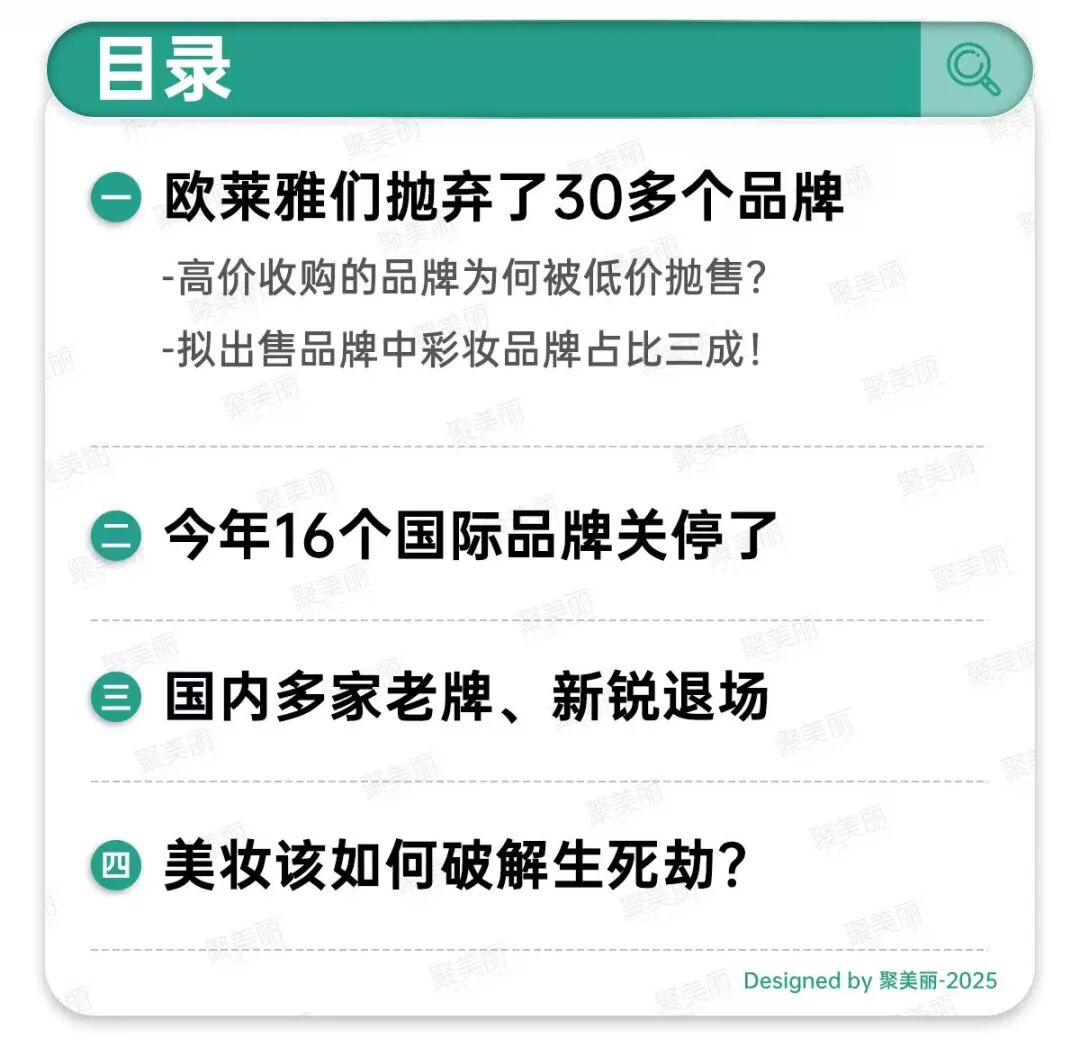
Core Insights - The cosmetics industry is experiencing a significant downturn, with many brands being sold or shut down rather than achieving sales success during promotional events [1][22] - Over 50 beauty brands have been categorized as "abandoned" this year, with notable examples including L'Oréal, Estée Lauder, and Unilever [1][5] - The trend indicates a shift from large-scale brand coverage to a focus on optimizing brand portfolios among international beauty giants [8][13] Brand Sales and Closures - International beauty giants have sold over 30 brands this year, including Unilever's sale of the high-end skincare brand CeraVe and Kering's sale of its beauty division to L'Oréal for €4 billion (approximately ¥331.96 billion) [3][5] - The majority of these "abandoned" brands were acquired at high valuations between 2014 and 2020, with some, like Avon, being sold for $3.7 billion (approximately ¥263.45 billion) after struggling to perform [6][7] - In 2025 alone, 16 international brands have been shut down due to operational difficulties and strategic misalignment, with L'Oréal closing three brands [14][18] Reasons for Brand Abandonment - The primary reasons for brand sales include the need for international beauty companies to streamline operations and focus on profitable segments, as seen with Unilever's efforts to make CeraVe profitable [7][18] - Many brands are facing challenges such as declining performance, increased marketing costs, and the inability to adapt to market demands, leading to closures [21][27] - The trend of brand closures is not limited to international brands; domestic brands are also facing similar pressures, with eight brands shutting down in 2025 due to strategic adjustments and profit pressures [23][26] Market Trends and Future Outlook - The industry is witnessing a shift towards strategic restructuring and value rediscovery rather than mere expansion, indicating a potential ongoing consolidation phase [13][32] - The focus is now on leveraging technology and innovation to create competitive advantages, with companies encouraged to find niche markets and enhance product offerings [31][32] - The ongoing challenges suggest that the beauty industry will continue to experience a wave of brand eliminations, with survival dependent on strategic adaptability and resource management [22][32]