
蜜丝佛陀

Search documents
科蒂领导层巨变
Sou Hu Cai Jing· 2026-01-05 15:56
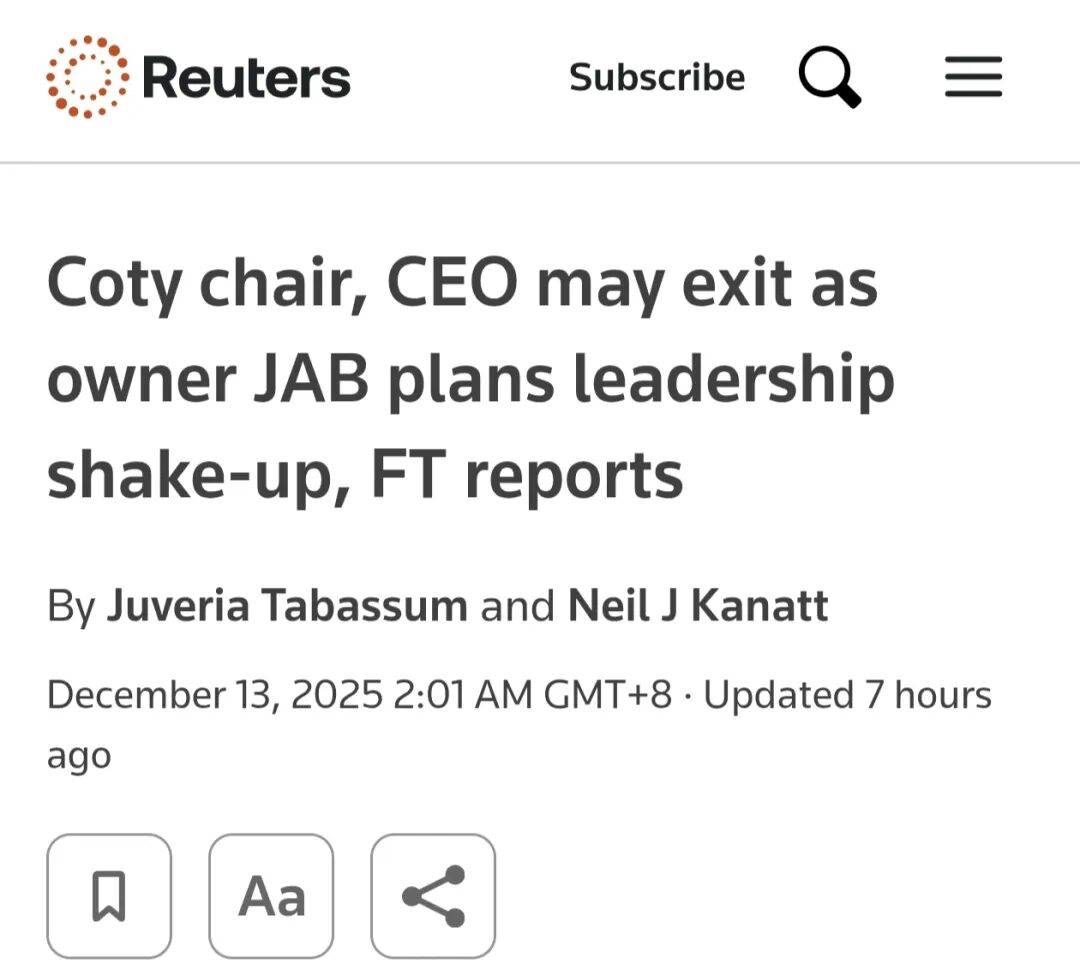
Core Viewpoint - Coty Group is undergoing a significant leadership restructuring as its major shareholder, JAB Holdings, aims to address ongoing performance pressures and seek a turnaround after a prolonged period of underperformance in the capital markets [1][3]. Group 1: Leadership Changes - Current Chairman Peter Harf is expected to resign, followed by CEO Sue Nabi, which has led to a 3% drop in Coty's stock price [1]. - The leadership changes are seen as a decisive move to reverse losses and transform the company amid financial challenges [1][3]. Group 2: Financial Performance - Coty Group's stock price has fallen approximately 55% over the past year, with its market value decreasing from around $10 billion (approximately 70.55 billion RMB) two years ago to $2.9 billion (approximately 20.46 billion RMB) currently [3]. - The company has reported a series of disappointing earnings, attributing the decline to a slowdown in the overall market, which has significantly impacted investor confidence [3]. Group 3: Business Challenges - Coty faces major uncertainties in its core business, particularly regarding its partnership with Kering and its brand Gucci, as Kering has announced a €4 billion (approximately 33.13 billion RMB) deal to sell its beauty division to L'Oréal, which will affect Coty's exclusive rights to Gucci beauty products starting in 2028 [3][5]. - Gucci beauty products account for about 9% of Coty's total revenue, making this transition critical for the company's financial health [3]. Group 4: Strategic Adjustments - In response to declining sales and financial pressure, Coty is considering divesting its mass cosmetics business, which includes brands like Max Factor, Rimmel, and Cover Girl, while attempting to merge its mass and premium fragrance businesses [5]. - New product launches, such as the Origen and Infiniment Coty fragrance lines, have not met sales expectations, indicating challenges in expanding new business lines [5]. Group 5: Historical Context - Coty has struggled to establish a competitive edge against industry giants like L'Oréal and Estée Lauder since its IPO in 2013, facing difficulties in integrating a $12.5 billion (approximately 88.19 billion RMB) acquisition of Procter & Gamble's beauty business [7]. - CEO Sue Nabi, who took over in 2020, was expected to bring stability after a period of frequent leadership changes, but investor patience is waning due to the company's poor performance under her leadership [7].

今年超50个美妆品牌成“弃子”
3 6 Ke· 2025-12-10 00:24
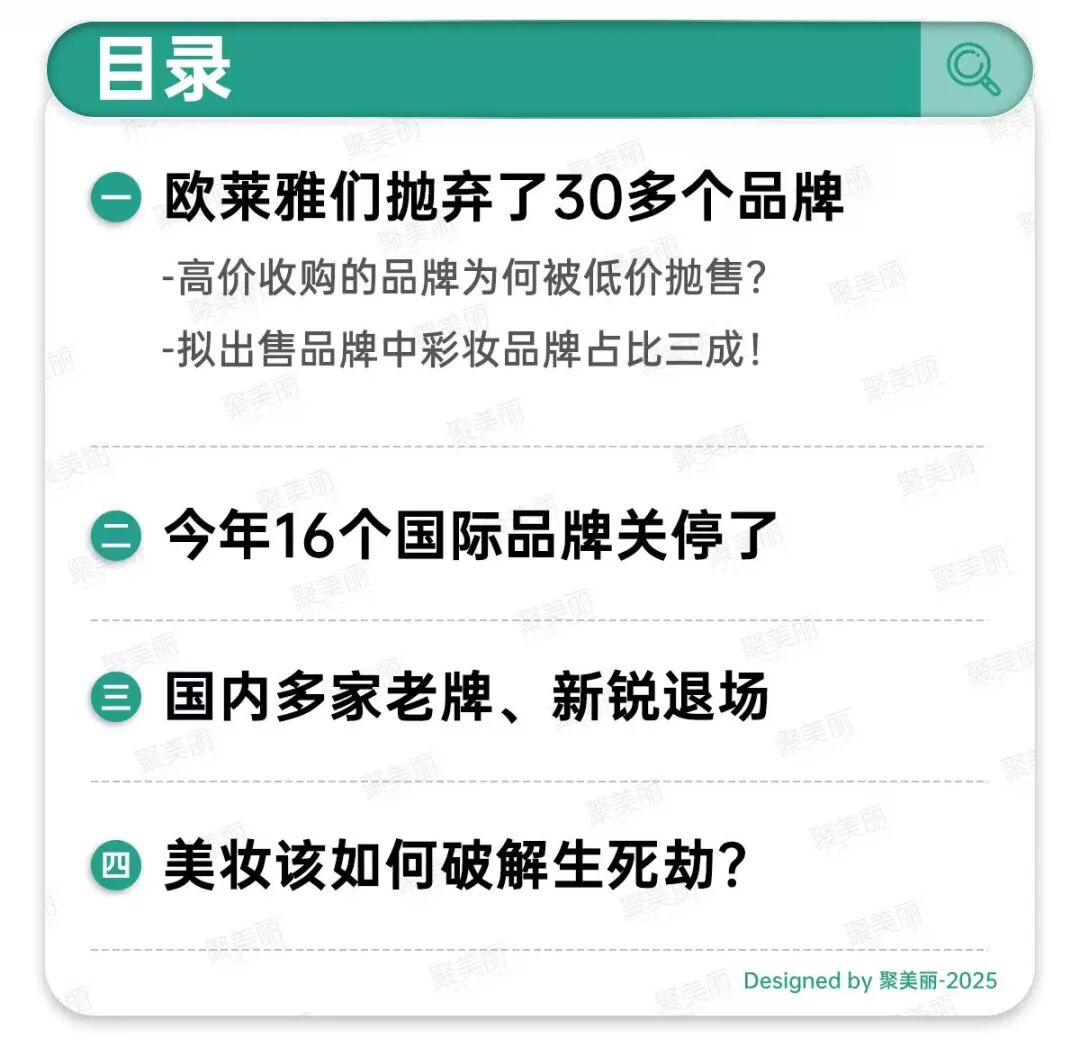
Core Insights - The cosmetics industry is experiencing a significant downturn, with many brands being sold or shut down rather than achieving sales success during promotional events [1][22] - Over 50 beauty brands have been categorized as "abandoned" this year, with notable examples including L'Oréal, Estée Lauder, and Unilever [1][5] - The trend indicates a shift from large-scale brand coverage to a focus on optimizing brand portfolios among international beauty giants [8][13] Brand Sales and Closures - International beauty giants have sold over 30 brands this year, including Unilever's sale of the high-end skincare brand CeraVe and Kering's sale of its beauty division to L'Oréal for €4 billion (approximately ¥331.96 billion) [3][5] - The majority of these "abandoned" brands were acquired at high valuations between 2014 and 2020, with some, like Avon, being sold for $3.7 billion (approximately ¥263.45 billion) after struggling to perform [6][7] - In 2025 alone, 16 international brands have been shut down due to operational difficulties and strategic misalignment, with L'Oréal closing three brands [14][18] Reasons for Brand Abandonment - The primary reasons for brand sales include the need for international beauty companies to streamline operations and focus on profitable segments, as seen with Unilever's efforts to make CeraVe profitable [7][18] - Many brands are facing challenges such as declining performance, increased marketing costs, and the inability to adapt to market demands, leading to closures [21][27] - The trend of brand closures is not limited to international brands; domestic brands are also facing similar pressures, with eight brands shutting down in 2025 due to strategic adjustments and profit pressures [23][26] Market Trends and Future Outlook - The industry is witnessing a shift towards strategic restructuring and value rediscovery rather than mere expansion, indicating a potential ongoing consolidation phase [13][32] - The focus is now on leveraging technology and innovation to create competitive advantages, with companies encouraged to find niche markets and enhance product offerings [31][32] - The ongoing challenges suggest that the beauty industry will continue to experience a wave of brand eliminations, with survival dependent on strategic adaptability and resource management [22][32]



业绩承压下“断臂求生”?科蒂或分拆价值12亿美元大众彩妆业务
Xin Jing Bao· 2025-10-14 11:31
Core Viewpoint - Coty Inc. is undergoing a significant strategic restructuring, focusing on a comprehensive evaluation of its mass beauty business to maximize long-term value and optimize asset allocation [1][2] Group 1: Business Overview - Coty Inc. was founded in 1904 in Paris and operates a range of iconic brands across fragrance, makeup, skincare, and body care, selling in over 120 countries [2] - The mass beauty segment, valued at $1.2 billion, includes brands such as CoverGirl, Rimmel, Sally Hansen, and Max Factor, with a nearly $400 million revenue contribution from Brazil [2][3] Group 2: Financial Performance - For the fiscal year ending June 30, 2025, Coty reported net revenues of $5.893 billion, a year-over-year decline of 3.68%, and a net loss of $381 million, compared to a profit of $76.2 million in the previous year [4] - The mass beauty segment experienced a revenue drop of 8% year-over-year, generating $2.073 billion in the same fiscal year [4][5] Group 3: Market Challenges - The mass beauty business has faced ongoing challenges, including a significant decline in the U.S. market, exacerbated by retailer inventory reductions and overall market pressures [4][5] - Coty has recorded a continuous decline in mass beauty revenues over four consecutive quarters, with Q1, Q2, and Q3 revenues of approximately $555 million, $554 million, and $470 million, respectively, reflecting year-over-year decreases of 3%, 8%, and 9.4% [6] Group 4: Organizational Changes - Coty is implementing organizational changes to integrate its high-end beauty and mass fragrance businesses, which together account for 69% of the company's sales [3][4] - The company has appointed Gordon von Bretten as president of the mass beauty division to explore potential in mass cosmetics, skincare, and personal care, while leading the strategic review [6]