薄钢板

Search documents
在向新向优中牢牢把握发展主动
Xin Lang Cai Jing· 2026-02-26 18:39
Group 1 - The core argument emphasizes the importance of improving total factor productivity (TFP) as a measure of economic quality and potential growth, with China's TFP growth averaging 2.2% from 2013 to 2023, ranking third among 120 economies globally [1][12] - The article highlights the role of technological innovation in supporting TFP growth, indicating that China's economic structure is shifting towards higher quality and innovation-driven development [1][4] - The "14th Five-Year Plan" focuses on innovation-driven strategies and comprehensive reforms to strengthen China's economic resilience and adaptability in a changing global landscape [1][4] Group 2 - The article discusses the integration of advanced production factors to enhance TFP, with specific initiatives such as increasing basic research funding and promoting the "Artificial Intelligence+" action plan [2][13] - It mentions the establishment of various innovation platforms and the optimization of manufacturing pilot platforms to facilitate seamless connections between innovation and industry [3][4] - The report notes that the agricultural sector has maintained a stable grain output of over 1.4 trillion jin for two consecutive years, and the manufacturing sector has held the world's largest added value for 16 years [4][10] Group 3 - The article outlines the importance of market-driven resource allocation reforms, emphasizing the need to break down local protectionism and promote efficient resource distribution [5][9] - It highlights the ongoing reforms in various regions, such as the establishment of unified factor markets in Hebei, which have improved resource allocation efficiency [8][9] - The report indicates that by 2025, the proportion of inter-provincial trade sales is expected to rise to 41%, reflecting enhanced resource optimization and reduced market transaction costs [9][10] Group 4 - The article states that China's foreign investment restrictions in the manufacturing sector are being lifted, and pilot programs for service sector openness are being implemented [10][12] - It emphasizes the dual approach of internal system optimization and external resource introduction to enhance TFP, which is crucial for sustaining economic growth [10][14] - The report mentions that international institutions have raised China's GDP growth forecast for 2026, attributing this to the anticipated continuous improvement in TFP [13][14]
新华全媒头条|在向新向优中牢牢把握发展主动——从全要素生产率稳步提升看中国经济优势潜力
Xin Hua She· 2026-02-26 15:49
Group 1 - The core viewpoint emphasizes the importance of high-quality development in China, focusing on improving labor, capital, land, resource, and environmental efficiency, as well as enhancing technological progress and total factor productivity (TFP) [1] - From 2013 to 2023, China's TFP grew at an average annual rate of 2.2%, ranking third among 120 global economies, supported by technological innovation and structural economic improvements [1] - The "14th Five-Year Plan" aims to strengthen innovation-driven development and deepen reforms to bolster China's economic resilience and adaptability [1] Group 2 - In the steel industry in Shandong, technological advancements have led to a significant increase in productivity, with a production chain valued at 200 billion yuan moving towards higher global value chains [2] - The integration of technology and industry is emphasized, with initiatives to enhance basic research funding and promote AI applications, which are expected to stimulate TFP growth [2][3] - The manufacturing sector's contribution to GDP remains strong, with industrial value added accounting for 35% of economic growth and service sector value added reaching 57.7% [3] Group 3 - High-tech manufacturing's value added now exceeds 17% of total industrial value added, and the digital economy is projected to reach 49 trillion yuan, indicating a shift towards new economic drivers [4] - By 2025, China aims to rank 10th in the global innovation index, maintaining its position as the top among 36 upper-middle-income economies [4] Group 4 - Reforms in resource allocation, such as the "acreage efficiency reform" in Anhui, are shifting focus from quantity to quality, enhancing land resource utilization [5] - The market-driven pricing mechanism for factors of production is being strengthened in Shanxi, promoting efficient resource allocation and reducing transaction costs [6][7] Group 5 - In Hebei, the establishment of a unified factor market is improving resource allocation efficiency, facilitating the movement of talent and labor across regions [8] - By 2025, inter-provincial trade is expected to account for 41% of total sales, with cross-regional electricity transactions reaching 24% of the national market, reflecting enhanced resource optimization [9] Group 6 - The opening of data spaces in cities like Guangzhou aims to lower barriers to data access, promoting equal sharing of data resources [10] - Continuous policy support is fostering smooth flow and efficient allocation of factors, with initiatives targeting the integration of digital technology and the real economy [12] Group 7 - Various regions are innovating in factor allocation methods, with pilot programs focusing on market-driven pricing and efficient resource flow [13] - International institutions are optimistic about China's GDP growth, attributing it to the expected continuous improvement in TFP [13]
新华全媒头条 | 在向新向优中牢牢把握发展主动——从全要素生产率稳步提升看中国经济优势潜力
Xin Hua She· 2026-02-26 13:27
Group 1 - The core viewpoint emphasizes the importance of high-quality development in China, focusing on improving labor, capital, land, resource, and environmental efficiency, as well as enhancing technological progress and total factor productivity (TFP) [1] - From 2013 to 2023, China's TFP has grown at an average annual rate of 2.2%, ranking third among 120 global economies, supported by technological innovation and structural economic improvements [1] - The "14th Five-Year Plan" aims to strengthen innovation-driven development and deepen reforms to bolster China's economic resilience and adaptability [1] Group 2 - The steel industry in Rizhao, Shandong, exemplifies high-quality development, with a production line that transforms steel into ultra-thin sheets, showcasing the role of technology in enhancing productivity [2] - The Chinese government is focusing on integrating education, technology, and talent development to foster innovation and improve TFP through various initiatives, including increased funding for basic research and technology upgrades [2][3] - The manufacturing sector has seen a stable increase in value-added, with the industrial value-added contribution to economic growth rising to 35%, and the service sector's contribution to GDP increasing to 57.7% [3] Group 3 - High-tech manufacturing's value-added now accounts for over 17% of total industrial value-added, with the digital economy projected to reach 49 trillion yuan, indicating a shift towards new economic drivers [4] - By 2025, China aims to rank 10th globally in the innovation index, leading among 36 upper-middle-income economies, reflecting a significant technological advancement [4] Group 4 - Reforms in resource allocation, such as the "acreage efficiency reform" in Anhui, are shifting focus from quantity to quality, enhancing land resource utilization [5] - The market-driven pricing mechanism for factors of production in Shanxi is being strengthened, leading to increased market vitality and efficiency in resource allocation [6][7] Group 5 - In Hebei, the establishment of a unified factor market is improving resource allocation efficiency, facilitating smoother labor and talent mobility across provinces [8] - By 2025, inter-provincial trade sales are expected to account for 41% of total sales, with cross-regional electricity transactions reaching 24% of the national market, indicating enhanced resource flow [9] Group 6 - The opening of the Guangzhou urban trusted data space aims to lower data access barriers, promoting equal sharing of data resources among various entities [10] - The "14th Five-Year Plan" highlights the steady improvement of TFP as a core support for activating China's economic growth potential, with a target of maintaining an annual growth rate of around 2% until 2035 [10][11] Group 7 - China's favorable conditions for improving TFP include a large and diverse talent pool, leading technological innovation clusters, and a robust renewable energy system [11] - Recent policy initiatives are aimed at promoting the smooth flow and efficient allocation of factors, including actions to integrate digital technology with the real economy and enhance talent mobility [12][13]
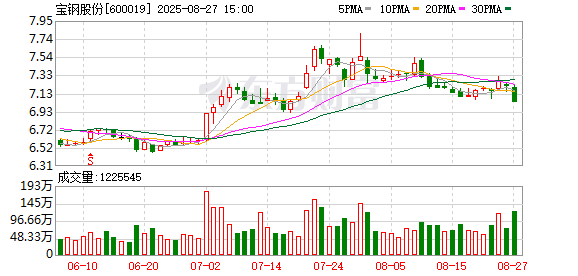
宝钢股份上半年净利增长超7% 现金流状况大幅改善
Zheng Quan Shi Bao· 2025-08-27 17:40
Core Insights - Baosteel Co., Ltd. reported a revenue of 151.37 billion yuan for the first half of the year, a year-on-year decrease of 7.28%, while net profit increased by 7.36% to 4.88 billion yuan, indicating strong profitability in the industry [2] - The increase in net profit is attributed to enhanced market coordination and cost control, leading to an expansion in the purchase-sale price difference [2] - The average price of iron ore and coking coal saw significant declines, with iron ore prices down 14.4% year-on-year and coking coal prices down 41.4% [2] Financial Performance - The company achieved an iron output of 23.71 million tons and a steel output of 25.73 million tons, with a sales volume of 25.31 million tons of finished products [3] - Cash flow from operating activities improved significantly, reaching 16.65 billion yuan, a 190.14% increase compared to the same period last year [3] - Sales expenses rose by 8.0% to 858 million yuan, while financial expenses decreased by 21.7% to 528 million yuan due to reduced interest expenses [3] Market Dynamics - The domestic market for the company's products spans various sectors including automotive, home appliances, energy, and marine equipment, contributing to the completion of the world's highest dam project [3] - The company faced trade protection challenges in overseas markets but managed to increase export orders by 9.4% to 3.32 million tons, exporting to over 70 countries and regions [3] Investment Activities - Baosteel completed equity investments totaling 5.59 billion yuan, acquiring a 49% stake in Maanshan Iron & Steel Co., Ltd. and establishing a joint venture with Saudi Aramco [4] - Fixed asset investments amounted to 9.27 billion yuan, focusing on projects such as a zero-carbon high-grade thin steel plate factory and optimizing product structures [4]