西北菜

Search documents
西贝上市还有戏吗?融资成功,新荣记创始人张勇出手帮了贾国龙
Sou Hu Cai Jing· 2026-01-21 17:07
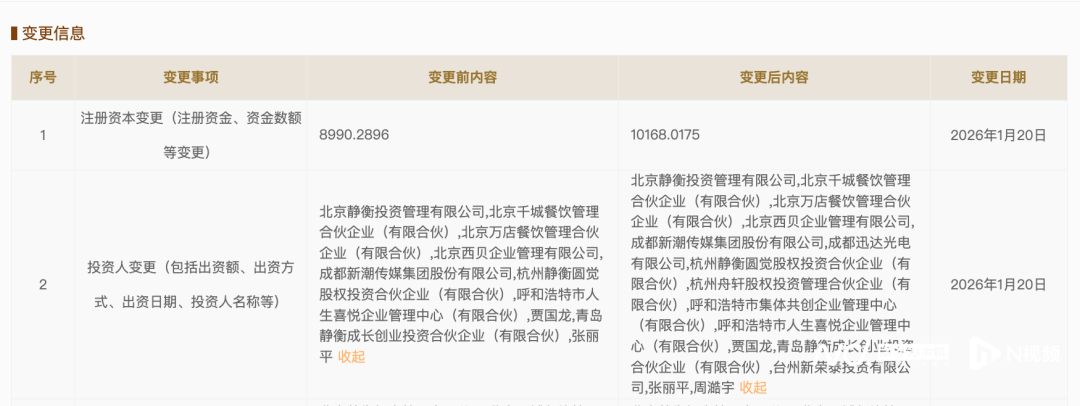
Group 1 - The core point of the news is that the Inner Mongolia Xibei Catering Group Co., Ltd. has added five new shareholders and increased its registered capital from 89.90 million yuan to 102 million yuan, indicating a potential shift in its financial structure and investor confidence [1][2][3]. - The new shareholders include notable figures such as Zhang Yong, founder of the high-end restaurant brand Xinrongji, and Hu Xiaoming, former CEO of Ant Group, which may enhance Xibei's market position and operational capabilities [5][24]. - The company is facing significant challenges, including the planned closure of 102 stores due to a 50% year-on-year decline in revenue, which reflects broader issues in the restaurant industry amid a cooling market environment [7][20]. Group 2 - The recent financing round is seen as a temporary relief for Xibei, allowing it to stabilize its cash flow and support operational adjustments amidst ongoing challenges [24][25]. - The controversy surrounding the use of pre-prepared dishes has exacerbated Xibei's operational pressures, highlighting the need for the company to address consumer trust issues while navigating a difficult industry landscape [26]. - Xibei's founder, Jia Guolong, has previously indicated plans for an IPO in 2026-2027, aiming for a revenue target of 20 billion yuan, which now appears increasingly challenging given the current market conditions and operational setbacks [21][20].

Boys help boys,张勇终于出手帮了贾国龙
Xin Lang Cai Jing· 2026-01-21 10:21
Core Insights - Xibei Restaurant Group has received A-round financing from multiple investors, including Taizhou Xinrongtai Investment Co., Ltd. and Hohhot Collective Co-Creation Enterprise Management Center [2] - The company's registered capital has increased to 101.68 million yuan, while founder Jia Guolong's shareholding has decreased to 26.16% [2] Financing and Investment - The A-round financing is seen as a positive development for Xibei amid ongoing public relations challenges [2][5] - Taizhou Xinrongtai's legal representative, Zhang Yong, is a well-known figure in the high-end dining sector, which may lend credibility to Xibei's future prospects [5][6] Business Challenges - Xibei plans to close 102 stores in the first quarter of the year, indicating significant operational challenges [5] - The company aims to go public by 2026, with a target revenue of 20 billion yuan, requiring a compound annual growth rate of at least 33% from its current revenue of 6.2 billion yuan [9][10] Market Conditions - Xibei's customer traffic has dropped to 40% of normal levels since a public relations crisis began in September 2022, complicating its path to an IPO [9][10] - The ongoing crisis has likely led to a downward adjustment in Xibei's valuation, making the recent investment more attractive [7]

西贝关店102家:没有舆论风波,这些门店就能保住吗?
虎嗅APP· 2026-01-15 14:18
Core Viewpoint - The closure of 102 stores by Xibei represents the largest adjustment in its 38-year history, driven by operational challenges rather than just public relations issues [4][6]. Group 1: Operational Challenges - Xibei's single-store net profit margin is only 5%, with some stores facing fixed costs nearing 500,000 yuan per month, necessitating monthly revenues of 800,000 yuan to break even [6]. - The closures were primarily of low-revenue stores, selected based on hard metrics like rent costs and customer traffic, indicating pre-existing operational difficulties [6][12]. - The high-cost operational model, including premium ingredients and employee benefits, has become unsustainable in a competitive environment with declining consumer spending [6][12]. Group 2: Market Position and Consumer Perception - Xibei's average customer spending of approximately 92 yuan is not competitive in a market increasingly focused on value, particularly among its core demographic of price-sensitive family and elderly consumers [7][12]. - The backlash against Xibei during the pre-prepared food controversy highlighted a disconnect between the company's definition of "pre-prepared food" and consumer perceptions, exacerbating existing operational vulnerabilities [7][12]. Group 3: Strategic Adjustments - In response to declining customer traffic, Xibei attempted to revert some food preparation processes back to stores and reduced prices on over 30 menu items, but these measures did not fully restore customer flow [9][12]. - The decision to maintain operations for pre-booked events, despite financial losses, reflects a commitment to customer service but also raises questions about the sustainability of such decisions under financial strain [9][10]. Group 4: Future Outlook - Xibei's future stability hinges on addressing the long-standing imbalance between expansion and operational efficiency, as well as improving communication with consumers regarding its value proposition [12][13]. - The recent store closures serve as a cautionary tale for the restaurant industry, emphasizing that growth must be built on a solid operational foundation rather than mere expansion [12][13].