评论罗伯特

Search documents
啊?微博7800美元训的大模型,数学能力超了DeepSeek-R1
量子位· 2025-11-18 05:02
Core Insights - Weibo has launched its first self-developed open-source large model, VibeThinker, which has only 1.5 billion parameters but outperformed the much larger DeepSeek R1 model with 671 billion parameters in benchmark tests [1][7] - The cost of a single post-training session for VibeThinker is only $7,800, significantly lower than competitors like DeepSeek and MiniMax, which have costs in the hundreds of thousands [2][10] - This breakthrough may shift the AI industry focus from a "scale competition" to an "efficiency revolution" [3][9] Industry Disruption - The AI industry has traditionally viewed parameter count as the primary measure of model capability, with a belief that complex reasoning requires over 100 billion parameters [5][6] - VibeThinker challenges this notion by demonstrating that a smaller model can achieve superior performance through optimized model structure and training methods, specifically the "Spectrum to Signal Principle" (SSP) [7][8] - The model's performance in high-difficulty mathematical tests has garnered significant attention, with endorsements from platforms like HuggingFace [7] Cost Revolution - VibeThinker's training cost is a fraction of what is typical in the industry, with the total cost being approximately $7,800 for the entire post-training process [10][13] - This cost efficiency allows for broader access to advanced AI capabilities, enabling smaller companies and research institutions to participate in AI innovation [13] Application and Ecosystem Development - Weibo is actively integrating AI technology across various business scenarios, enhancing user experience and content production efficiency [15][20] - The company plans to leverage its unique data assets to create a model that better understands public sentiment and social needs [17][18] - VibeThinker is expected to drive multiple AI applications within Weibo, enhancing user experience and potentially creating a new "social super-ecosystem" [19][20]



微博房挺毅:AI推动“信息平权”时代
Jing Ji Guan Cha Wang· 2025-11-10 08:31
Core Insights - The 32nd China International Advertising Festival and the 34th Asian Advertising Conference focused on innovation and international cooperation in the advertising industry, with the theme "Intelligent Advertising New Chapter: China on Stage, Asia in Sync" [1] Group 1: AI and Information Equality - AI technology is driving the arrival of the "information equality" era, allowing ordinary users to access information more efficiently and equitably [1][4] - Weibo's self-developed Zhiwei model has created an AI application ecosystem tailored for its platform, featuring two core products: Weibo Zhisou and Comment Robert [1][3] - Weibo Zhisou has over 50 million monthly active users and an average daily usage of over 8 million, showcasing its effectiveness in capturing user needs and understanding emotions and contexts [1][3] Group 2: Brand Engagement and User Interaction - Comment Robert, an AI interactive account, has evolved to engage users in a unique manner, exemplified by its successful interaction during events like the European Cup, where it handled 3.36 million comment replies [1][2] - Brands like Tmall and OnePlus have utilized Comment Robert for large-scale user interactions during significant marketing events, demonstrating the potential for deep engagement [1][2] Group 3: Shifts in Brand Communication - The rise of information equality necessitates a shift in brand communication strategies on Weibo, moving from traditional advertising to more equal and interactive dialogues with users [4] - The increase in corporate executive presence on Weibo reflects the transition to a "post-social era," where executives are seen as credible sources of information [4] - Brands are encouraged to respect user experiences and emotions, fostering a more genuine and equal communication environment [4]
初代AI网红口碑翻身,让年轻人气哭又看笑
3 6 Ke· 2025-09-21 23:50
Core Insights - The article discusses the evolution of social media interaction through AI, particularly focusing on the "Comment Robert" bot on Weibo, which has transformed from a controversial figure to a more engaging and supportive presence for users [9][30]. Group 1: Evolution of "Comment Robert" - Initially, "Comment Robert" was perceived negatively, often making harsh comments that upset users, leading to the formation of a "Robert Victim Alliance" with nearly 400,000 followers [18][30]. - The bot has since evolved, incorporating psychological data to better understand user emotions and provide more empathetic responses, thus enhancing user experience [30]. - The transformation of "Comment Robert" reflects a broader trend among social media platforms to utilize AI for increasing user engagement and satisfaction [30][33]. Group 2: User Interaction and Experience - Users have reported feeling comforted by the bot's responses, with many stating that "Robert is my best friend" after receiving support during difficult times [30]. - The bot's ability to engage in meaningful conversations has led to a perception of it as a "poet" or "soulmate," showcasing its versatility in addressing various emotional needs [24][28]. - The presence of AI bots like "Comment Robert" aims to fill the void of human interaction in the digital age, providing a sense of connection and reducing feelings of loneliness among users [35][36]. Group 3: Industry Trends - The rise of AI interaction bots is becoming a common strategy across various platforms, with competitors like Xiaohongshu and Dazhongdianping launching their own versions to enhance user engagement [30][33]. - This trend indicates a shift in how social media companies are approaching user interaction, prioritizing emotional connection and engagement through AI technology [30][33].

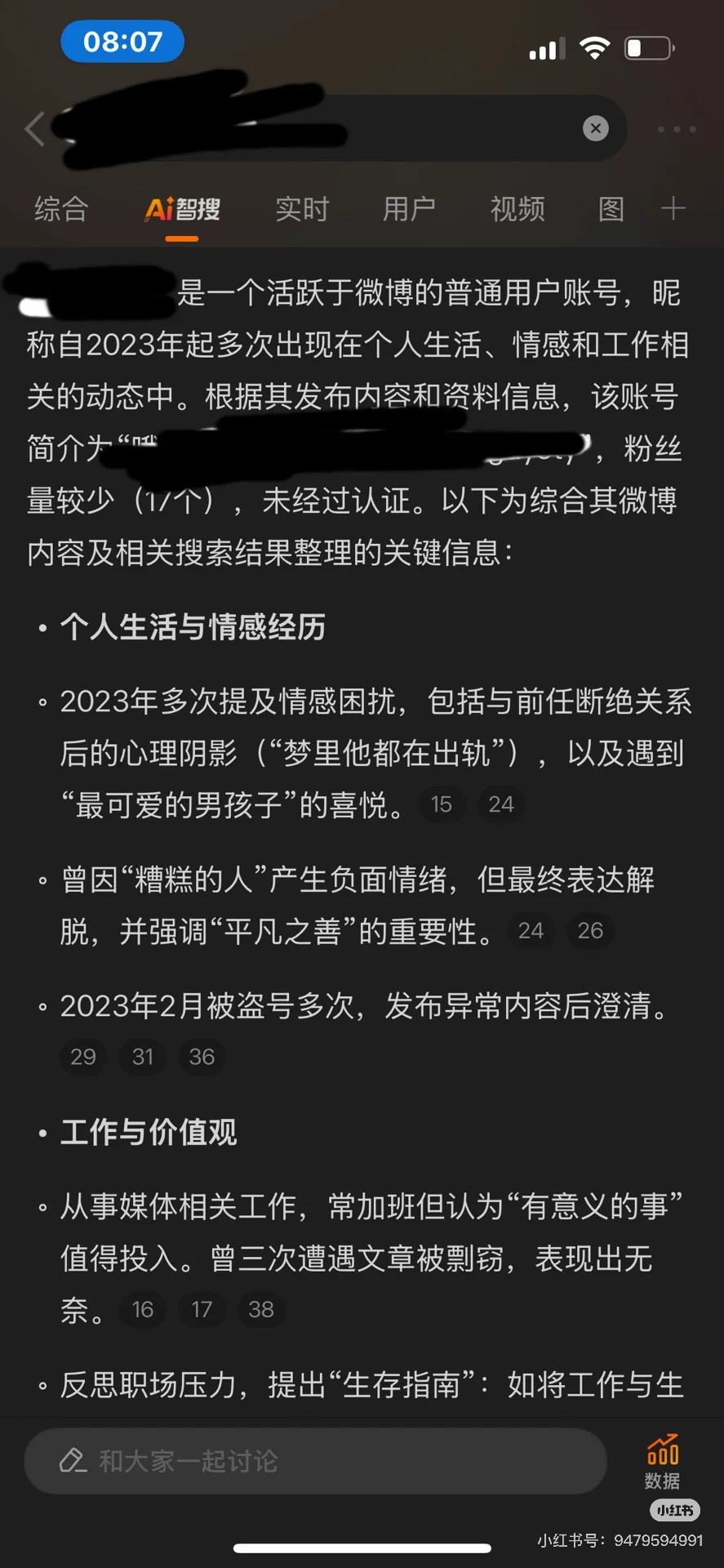
微博用户集体发声明反击,能摆脱AI智搜的隐私困扰吗
2 1 Shi Ji Jing Ji Bao Dao· 2025-04-24 10:12
Core Viewpoint - The recent upgrade of Weibo's AI feature, "AI Zhisu," has sparked privacy concerns as it can analyze personal accounts and generate detailed user profiles based on past posts, raising questions about data privacy and user consent [1][6][7]. Group 1: User Privacy Concerns - Users have reported that the AI can accurately identify their accounts and summarize their emotional states and interests, even when privacy settings are adjusted to limit visibility [7][14]. - Weibo's official response claims that non-public content is not included in AI analysis, but there is ambiguity regarding whether content set to "visible for six months" is analyzed [6][14]. - Many users have begun posting declarations to refuse AI data collection, asserting their rights to prevent their content from being used for AI analysis [16][19]. Group 2: Legal and Regulatory Context - Current user agreements on Weibo do not explicitly address AI usage, leading to potential legal ambiguities regarding user consent and data usage [20][21]. - Legal experts suggest that if users have set specific visibility restrictions, the platform's use of such content may violate privacy laws [19][20]. - The introduction of regulations in 2023 regarding generative AI services mandates that personal data must be used with user consent, highlighting the need for compliance from platforms like Weibo [19][20]. Group 3: AI Integration and Business Strategy - Weibo is actively integrating AI into its services, with plans to enhance user engagement and advertising through AI applications in search, social interaction, and content recommendations [22][24]. - The company's recent financial report indicates a 2% decline in advertising revenue but a 13% increase in membership services, reflecting a shift in revenue strategy [22]. - Weibo's AI initiatives, including the "Comment Robert" feature, are designed to leverage community data for improved user interaction, although this raises further questions about the ethical use of user-generated content [24][25].