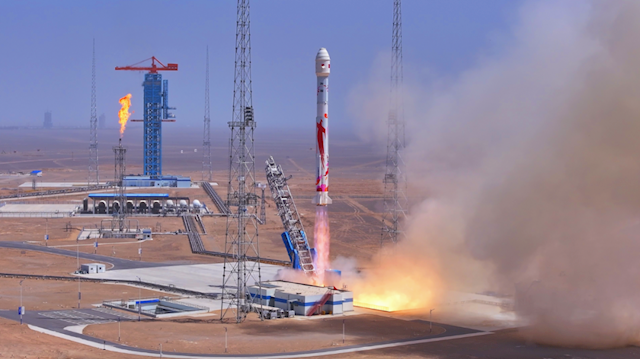
谷神星一号系列火箭

Search documents
商业航天2026年“首飞” 谷神星一号成功发射
Zheng Quan Shi Bao Wang· 2026-01-16 06:44
Core Viewpoint - The successful launch of the Ceres-1 sea-launched rocket marks a significant milestone for China's commercial space sector, enhancing the capabilities of the Tianqi satellite constellation and expanding its applications across various industries [1][4]. Group 1: Company Overview - Ceres-1 is a core solid launch vehicle developed by Beijing Xinghe Power Aerospace Technology Co., Ltd., representing the company's commercialized model [2]. - Founded in February 2018, Xinghe Power is the first private commercial rocket enterprise in China to achieve mass production and high-frequency launches [2]. - The Ceres-1 rocket has a length of approximately 20 meters and a takeoff weight of 33 tons, with payload capacities of 300 kg to a 500 km sun-synchronous orbit and 270 kg to a 700 km orbit [2]. Group 2: Launch and Performance - The recent launch successfully deployed four satellites into a near-Earth orbit, contributing to the global networking of the Tianqi satellite constellation [1][4]. - Since its first flight in September 2023, the Ceres-1 sea-launched rocket has achieved a 100% success rate across six launches [2]. - The sea-launch model offers flexibility in selecting optimal launch points, improving orbital accuracy and reducing safety risks [4]. Group 3: Market and Financial Insights - The commercial space sector has attracted significant capital, with Xinghe Power raising 2 billion yuan in A-round financing in 2020 and 2.4 billion yuan in D-round financing in September 2025, achieving a post-investment valuation of 15-16 billion yuan [3]. - The company is expected to complete its IPO counseling process within 3 to 12 months, with optimistic projections for filing its prospectus in the second quarter of 2026 [3]. - The demand for low-orbit satellite networking is increasing, providing a broad market space for commercial rocket enterprises with high reliability and low costs [4].

朱雀腾空“箭”指苍穹 恒友汇解码中国商业航天崛起大势
Cai Fu Zai Xian· 2025-05-19 08:25
Core Insights - The successful launch of the Zhuque-2 rocket marks a significant milestone for Blue Arrow Aerospace and highlights the rapid development and maturation of China's commercial space industry [1][4] - The growth of China's commercial space sector is driven by a combination of government policy support, market demand, and technological innovation, indicating a strong upward trajectory [2][8] Industry Development - China's commercial space industry is seen as a key driver for high-quality economic development and technological advancement, with policies encouraging private investment in space infrastructure since 2014 [2][8] - The market demand for satellite internet, earth observation, and other emerging applications is surging, leading to explosive growth in the need for cost-effective and reliable commercial launch services [2][3] Market Potential - The global space economy is projected to exceed $1 trillion by 2030, with significant demand for low Earth orbit communication satellites driving the need for launch vehicles [3] - China's commercial space industry is expected to grow from a value of 1 trillion yuan in 2020 to approximately 2.3 trillion yuan by 2024, with a compound annual growth rate of 22.9% [3] Company Achievements - Blue Arrow Aerospace has established itself as a leader in commercial launch services, successfully completing multiple launches and enhancing its rocket technology, including the Zhuque-2's improved thrust and payload compatibility [5][9] - The number of commercial space companies in China has surpassed 500, covering the entire industry chain from rocket launch to satellite manufacturing [6] Investment Landscape - Investment in China's commercial space sector reached 18.1 billion yuan in 2024, with significant funding directed towards satellite internet and rocket launch services [7] - The emergence of unicorn companies in the sector reflects the growing confidence of investors in the long-term value of commercial space ventures [7][9] Future Outlook - The successful operation of the Zhuque-2 rocket and plans for the Zhuque-3, which aims to achieve reusable rocket technology, position Blue Arrow Aerospace as a potential leader in the global space market [9] - The commercial space industry in China is entering a phase of positive feedback loops driven by policy support, technological breakthroughs, and financial collaboration, suggesting a bright future for the sector [9]