
资产负债管理系统

Search documents
银行数字化抢蛋糕比赛,胜负已分?
Tai Mei Ti A P P· 2025-12-09 12:21
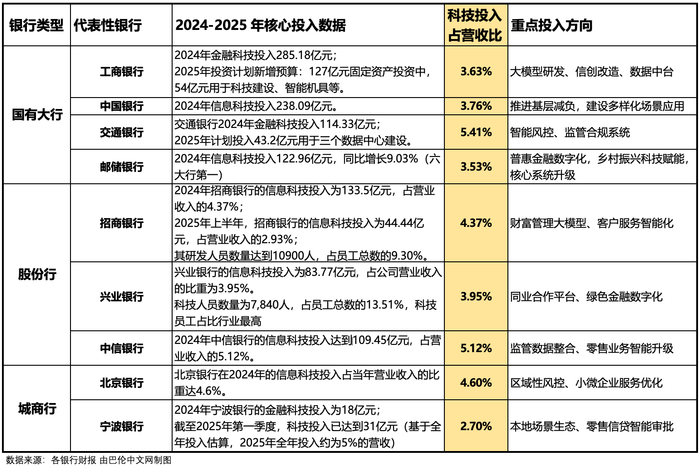
Core Insights - The digital transformation of China's banking industry is entering a "deep water zone" by 2025, characterized by market expansion, technological upgrades, and intensified competition [1] - The IT investment in the banking sector is projected to reach 169.315 billion yuan in 2024, with a growth rate of 3.6%, and is expected to exceed 266.2 billion yuan by 2028 [1] - The digital bidding landscape shows that successful digitalization in banking relies not only on investment scale but also on precise alignment with the bank's positioning and strategic partnerships [1] Investment Trends - In 2024, the six major state-owned commercial banks are expected to invest a total of 125.459 billion yuan in fintech, accounting for 52% of the total banking sector investment [2] - By 2025, the banking sector's fintech investment is anticipated to reach 333.85 billion yuan, representing a 38% increase from 2024 [2] Bank Types and Investment Focus - State-owned banks are leading in digital investment, with major banks like ICBC planning to invest 285.18 billion yuan in fintech in 2024, while smaller banks are focusing on localized services and specific pain points [3][5] - The investment focus for state-owned banks includes large model development, data platforms, and intelligent risk control systems [3] - Regional banks are prioritizing local economic services and optimizing processes for small and medium enterprises, with some banks investing over 6% of their revenue in technology [5] Digital Bidding Characteristics - The digital bidding projects are categorized into four main tracks: risk management, compliance control, data services, and technology platforms, each with varying technical requirements and budget allocations [7][8] - Risk management projects are rated the highest in complexity, requiring a deep understanding of financial logic and AI technology [7] - Compliance control projects are driven by regulatory requirements and have a high degree of standardization, making them easier to replicate [7] Competitive Landscape - A dual-competitive landscape is emerging between bank technology subsidiaries, which excel in understanding financial regulations, and internet technology companies, which leverage general technology capabilities [10][11] - The collaboration between bank technology subsidiaries and internet technology companies is becoming a mainstream approach, combining business understanding with technological innovation [17] Future Outlook - The investment landscape is expected to become more differentiated, with large banks focusing on systematic construction while smaller banks target essential local needs [18] - The emphasis will shift towards practical technologies that address compliance issues and enhance operational efficiency, with a growing trend of collaboration between different types of technology providers [18]




百万级项目频现!银行业密集启动科技招标,数字化转型驶入深水区
Xin Lang Cai Jing· 2025-11-17 12:24
Core Insights - Recent trends show multiple banks accelerating their technology procurement efforts, with significant budgets allocated for projects in areas such as large model development, computing infrastructure, and intelligent risk control [1][3][6] - The banking industry's IT investment is projected to reach 169.315 billion yuan in 2024, marking a 3.6% increase from 2023, and is expected to exceed 266.227 billion yuan by 2028 [7] Group 1: Technology Procurement Trends - Major banks are shifting from fragmented IT equipment purchases to systematic and ecological strategic layouts, with policy banks leading through large-scale tenders and framework agreements [3][4] - State-owned banks and national joint-stock banks dominate the technology procurement market, focusing on high-budget, long-cycle projects [3][4] - Smaller banks are adopting a more targeted approach, focusing on regional needs and core requirements with flexible budget scales [4] Group 2: Drivers of Technology Investment - The narrowing net interest margin and pressure on traditional lending businesses are pushing banks to leverage technology for competitive differentiation and cost control [6] - Regulatory policies are also driving technology projects, with over 30 "one-table" related projects initiated or completed across the industry since October [6][9] - External competition from fintech companies and internet platforms is compelling banks to accelerate their transformation efforts [6][9] Group 3: Challenges and Risks - The rapid pace of technology procurement presents challenges such as unclear risk responsibilities in outsourcing partnerships and compliance with regulatory requirements [9][10] - A notable case involving Guizhou Bank highlights issues with contract clarity and risk assessment in technology procurement [9] - The fast iteration of technology poses adaptation risks, as banks may face additional costs for upgrades if algorithms become outdated [10] Group 4: Future Considerations - The banking industry needs to establish a more systematic technology governance framework, including lifecycle management of suppliers and risk assessment mechanisms [10] - Balancing technological innovation with risk management will be crucial for banks to transform technology investments into core competitive advantages [10]




数字金融竞速 多家银行密集招标
Bei Jing Shang Bao· 2025-11-16 15:53
Core Viewpoint - The digital transformation in the banking sector has shifted from an optional choice to a necessary requirement for survival, prompting a competitive race focused on technology, human resources, and ecosystem development [1][6]. Group 1: Technology Procurement Trends - Multiple banks, including Shanghai Pudong Development Bank, China Construction Bank, China CITIC Bank, Industrial Bank, and Guilin Bank, have recently announced technology procurement tenders, indicating a significant increase in technology investment and service optimization [3][4]. - Shanghai Pudong Development Bank plans to select 12-18 suppliers for IT outsourcing services from 2025 to 2028, with a service period of three years, to alleviate the shortage of developers and enhance IT construction efficiency [3]. - China Construction Bank's Hubei branch has set an annual tender control price of 22.5 million yuan for software development and technical services, aiming to select three suppliers for a three-year collaboration [3]. Group 2: Strategic Implications of Digital Transformation - The concentrated technology procurement by banks signals that the digital transformation is entering a "deep water zone," moving beyond basic system maintenance to strategic planning for future competition [4][5]. - The high entry barriers set by banks for suppliers reflect a shift in demand from basic supply to high-quality matching, indicating a need for long-term collaborative partners with deep financial business understanding and complex project experience [5][6]. - The current wave of technology investment is driven by multiple competitive pressures, including narrowing net interest margins and challenges from fintech companies and internet platforms, necessitating banks to leverage technology for differentiation and cost control [6]. Group 3: Future Focus Areas for Technology Investment - Future technology investments in the banking sector are expected to focus on three core areas: data security and application, compliance and risk control system upgrades, and comprehensive solutions for intelligent financial transformation [6].

数字金融竞速!多家银行密集招标,技术、人力采购“潮涌”
Bei Jing Shang Bao· 2025-11-16 11:16
Core Insights - The digital transformation in the banking sector has shifted from an option to a necessity for survival, prompting a competitive race focused on technology, human resources, and ecosystem development [1][4] - Multiple banks, including Shanghai Pudong Development Bank, China Construction Bank, and others, have recently announced technology procurement tenders, indicating a significant increase in technology investment and service optimization [2][3] Group 1: Technology Procurement Trends - Several banks are actively seeking external support for technology projects, with significant tenders being issued for IT services and system upgrades [2][3] - Shanghai Pudong Development Bank plans to establish an IT outsourcing resource pool with 12-18 suppliers for a three-year period, addressing the shortage of developers and enhancing IT efficiency [2] - China Construction Bank's Hubei branch has set a tender control price of 22.5 million yuan for software development and technical services, aiming to select three suppliers for a three-year collaboration [2] Group 2: Strategic Implications - The concentrated technology procurement signals that the banking industry is entering a "deep water zone" in digital transformation, moving beyond basic system maintenance to strategic planning for future competition [3][4] - The high entry barriers set by banks for suppliers reflect a shift in demand from basic services to high-quality partnerships that can deeply understand financial operations and manage complex projects [3] Group 3: Industry Challenges and Responses - The push for technology investment is driven by multiple competitive pressures, including narrowing net interest margins and challenges from fintech companies and internet platforms [4] - Banks are compelled to leverage technology to create differentiated advantages, control operational costs, and enhance customer experience, making technology investment a defensive strategy against short-term challenges [4] Group 4: Future Focus Areas - Future technology investments in the banking sector are expected to focus on three core areas: data security and application, compliance and risk control system upgrades, and comprehensive solutions for intelligent financial transformation [5]
