越南木薯粉

Search documents
多式联运 跨越山海 年货班列“速递”全球年味
Zhong Guo Qing Nian Bao· 2026-02-09 22:14
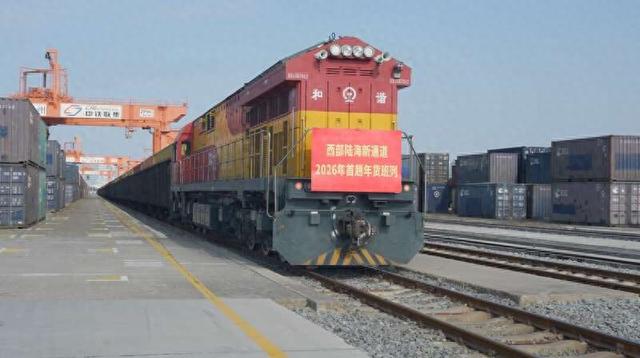
Core Viewpoint - The news highlights the efficiency and growth of the Guangxi Beibu Gulf Port's automated container terminal and the Western Land-Sea New Corridor, which significantly enhances cross-border logistics and trade, particularly for seasonal goods during the Spring Festival [2][4][6]. Group 1: Logistics Efficiency - The Western Land-Sea New Corridor has drastically reduced logistics time, allowing for fresh goods like cassava flour from Vietnam to be transported efficiently, benefiting both local farmers and the processing industry [2][4]. - The customs at Qinzhou Port have implemented tailored clearance measures, enabling rapid inspections and facilitating a smooth flow of goods, with some inspections completed in under three hours [3][4]. - The integration of rail and port operations has improved efficiency, with the elimination of barriers allowing for direct transfer from ship to train, thus enhancing operational speed [4][5]. Group 2: Growth Metrics - Since its inception in 2017, the annual transport volume of the Western Land-Sea New Corridor has surged from 3,382 TEUs to 1.425 million TEUs by 2025, marking an increase of approximately 420 times [4][5]. - The variety of goods transported via this corridor has expanded to over 1,300 types, reaching 18 provinces and 75 cities in China, and connecting to 584 ports in 127 countries and regions globally [5]. - In January alone, the corridor transported 114,000 TEUs, reflecting a year-on-year growth of 9% [5]. Group 3: Infrastructure Development - The completion of the Ma Huang Station upgrade has enhanced the railway capacity, transitioning from a single track to a double track, which improves the overall efficiency of the Western Land-Sea New Corridor [5]. - The establishment of modern logistics bases, such as Nanning International Railway Port and Qinzhou Railway Container Center, has further bolstered freight capacity and operational capabilities [4][5]. Group 4: Economic Impact - The operations at the Qinzhou automated container terminal not only facilitate the import of goods like Thai coconuts and Cambodian rice but also support local employment in Vietnam through the establishment of subsidiaries [2][6]. - The corridor plays a crucial role in the dual-directional trade strategy, enhancing both imports and exports, thereby contributing to the broader "Belt and Road" initiative [6].


【新春走基层】年货班列满载全球年味
Zhong Guo Qing Nian Bao· 2026-02-04 13:20
Core Viewpoint - The article highlights the efficiency and growth of the Western Land-Sea New Corridor, showcasing its role in facilitating cross-border trade and logistics, particularly in the context of the upcoming Spring Festival, with a focus on the import of goods from Southeast Asia to Western China [1][3][10]. Group 1: Logistics and Operations - The Western Land-Sea New Corridor has significantly reduced logistics time, ensuring the freshness of imported goods such as cassava flour from Vietnam, thanks to efficient iron-sea intermodal transport [3][4]. - The customs at Qinzhou Port have implemented tailored clearance processes, allowing for rapid inspections and releases of goods, with some processes completed in under three hours [4][6]. - The automation and modernization of the Qinzhou Port have led to a streamlined operation where containers can be transferred directly from ships to trains without delays, enhancing overall efficiency [6][7]. Group 2: Growth Metrics - Since its inception in 2017, the annual transport volume of the Western Land-Sea New Corridor has surged from 3,382 TEUs to 1.425 million TEUs by 2025, marking a 420-fold increase [7]. - The corridor now supports over 1,300 types of goods, reaching 18 provinces and municipalities, 75 cities, and 165 stations, with connections to 584 ports in 127 countries and regions [7][10]. - In January 2026, the corridor recorded a 9.8% year-on-year increase in cargo transport, totaling 114,600 TEUs [10]. Group 3: Economic Impact - The operations of the Western Land-Sea New Corridor have not only improved logistics but also created job opportunities in Vietnam, benefiting local farmers and enhancing the regional cassava processing industry [3][10]. - The corridor facilitates the import of diverse goods, including Thai coconuts, Cambodian rice, and Indonesian shrimp, contributing to the availability of international products in Chinese markets [10].